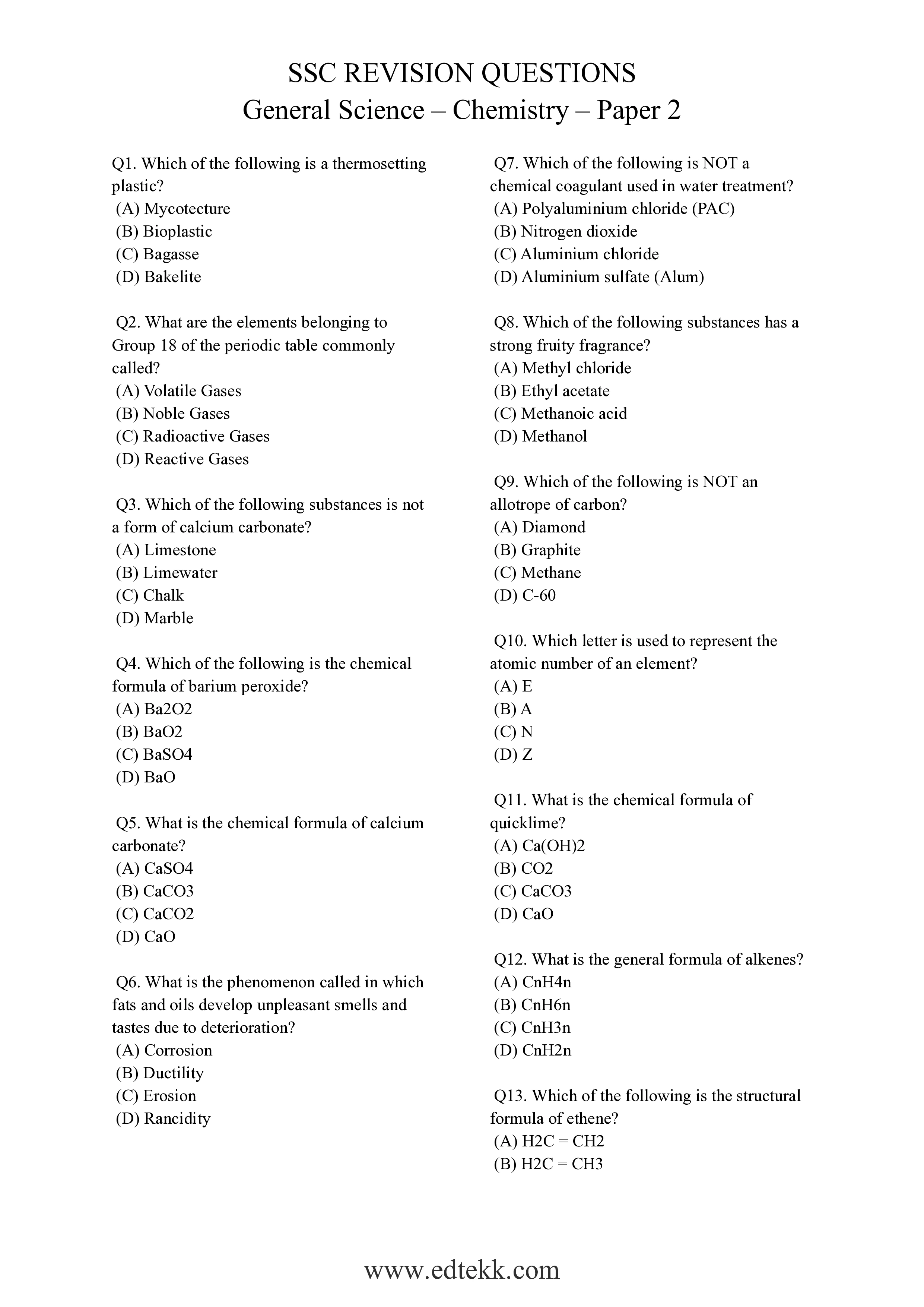
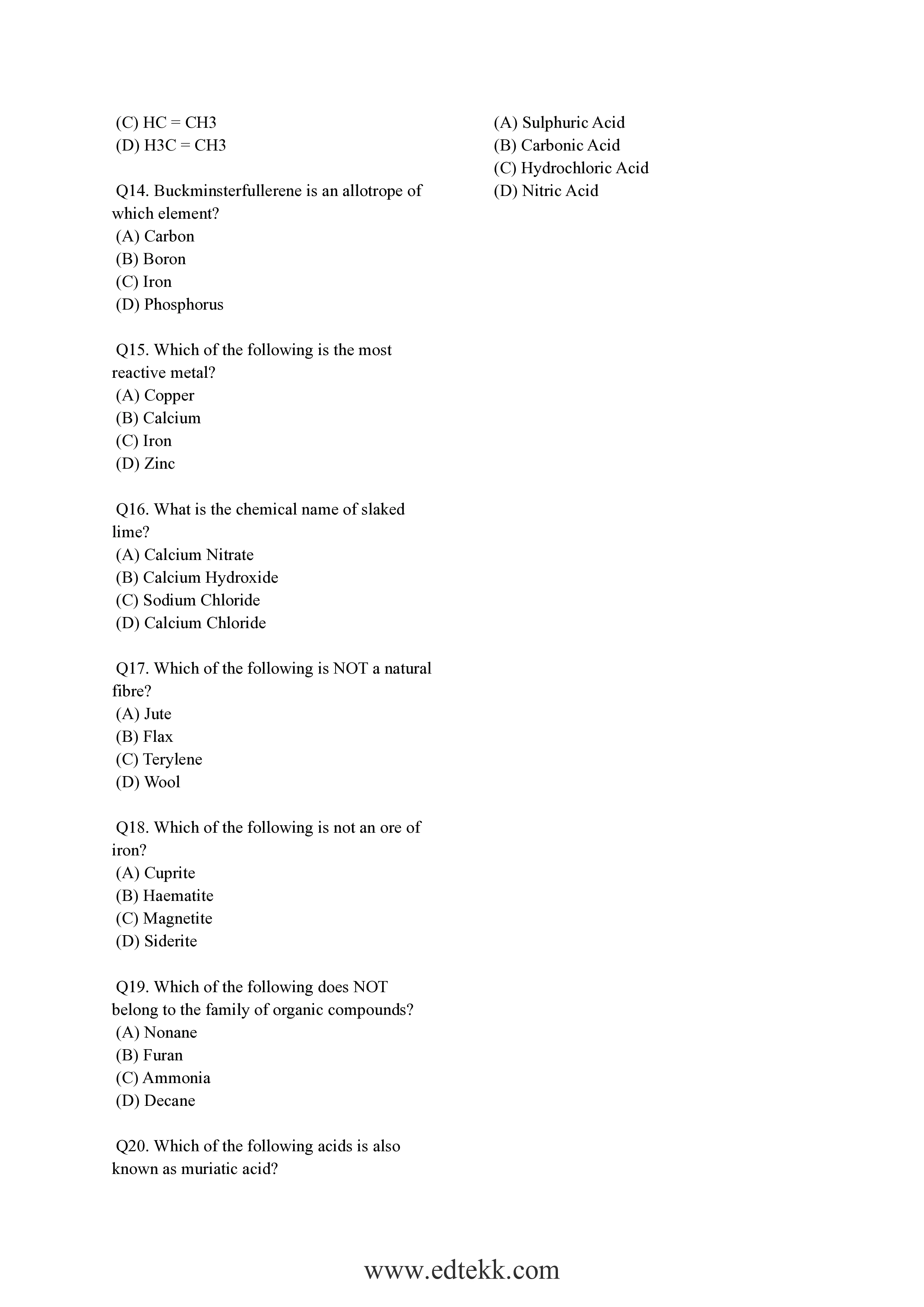
Enhance your Chemistry preparation with the second SSC General Science revision paper. This practice set contains objective-type questions relevant to SSC CGL, CHSL, CPO, MTS, GD and Selection Post examinations. Revise important Chemistry concepts, attempt exam-oriented MCQs and improve your understanding with correct answers and explanations.
Test Details
Topic: Chemistry
Total Questions: 20
Question Format: MCQs – Single Correct Answer
Suitable for: SSC CGL, CHSL, CPO, MTS, GD, Selection Post
Download All Papers in This Series (PDF)
Questions and Answers
Q1. Which of the following is a thermosetting plastic?
(A) Mycotecture
(B) Bioplastic
(C) Bagasse
(D) Bakelite
Explanation: Bakelite is a thermosetting plastic produced by the condensation polymerisation of phenol and formaldehyde. Once heated and moulded, it forms a rigid, cross-linked structure that cannot be softened and reshaped by reheating. Due to its excellent electrical insulating properties, it is commonly used in electrical switches and insulating components.
Q2. What are the elements belonging to Group 18 of the periodic table commonly called?
(A) Volatile Gases
(B) Noble Gases
(C) Radioactive Gases
(D) Reactive Gases
Explanation: Group 18 elements of the periodic table are commonly known as noble gases. They include helium, neon, argon, krypton, xenon, radon and oganesson. They generally possess completely filled outermost electron shells, making them relatively unreactive. However, some heavier noble gases can form compounds under specific conditions.
Q3. Which of the following substances is not a form of calcium carbonate?
(A) Limestone
(B) Limewater
(C) Chalk
(D) Marble
Explanation: Limewater is a dilute aqueous solution of calcium hydroxide, Ca(OH)₂, and is not a form of calcium carbonate. Limestone, chalk and marble are naturally occurring rocks composed predominantly of calcium carbonate (CaCO₃).
Q4. Which of the following is the chemical formula of barium peroxide?
(A) Ba2O2
(B) BaO2
(C) BaSO4
(D) BaO
Explanation: Barium peroxide has the chemical formula BaO₂. It consists of barium ions (Ba²⁺) and peroxide ions (O₂²⁻). Barium oxide has the formula BaO, while barium sulphate is represented by BaSO₄.
Q5. What is the chemical formula of calcium carbonate?
(A) CaSO4
(B) CaCO3
(C) CaCO2
(D) CaO
Explanation: Calcium carbonate has the chemical formula CaCO₃. It is the principal constituent of limestone, chalk and marble and is also found in materials such as eggshells and seashells.
Q6. What is the phenomenon called in which fats and oils develop unpleasant smells and tastes due to deterioration?
(A) Corrosion
(B) Ductility
(C) Erosion
(D) Rancidity
Explanation: Rancidity is the deterioration of fats and oils that produces unpleasant smells and tastes. It commonly occurs through oxidation or hydrolysis, particularly when food containing fats is exposed to air, moisture, heat or light. Storing food in airtight containers and protecting it from excessive heat and light helps prevent rancidity.
Q7. Which of the following is NOT a chemical coagulant used in water treatment?
(A) Polyaluminium chloride (PAC)
(B) Nitrogen dioxide
(C) Aluminium chloride
(D) Aluminium sulfate (Alum)
Explanation: Nitrogen dioxide (NO₂) is not a chemical coagulant used in conventional water treatment. Polyaluminium chloride (PAC), aluminium sulphate (alum) and aluminium chloride are aluminium-based coagulants that destabilise suspended and colloidal particles, facilitating their removal from water.
Q8. Which of the following substances has a strong fruity fragrance?
(A) Methyl chloride
(B) Ethyl acetate
(C) Methanoic acid
(D) Methanol
Explanation: Ethyl acetate is an ester with a characteristic pleasant, fruity odour. Esters are commonly responsible for the fruity fragrances of many fruits and are widely used in perfumes, artificial flavourings and as organic solvents in paints, adhesives and nail polish removers.
Q9. Which of the following is NOT an allotrope of carbon?
(A) Diamond
(B) Graphite
(C) Methane
(D) C-60
Explanation: Methane (CH₄) is not an allotrope of carbon because it contains both carbon and hydrogen atoms. Diamond, graphite and C₆₀ (Buckminsterfullerene) are allotropes of carbon, as they consist entirely of carbon atoms arranged in different structural forms.
Q10. Which letter is used to represent the atomic number of an element?
(A) E
(B) A
(C) N
(D) Z
Explanation: The atomic number of an element is represented by the symbol Z. It equals the number of protons present in an atom’s nucleus and determines the identity of the element. In an electrically neutral atom, the number of electrons equals the atomic number. However, this equality does not hold for ions.
Q11. What is the chemical formula of quicklime?
(A) Ca(OH)2
(B) CO2
(C) CaCO3
(D) CaO
Explanation: Quicklime is calcium oxide (CaO). It is produced by heating limestone (calcium carbonate, CaCO₃) strongly, causing it to decompose into calcium oxide and carbon dioxide. Calcium hydroxide [Ca(OH)₂] is known as slaked lime.
Q12. What is the general formula of alkenes?
(A) CnH4n
(B) CnH6n
(C) CnH3n
(D) CnH2n
Explanation: The general molecular formula of open-chain alkenes containing one carbon–carbon double bond is CₙH₂ₙ, where n is at least 2. Alkenes are unsaturated hydrocarbons. For example, ethene (C₂H₄) and propene (C₃H₆) follow this formula. Cyclic alkenes and compounds with multiple double bonds have different general formulas.
Q13. Which of the following is the structural formula of ethene?
(A) H2C = CH2
(B) H2C = CH3
(C) HC = CH3
(D) H3C = CH3
Explanation: Ethene (C₂H₄) is the simplest alkene and contains two carbon atoms joined by a double bond. Each carbon atom is bonded to two hydrogen atoms. Therefore, its structural formula is CH₂=CH₂. Ethene is an unsaturated hydrocarbon and an important raw material in the manufacture of polyethylene.
Q14. Buckminsterfullerene is an allotrope of which element?
(A) Carbon
(B) Boron
(C) Iron
(D) Phosphorus
Explanation: Buckminsterfullerene (C₆₀) is an allotrope of carbon belonging to the fullerene family. It consists of 60 carbon atoms arranged in a hollow spherical structure resembling a football, with 12 pentagonal and 20 hexagonal rings.
Q15. Which of the following is the most reactive metal?
(A) Copper
(B) Calcium
(C) Iron
(D) Zinc
Explanation: Calcium is the most reactive metal among the given options. It belongs to Group 2 of the periodic table and readily loses two electrons to form Ca²⁺ ions. In the metal reactivity series, calcium is more reactive than zinc, iron and copper.
Q16. What is the chemical name of slaked lime?
(A) Calcium Nitrate
(B) Calcium Hydroxide
(C) Sodium Chloride
(D) Calcium Chloride
Explanation: Slaked lime is the common name for calcium hydroxide, with the chemical formula Ca(OH)₂. It is produced by adding water to quicklime (calcium oxide) in a process called slaking. It is widely used in whitewashing, construction, water treatment and various industrial processes.
Q17. Which of the following is NOT a natural fibre?
(A) Jute
(B) Flax
(C) Terylene
(D) Wool
Explanation: Terylene is a synthetic fibre made from polyethylene terephthalate (PET), a type of polyester. In contrast, jute and flax are natural plant fibres, while wool is a natural animal fibre. Therefore, Terylene is the only synthetic fibre among the given options.
Q18. Which of the following is not an ore of iron?
(A) Cuprite
(B) Haematite
(C) Magnetite
(D) Siderite
Explanation: Cuprite (Cu₂O) is an ore of copper, not iron. It is also known as red copper ore. Haematite (Fe₂O₃), magnetite (Fe₃O₄) and siderite (FeCO₃) are important ores of iron and are used in its extraction.
Q19. Which of the following does NOT belong to the family of organic compounds?
(A) Nonane
(B) Furan
(C) Ammonia
(D) Decane
Explanation: Ammonia (NH₃) is an inorganic compound consisting of nitrogen and hydrogen. Nonane and decane are alkanes, while furan is a heterocyclic aromatic organic compound containing oxygen in its ring. Therefore, ammonia is the only inorganic compound among the given options.
Q20. Which of the following acids is also known as muriatic acid?
(A) Sulphuric Acid
(B) Carbonic Acid
(C) Hydrochloric Acid
(D) Nitric Acid
Explanation: Hydrochloric acid (HCl) is commonly known as muriatic acid, particularly in commercial applications. It is a strong mineral acid widely used in metal cleaning, chemical manufacturing and pH adjustment.
Question Paper Images