Build a strong foundation in Chemistry with this General Science revision practice set for SSC examinations. It includes important Chemistry MCQs designed for SSC CGL, CHSL, CPO, MTS, GD and Selection Post aspirants. Practise objective questions, revise essential concepts and learn through accurate answers and explanations.
Test Details
Topic: Chemistry
Total Questions: 20
Question Format: MCQs – Single Correct Answer
Suitable for: SSC CGL, CHSL, CPO, MTS, GD, Selection Post
Download All Papers in This Series (PDF)
Questions and Answers
Q1. Which compound has the chemical formula CHCl₃ and a melting point of 209 K?
(A) Chloroform
(B) Carbon tetrachloride
(C) Chlorophenol
(D) Chloroethanol
Explanation: Chloroform (CHCl₃), also known as trichloromethane, has a melting point of approximately 209 K (−64 °C). It is a colourless, volatile liquid with a characteristic sweet smell. Although historically used as an anaesthetic, it is no longer commonly used for this purpose because of its toxicity.
Q2. Which naturally occurring acid is present in the stings of certain ants?
(A) Lactic acid
(B) Citric acid
(C) Methanoic acid
(D) Oxalic acid
Explanation: Methanoic acid, commonly known as formic acid, is naturally present in the venom of many ant species. It is responsible for the characteristic irritating sensation associated with certain ant stings. Its chemical formula is HCOOH. However, not all ant species use formic acid as their primary defensive chemical.
Q3. What is heavy water primarily used for?
(A) In fire extinguisher
(B) In washing cloth
(C) In nuclear reactors
(D) In both Nuclear reactors and Fire extinguisher
Explanation: Heavy water (D₂O) is primarily used as a neutron moderator in nuclear reactors. It slows down fast neutrons without absorbing many of them, thereby helping sustain the nuclear fission chain reaction. It is also used as a coolant in certain types of nuclear reactors.
Q4. Which class of organic compounds contains a hydroxyl (–OH) functional group attached to a saturated carbon atom?
(A) Alcohol
(B) Ethane
(C) Ketone
(D) Aldehyde
Explanation: Alcohols are organic compounds containing a hydroxyl (–OH) functional group attached to a saturated carbon atom. Their general structure is represented as R–OH, where R denotes an alkyl group. Ethanol and methanol are common examples of alcohols used in laboratories and industries.
Q5. Which of the following yeast species is used in the manufacture of alcoholic beverages?
(A) Kluyveromyces lactis
(B) Saccharomyces cerevisiae
(C) Cryptococcus neoformans
(D) Pichia pastoris
Explanation: Saccharomyces cerevisiae is commonly known as baker’s yeast and brewer’s yeast. It carries out alcoholic fermentation by converting sugars into ethanol and carbon dioxide. This property makes it important in the production of beer, wine and other alcoholic beverages, as well as in bread-making.
Q6. What is the electrochemical process used to form a thick oxide layer on aluminium called?
(A) Galvanisation
(B) Anodising
(C) Ductility
(D) Corrosion
Explanation: Anodising is an electrochemical process used to form a thick, protective aluminium oxide layer on the surface of aluminium. It improves corrosion resistance, increases surface hardness and provides a suitable surface for colouring.
Q7. What is the chemical name of saltpetre?
(A) sodium chloride
(B) potassium chloride
(C) potassium nitrate
(D) sodium hydroxide
Explanation: Saltpetre, also spelled saltpeter, is the common name for potassium nitrate (KNO₃). It is used in fertilisers and in the manufacture of explosives. Sodium chloride, in contrast, is commonly known as common salt.
Q8. What are hydrocarbons containing exactly two carbon–carbon double bonds called?
(A) Dialkyne
(B) Terpenes
(C) Trialkyne
(D) Dienes
Explanation: Dienes are hydrocarbons containing two carbon–carbon double bonds (C=C). Depending on the arrangement of these bonds, they are classified as conjugated, isolated or cumulated dienes. Dialkynes, in contrast, contain two carbon–carbon triple bonds.
Q9. Which common bleaching agent contains calcium hypochlorite as its principal active ingredient?
(A) Bleaching powder
(B) Baking soda
(C) Baking powder
(D) Washing soda
Explanation: Bleaching powder is a commonly used bleaching and disinfecting agent containing calcium hypochlorite and other calcium-containing chlorine compounds. It releases available chlorine, which forms disinfecting and oxidising species in water. It is used for water disinfection, surface sanitation and bleaching textiles and paper.
Q10. What is the common name of the compound with the chemical formula C₆H₆?
(A) Methanol
(B) Benzene
(C) Acetic acid
(D) Acetone
Explanation: Benzene (C₆H₆) is an aromatic hydrocarbon consisting of a six-carbon ring with delocalised pi electrons. It is a colourless, volatile liquid widely used as an industrial chemical feedstock. Its molecular formula is C₆H₆, distinguishing it from methanol, acetic acid and acetone.
Q11. Which particles constitute the nucleus of an atom?
(A) Only electrons
(B) Only protons
(C) Both protons and neutrons
(D) Both protons and electrons
Explanation: The nucleus of most atoms contains positively charged protons and electrically neutral neutrons, collectively called nucleons. Electrons occupy regions outside the nucleus. An important exception is ordinary hydrogen (protium or hydrogen-1), whose nucleus contains only one proton and no neutrons.
Q12. What is the name of the compound with the chemical formula CH₃CH₂OH?
(A) Acetic Acid
(B) Ethanol
(C) Methane
(D) Chloroform
Explanation: CH₃CH₂OH is the chemical formula of ethanol, a two-carbon alcohol containing a hydroxyl group (-OH). It is also known as ethyl alcohol and is the characteristic alcohol present in alcoholic beverages.
Q13. Which of the following materials is used as a substitute for mercury in thermometers?
(A) Galinstan
(B) Arsenic
(C) Selenium
(D) Bromine
Explanation: Galinstan is a liquid metal alloy consisting primarily of gallium, indium and tin. It is used as a substitute for mercury in certain thermometers because it remains liquid at temperatures as low as approximately −19°C and has substantially lower toxicity than mercury.
Q14. What is the common name of calcium sulphate dihydrate?
(A) glass
(B) asbestos
(C) gypsum
(D) limestone
Explanation: Calcium sulphate dihydrate (CaSO₄·2H₂O) is commonly known as gypsum. It is a naturally occurring mineral used in the manufacture of plaster of Paris, cement and various building materials.
Q15. Which of the following elements belongs to the actinide series?
(A) Ytterbium
(B) Lutetium
(C) Curium
(D) Erbium
Explanation: Curium (Cm), with atomic number 96, is an actinide element. The actinide series generally extends from actinium (atomic number 89) to lawrencium (atomic number 103). These elements are associated with the filling of the 5f subshell. Curium is a radioactive synthetic element named after Marie and Pierre Curie.
Q16. What is the water found below the water table called?
(A) Water cycle
(B) Ground water
(C) Aquifer
(D) Water table
Explanation: Groundwater is the water present beneath the Earth’s surface in the saturated zone, below the water table. It occupies pores, cracks and spaces in soil and rocks. An aquifer is a geological formation capable of storing and transmitting groundwater; it is not another name for groundwater itself.
Q17. Is the pH value of soda water greater than, less than or equal to 7?
(A) >14
(B) >7
(C) 7
(D) <7
Explanation: Soda water contains dissolved carbon dioxide (CO₂), some of which reacts reversibly with water to form carbonic acid (H₂CO₃). This makes soda water acidic, with a pH below 7 under ordinary conditions. Its exact pH depends on dissolved CO₂ concentration, temperature and pressure.
Q18. What is the chemical name of table salt?
(A) Sodium chloride
(B) Potassium chloride
(C) Sodium bromide
(D) Potassium bromide
Explanation: Table salt is chemically known as sodium chloride (NaCl). It consists of sodium ions and chloride ions arranged in an ionic crystal lattice. It is commonly used for seasoning and preserving food.
Q19. Ozone is an allotrope of which chemical element?
(A) carbon dioxide
(B) oxygen
(C) hydrogen
(D) nitrogen
Explanation: Ozone (O₃) is an allotrope of oxygen. Allotropy refers to the existence of an element in two or more different structural forms. Oxygen also exists as diatomic oxygen (O₂), which is essential for respiration.
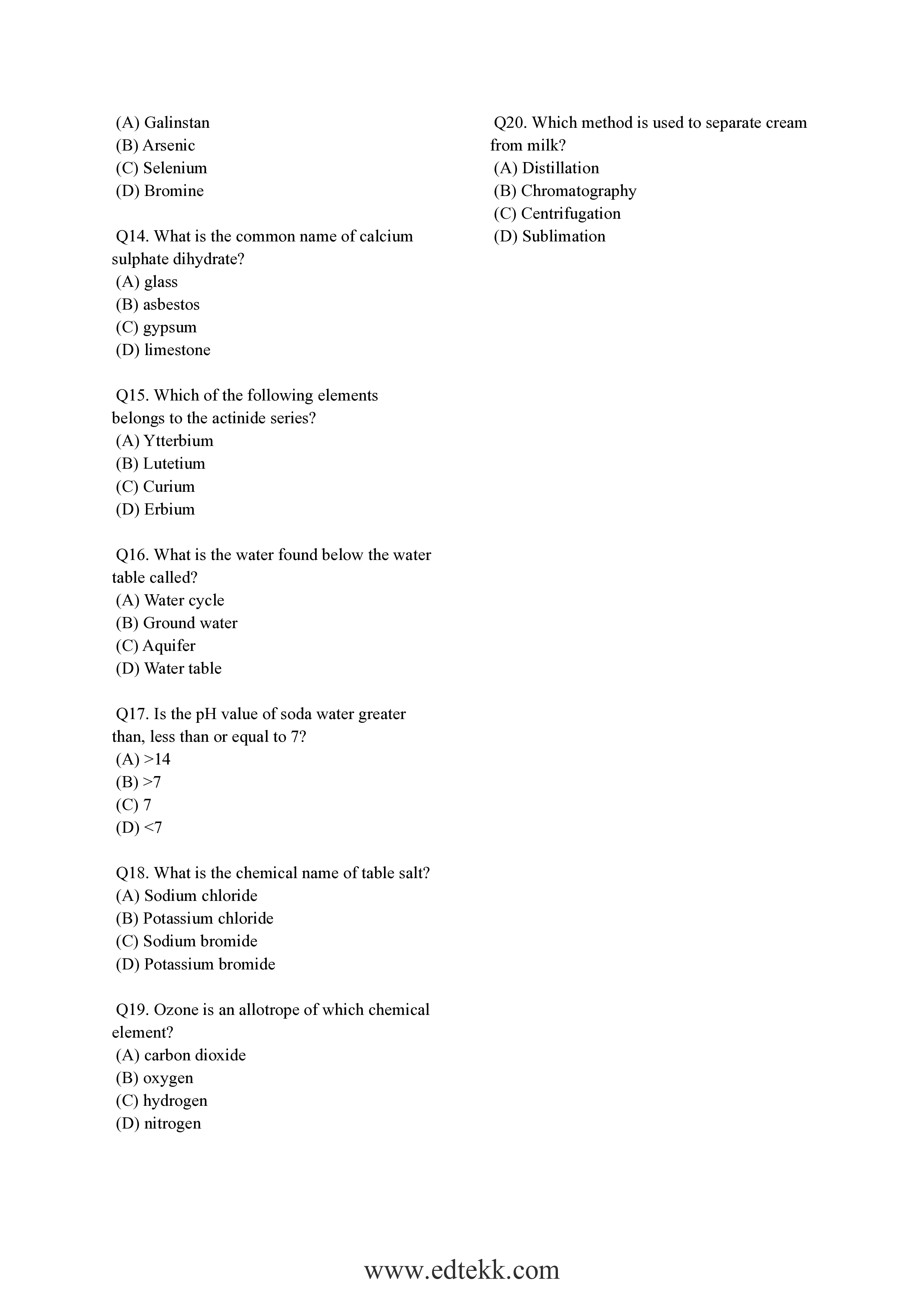
Q20. Which method is used to separate cream from milk?
(A) Distillation
(B) Chromatography
(C) Centrifugation
(D) Sublimation
Explanation: Centrifugation separates cream from milk based on differences in density. During rapid rotation, the denser aqueous portion moves outward more strongly, while the less dense fat-rich portion collects closer to the axis of rotation. This technique is widely used in dairy processing to separate cream from skimmed milk.
Question Paper Images