Improve your General Science preparation with the third Physics revision paper for SSC examinations. This practice set features objective questions relevant to SSC CGL, CHSL, CPO, MTS, GD and Selection Post exams. Attempt important Physics MCQs, evaluate your knowledge and strengthen exam readiness with accurate answers and explanations.
Test Details
Topic: Physics
Total Questions: 20
Question Format: MCQs – Single Correct Answer
Suitable for: SSC CGL, CHSL, CPO, MTS, GD, Selection Post
Download All Papers in This Series (PDF)
Questions and Answers
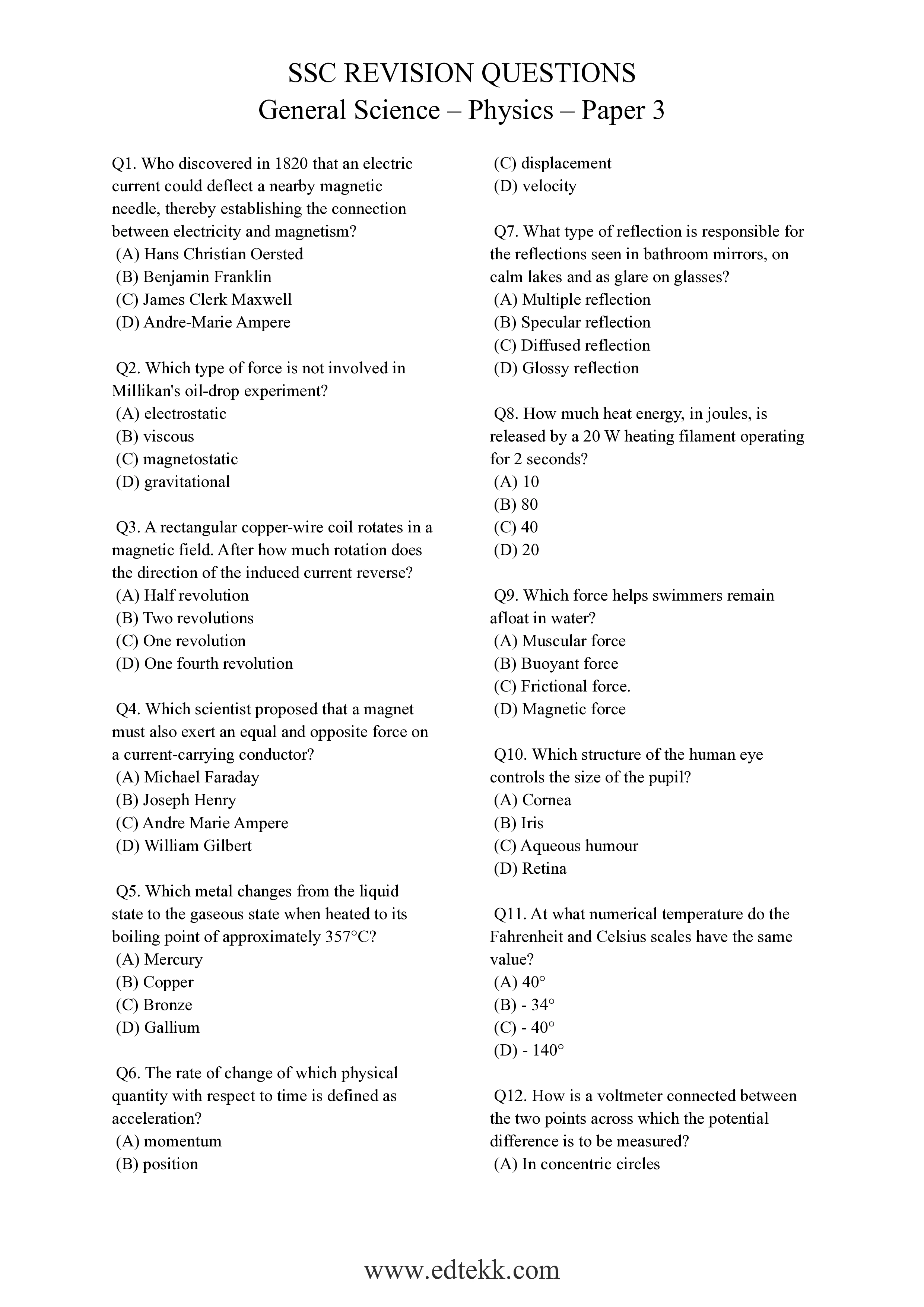
Q1. Who discovered in 1820 that an electric current could deflect a nearby magnetic needle, thereby establishing the connection between electricity and magnetism?
(A) Hans Christian Oersted
(B) Benjamin Franklin
(C) James Clerk Maxwell
(D) Andre-Marie Ampere
Explanation: Hans Christian Ørsted discovered the connection between electricity and magnetism in 1820. He observed that a compass needle deflected when placed near a current-carrying wire. This experiment demonstrated that an electric current produces a magnetic field and laid the foundation for the development of electromagnetism.
Q2. Which type of force is not involved in Millikan’s oil-drop experiment?
(A) electrostatic
(B) viscous
(C) magnetostatic
(D) gravitational
Explanation: In Millikan’s oil-drop experiment, the forces acting on an oil drop include gravitational force, electrostatic force, viscous drag and buoyant force. These forces are considered to determine the charge on the oil drops. Magnetostatic force is not involved in the standard experiment.
Q3. A rectangular copper-wire coil rotates in a magnetic field. After how much rotation does the direction of the induced current reverse?
(A) Half revolution
(B) Two revolutions
(C) One revolution
(D) One fourth revolution
Explanation: The direction of induced current in a rotating rectangular coil reverses after every half revolution (180°). This occurs because the direction of motion of the coil’s sides relative to the magnetic field reverses. This principle is used in an alternating-current (AC) generator.
Q4. Which scientist proposed that a magnet must also exert an equal and opposite force on a current-carrying conductor?
(A) Michael Faraday
(B) Joseph Henry
(C) Andre Marie Ampere
(D) William Gilbert
Explanation: André-Marie Ampère proposed that a magnet exerts an equal and opposite force on a current-carrying conductor, consistent with Newton’s third law of motion. His investigations into the interaction between electric currents and magnets contributed significantly to the development of electrodynamics.
Q5. Which metal changes from the liquid state to the gaseous state when heated to its boiling point of approximately 357°C?
(A) Mercury
(B) Copper
(C) Bronze
(D) Gallium
Explanation: Mercury has a boiling point of approximately 357°C at standard atmospheric pressure. When heated to this temperature, liquid mercury changes into mercury vapour. Mercury is unusual because it is a metal that remains liquid at ordinary room temperatures due to its relatively low melting point.
Q6. The rate of change of which physical quantity with respect to time is defined as acceleration?
(A) momentum
(B) position
(C) displacement
(D) velocity
Explanation: Acceleration is the rate of change of velocity with respect to time. It is a vector quantity and is mathematically expressed as (a=Delta v/Delta t). Its SI unit is metre per second squared (m/s²).
Q7. What type of reflection is responsible for the reflections seen in bathroom mirrors, on calm lakes and as glare on glasses?
(A) Multiple reflection
(B) Specular reflection
(C) Diffused reflection
(D) Glossy reflection
Explanation: Specular reflection occurs when light reflects from a smooth surface, with parallel incident rays remaining parallel after reflection. Bathroom mirrors and calm lake surfaces can produce clear reflections because their surfaces are relatively smooth. Glasses can also produce specular glare, although anti-reflective coatings reduce this effect.
Q8. How much heat energy, in joules, is released by a 20 W heating filament operating for 2 seconds?
(A) 10
(B) 80
(C) 40
(D) 20
Explanation: The heat energy produced by an electrical device is calculated using the formula (H=Ptimes t). Here, power is 20 W and time is 2 seconds. Therefore, (H=20times2=40) joules. This assumes that the filament operates at its rated power and all electrical energy is converted into heat.
Q9. Which force helps swimmers remain afloat in water?
(A) Muscular force
(B) Buoyant force
(C) Frictional force.
(D) Magnetic force
Explanation: Buoyant force is the upward force exerted by a fluid on an object partially or completely immersed in it. It helps swimmers remain afloat by opposing their weight. According to Archimedes’ principle, the buoyant force is equal to the weight of the fluid displaced by the immersed object.
Q10. Which structure of the human eye controls the size of the pupil?
(A) Cornea
(B) Iris
(C) Aqueous humour
(D) Retina
Explanation: The iris controls the size of the pupil and regulates the amount of light entering the eye. In bright light, its circular muscles contract and its radial muscles relax, constricting the pupil. In dim light, the radial muscles contract and the circular muscles relax, dilating the pupil.
Q11. At what numerical temperature do the Fahrenheit and Celsius scales have the same value?
(A) 40°
(B) – 34°
(C) – 40°
(D) – 140°
Explanation: The Fahrenheit and Celsius scales have the same numerical value at −40 degrees. This can be verified using the conversion formula (F=frac{9}{5}C+32). Substituting −40°C gives −40°F. Thus, −40 is the common numerical value on both scales.
Q12. How is a voltmeter connected between the two points across which the potential difference is to be measured?
(A) In concentric circles
(B) Along the same magnetic field
(C) In parallel
(D) Perpendicular to each other
Explanation: A voltmeter is connected in parallel across the two points between which the potential difference is to be measured. It has very high resistance, so it draws negligible current from the circuit and minimises disturbance to the potential difference being measured.
Q13. During winter in cold regions, lakes freeze at the surface, leaving the water below at approximately what temperature?
(A) 0°C
(B) 0°F
(C) 4°C
(D) 4°F
Explanation: Water has maximum density at approximately 4°C. During winter, water colder than 4°C becomes less dense and remains near the surface, eventually freezing. Consequently, the deeper water generally remains close to 4°C, allowing aquatic organisms to survive beneath the ice.
Q14. Which type of friction is considered a self-adjusting force?
(A) Kinetic Friction
(B) Static Friction
(C) Rolling Friction
(D) Centripetal Friction
Explanation: Static friction is a self-adjusting force that prevents relative motion between two surfaces in contact. Its magnitude adjusts to match the applied tangential force until it reaches the maximum limiting friction. When the applied force exceeds this limit, sliding begins and kinetic friction acts.
Q15. What is the upward buoyant force exerted by a fluid on an object called?
(A) torque
(B) upthrust
(C) moment
(D) pressure
Explanation: An object immersed wholly or partially in a fluid experiences an upward force called upthrust or buoyant force. According to Archimedes’ principle, the magnitude of this force equals the weight of the fluid displaced by the object.
Q16. Which of Newton’s laws provides a quantitative definition of force?
(A) Universal law of gravitation
(B) Second law of motion
(C) First law of motion
(D) Third law of motion
Explanation: Newton’s second law provides a quantitative relationship between net force and the rate of change of momentum. For an object of constant mass, it is expressed as (F=ma). Newton’s first law explains inertia, while the third law describes action–reaction pairs. The law of universal gravitation explains gravitational attraction between masses.
Q17. Which subatomic particles constitute cathode rays?
(A) protons
(B) positrons
(C) neutrons
(D) electrons
Explanation: Cathode rays are streams of negatively charged electrons emitted from the cathode in a discharge tube under suitable conditions. They travel towards the anode and can be deflected by electric and magnetic fields. J. J. Thomson’s experiments with cathode rays in 1897 established the existence of electrons.
Q18. Which physical quantity can change a body’s state of rest or uniform motion when an unbalanced external influence acts on it?
(A) Heat
(B) Power
(C) Force
(D) Energy
Explanation: Force is an external influence that can change an object’s state of rest or uniform motion. An unbalanced net force produces acceleration, resulting in a change in speed, direction or both. According to Newton’s second law, acceleration is directly proportional to the net force and inversely proportional to the object’s mass.
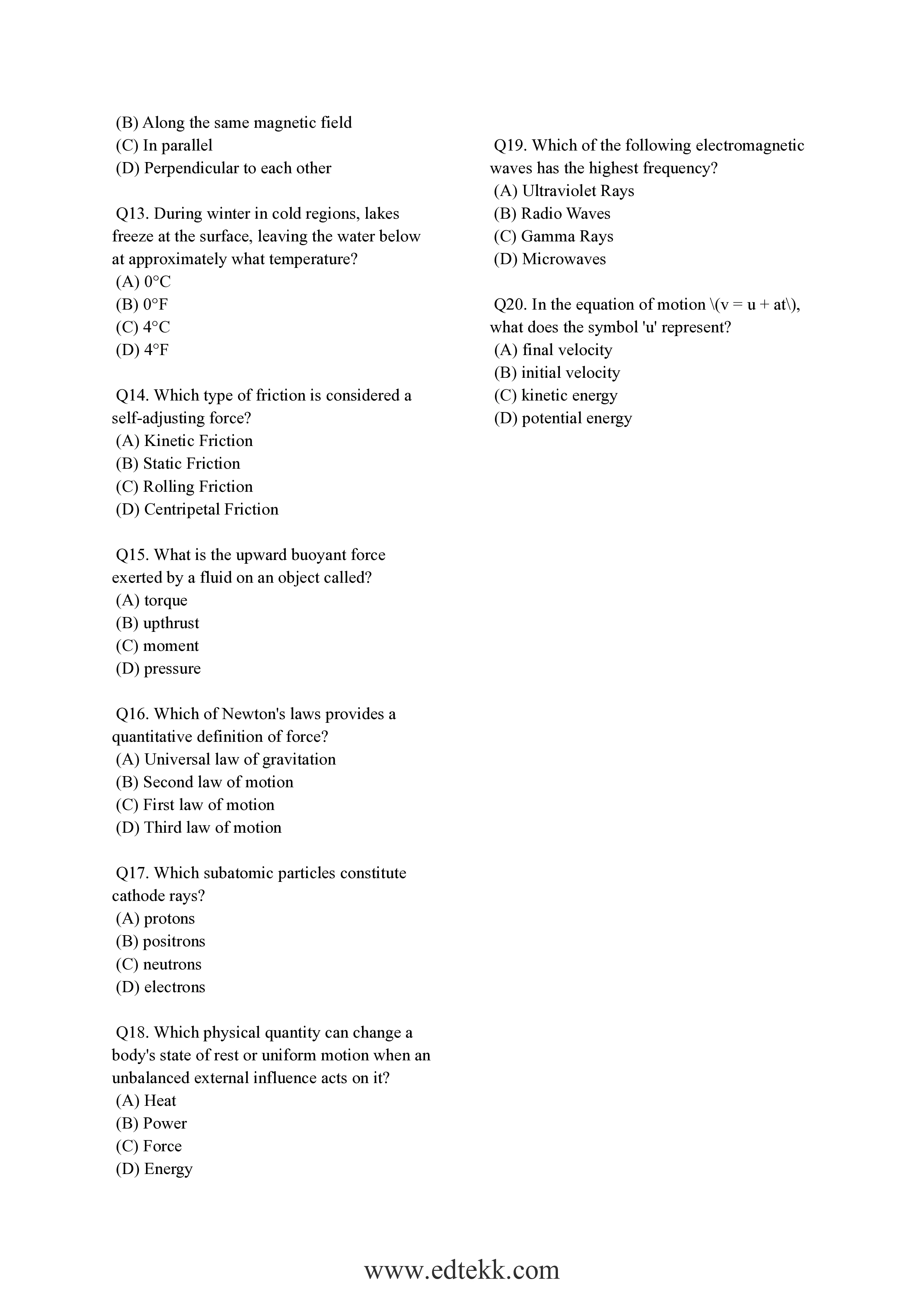
Q19. Which of the following electromagnetic waves has the highest frequency?
(A) Ultraviolet Rays
(B) Radio Waves
(C) Gamma Rays
(D) Microwaves
Explanation: Gamma rays have the highest frequency and shortest wavelength among the given electromagnetic waves. Their photon energies are higher than those of ultraviolet rays, microwaves and radio waves. According to the relationship c = νλ, frequency and wavelength are inversely proportional in a vacuum.
Q20. In the equation of motion (v = u + at), what does the symbol ‘u’ represent?
(A) final velocity
(B) initial velocity
(C) kinetic energy
(D) potential energy
Explanation: In the equation of motion (v = u + at), (u) represents initial velocity, (v) represents final velocity, (a) represents uniform acceleration and (t) represents the time interval. This equation applies to motion with constant acceleration.
Question Paper Images