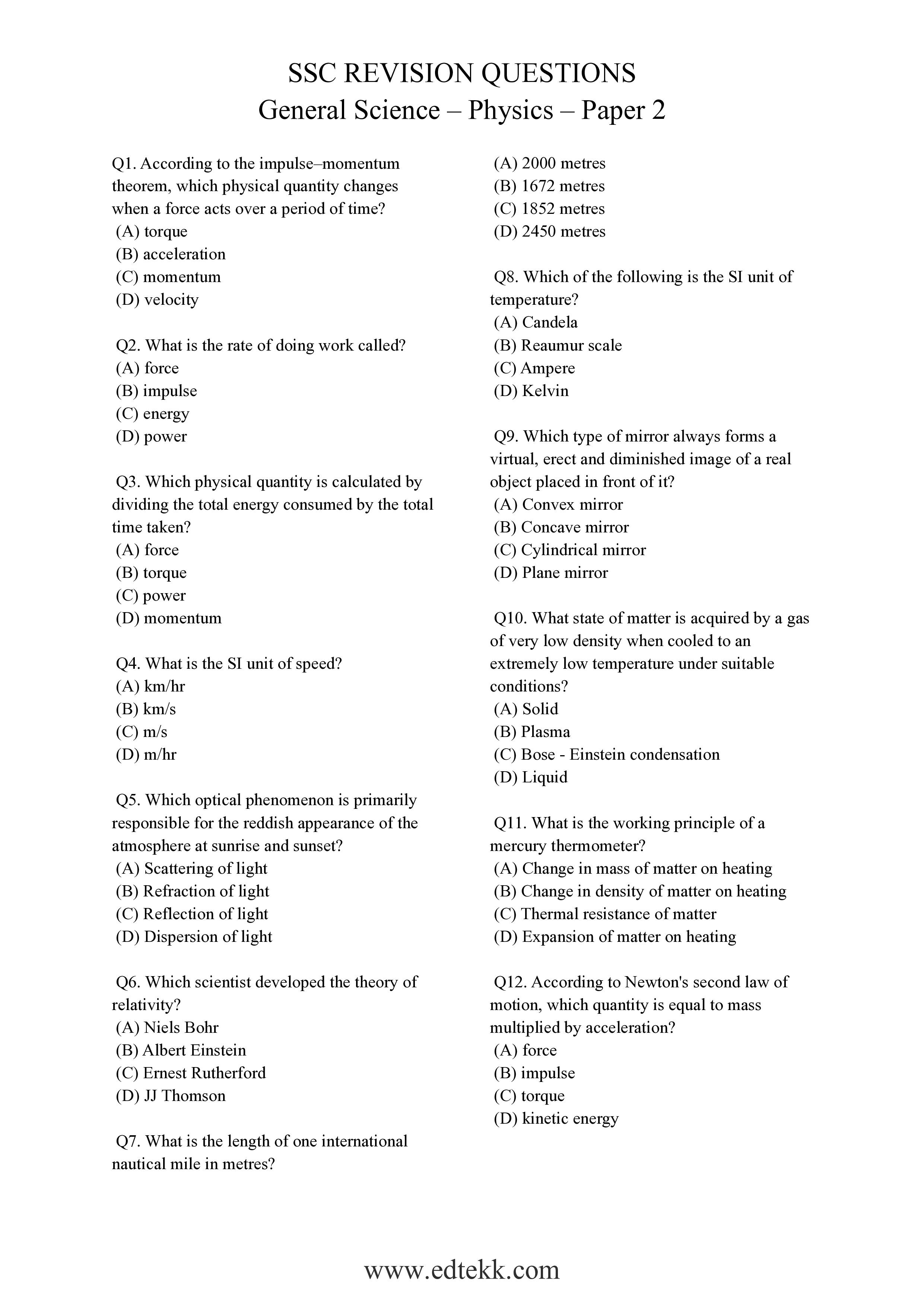
Strengthen your Physics preparation with this second SSC General Science revision practice set. It provides objective-type Physics questions for SSC CGL, CHSL, CPO, MTS, GD and Selection Post examinations. Test your knowledge through exam-focused MCQs, check correct answers and understand important concepts with explanations.
Test Details
Topic: Physics
Total Questions: 20
Question Format: MCQs – Single Correct Answer
Suitable for: SSC CGL, CHSL, CPO, MTS, GD, Selection Post
Download All Papers in This Series (PDF)
Questions and Answers
Q1. According to the impulse–momentum theorem, which physical quantity changes when a force acts over a period of time?
(A) torque
(B) acceleration
(C) momentum
(D) velocity
Explanation: According to the impulse-momentum theorem, the impulse of the net force acting on a body equals the change in its momentum. Mathematically, (J=Delta p). For a constant net force, (FDelta t=Delta p), where (F) is the net force and (Delta t) is the time interval.
Q2. What is the rate of doing work called?
(A) force
(B) impulse
(C) energy
(D) power
Explanation: Power is defined as the rate of doing work or transferring energy per unit time. Mathematically, average power is expressed as (P=W/t), where (W) represents the work done and (t) represents the time taken. Its SI unit is the watt (W), equivalent to one joule per second.
Q3. Which physical quantity is calculated by dividing the total energy consumed by the total time taken?
(A) force
(B) torque
(C) power
(D) momentum
Explanation: Average power is calculated by dividing the total energy consumed by the total time taken. Mathematically, (P_{text{average}}=E_{text{total}}/t_{text{total}}). Its SI unit is the watt (W), equivalent to one joule per second.
Q4. What is the SI unit of speed?
(A) km/hr
(B) km/s
(C) m/s
(D) m/hr
Explanation: The SI unit of speed is metre per second (m/s). Speed is defined as the distance travelled per unit time. Although kilometres per hour (km/h) is commonly used in everyday life, it is not the SI unit of speed.
Q5. Which optical phenomenon is primarily responsible for the reddish appearance of the atmosphere at sunrise and sunset?
(A) Scattering of light
(B) Refraction of light
(C) Reflection of light
(D) Dispersion of light
Explanation: The redness of the sky at sunrise and sunset is primarily caused by the scattering of sunlight in the atmosphere. Sunlight travels through a longer atmospheric path, causing shorter wavelengths, particularly blue light, to be scattered more strongly out of the direct beam. Consequently, the transmitted sunlight appears richer in red and orange wavelengths.
Q6. Which scientist developed the theory of relativity?
(A) Niels Bohr
(B) Albert Einstein
(C) Ernest Rutherford
(D) JJ Thomson
Explanation: Albert Einstein developed the special theory of relativity in 1905 and the general theory of relativity, published in its final form in 1915. These theories revolutionised the understanding of space, time, gravity and motion. Niels Bohr, Ernest Rutherford and J. J. Thomson contributed significantly to atomic physics.
Q7. What is the length of one international nautical mile in metres?
(A) 2000 metres
(B) 1672 metres
(C) 1852 metres
(D) 2450 metres
Explanation: One international nautical mile is exactly 1,852 metres. It is commonly used in maritime and aviation navigation and corresponds approximately to one minute of latitude.
Q8. Which of the following is the SI unit of temperature?
(A) Candela
(B) Reaumur scale
(C) Ampere
(D) Kelvin
Explanation: The kelvin (K) is the SI base unit of thermodynamic temperature. It is used in scientific measurements and is distinct from the Celsius and Fahrenheit scales commonly used for everyday temperature measurements.
Q9. Which type of mirror always forms a virtual, erect and diminished image of a real object placed in front of it?
(A) Convex mirror
(B) Concave mirror
(C) Cylindrical mirror
(D) Plane mirror
Explanation: A convex mirror always forms a virtual, erect and diminished image of a real object placed in front of it. The image appears behind the mirror, irrespective of the object’s position. Convex mirrors provide a wide field of view and are commonly used as rear-view and side-view mirrors in vehicles.
Q10. What state of matter is acquired by a gas of very low density when cooled to an extremely low temperature under suitable conditions?
(A) Solid
(B) Plasma
(C) Bose – Einstein condensation
(D) Liquid
Explanation: At sufficiently low temperatures and under suitable conditions, a dilute gas of bosonic particles can undergo Bose–Einstein condensation. In this state, a macroscopic number of particles occupy the same lowest-energy quantum state. Low temperature and low density alone are not sufficient; appropriate quantum and thermodynamic conditions are necessary.
Q11. What is the working principle of a mercury thermometer?
(A) Change in mass of matter on heating
(B) Change in density of matter on heating
(C) Thermal resistance of matter
(D) Expansion of matter on heating
Explanation: A mercury thermometer works on the principle of thermal expansion of matter. When temperature increases, mercury expands and rises through the narrow capillary tube. When temperature decreases, it contracts and its level falls. The change in mercury volume is used to indicate temperature.
Q12. According to Newton’s second law of motion, which quantity is equal to mass multiplied by acceleration?
(A) force
(B) impulse
(C) torque
(D) kinetic energy
Explanation: According to Newton’s second law of motion, the net force acting on a body equals the product of its mass and acceleration. Mathematically, (F = ma), where (F) represents force, (m) represents mass and (a) represents acceleration. The SI unit of force is the newton (N).
Q13. What type of motion does a freely falling body near Earth’s surface exhibit when air resistance is neglected?
(A) Non-uniform acceleration
(B) Uniform acceleration
(C) Zero acceleration
(D) Variable acceleration
Explanation: A freely falling body near Earth’s surface experiences approximately constant gravitational acceleration when air resistance is neglected and the distance travelled is relatively small. This acceleration is approximately 9.8 m/s², directed vertically downward. Hence, its motion is an example of uniformly accelerated motion.
Q14. Which law gives the expression for the electrostatic force between two stationary point charges in a vacuum?
(A) Lenz’s Law
(B) Gauss’s Law
(C) Ohm’s Law
(D) Coulomb’s Law
Explanation: Coulomb’s law describes the electrostatic force between two stationary point charges in vacuum. The magnitude of this force is directly proportional to the product of the charges and inversely proportional to the square of the distance between them. The force acts along the line joining the charges and may be attractive or repulsive.
Q15. Which of the following statements is correct?
(A) The watt is the SI unit of energy.
(B) Joule is the SI unit of work.
(C) Joule per second is the SI unit of energy.
(D) Joule per newton is the SI unit of power.
Explanation: The joule (J) is the SI unit of work and energy. One joule of work is done when a force of one newton moves an object one metre in the direction of the force. The watt (W), equivalent to one joule per second, is the SI unit of power.
Q16. What is the process involving the successive stages of vaporisation and condensation called?
(A) Sublimation
(B) Distillation
(C) Chromatography
(D) Crystallisation
Explanation: Distillation is a separation process involving vaporisation followed by condensation. The liquid mixture is heated to convert a component into vapour, which is subsequently cooled to obtain it in liquid form. It is commonly used to separate liquids with different boiling points or recover a solvent from a solution.
Q17. Which of the following physical quantities has the same dimensions as energy?
(A) Torque
(B) Linear Momentum
(C) Moment of inertia
(D) Angular momentum
Explanation: Torque and energy have the same dimensions, (ML^2T^{-2}). Torque is the product of force and perpendicular distance, whereas work is the product of force and displacement in the direction of the force. However, they represent different physical quantities: torque is expressed in N·m and energy in joules (J).
Q18. What are beta rays emitted by radioactive materials?
(A) The electrons orbiting around the nucleus
(B) Charged particles emitted by nucleus
(C) Neutral particles
(D) Electromagnetic radiations
Explanation: Beta rays consist of high-speed charged particles emitted during radioactive decay. Beta-minus (β⁻) particles are electrons, while beta-plus (β⁺) particles are positrons. These particles are produced during nuclear transformations and are not ordinary orbital electrons. Unlike gamma rays, beta rays are particulate radiation rather than electromagnetic radiation.
Q19. Which physical quantity is measured using the Réaumur scale?
(A) Length
(B) Elasticity
(C) Temperature
(D) Speed
Explanation: The Réaumur scale is a historical temperature scale in which the freezing point of water is 0°Ré and its boiling point is 80°Ré at standard atmospheric pressure. It was formerly used in some European countries but has largely been replaced by the Celsius scale.
Q20. A bullet of mass 10 g is fired at a velocity of 20 m/s from a gun of mass 2 kg. What is the recoil velocity of the gun, in m/s?
(A) 0.1
(B) 0.2
(C) 2
(D) 1
Explanation: According to the law of conservation of momentum, the initial total momentum of the gun–bullet system is zero. Therefore, (0.01 times 20 + 2v = 0), giving (v = -0.1text{ m/s}). The negative sign indicates that the gun recoils in the direction opposite to the bullet’s motion.
Question Paper Images