Revise important scientific concepts with General Science Practice Paper 9. This practice set features objective questions, correct answers and explanations to help candidates evaluate their subject knowledge and improve exam preparation for SSC, Railway, State PSC, Police Constable and Police SI examinations.
Test Details
Topic: General Science
Total Questions: 20
Question Format: MCQs – Single Correct Answer
Suitable for: SSC exams, Railway exams, State PSC, Police Constable, Police SI
Download All Papers in This Series (PDF)
Questions and Answers
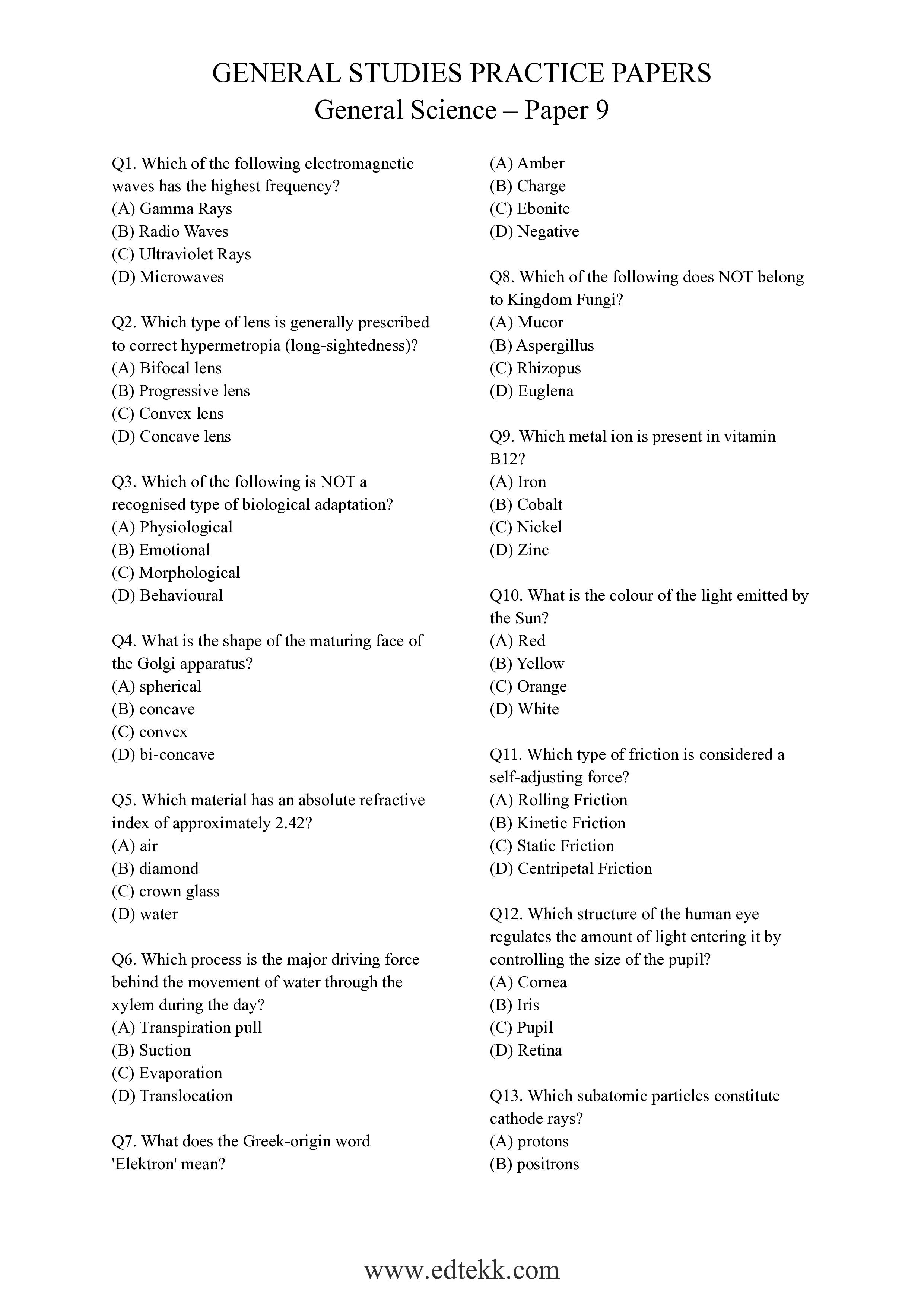
Q1. Which of the following electromagnetic waves has the highest frequency?
(A) Gamma Rays
(B) Radio Waves
(C) Ultraviolet Rays
(D) Microwaves
Explanation: Gamma rays have the highest frequency and shortest wavelength among the given electromagnetic waves. Their photon energies are higher than those of ultraviolet rays, microwaves and radio waves. According to the relationship c = νλ, frequency and wavelength are inversely proportional in a vacuum.
Q2. Which type of lens is generally prescribed to correct hypermetropia (long-sightedness)?
(A) Bifocal lens
(B) Progressive lens
(C) Convex lens
(D) Concave lens
Explanation: Hypermetropia, or long-sightedness, makes nearby objects difficult to see clearly because their images tend to form behind the retina. A convex (converging) lens corrects this defect by converging incoming light rays so that the image forms on the retina.
Q3. Which of the following is NOT a recognised type of biological adaptation?
(A) Physiological
(B) Emotional
(C) Morphological
(D) Behavioural
Explanation: Biological adaptations are generally classified into three principal categories: morphological (structural), physiological (functional) and behavioural adaptations. These adaptations involve changes in body structure, internal functioning and behaviour, respectively, that improve an organism’s survival and reproductive success. Emotional adaptation is not recognised as a principal category of biological adaptation.
Q4. What is the shape of the maturing face of the Golgi apparatus?
(A) spherical
(B) concave
(C) convex
(D) bi-concave
Explanation: The maturing face of the Golgi apparatus is generally convex in shape and is also called the trans face. It is usually directed towards the plasma membrane and is involved in sorting and packaging processed materials into vesicles for transport. The forming face, or cis face, is generally concave.
Q5. Which material has an absolute refractive index of approximately 2.42?
(A) air
(B) diamond
(C) crown glass
(D) water
Explanation: Diamond has an absolute refractive index of approximately 2.42. The absolute refractive index of a medium is the ratio of the speed of light in vacuum to its speed in that medium. Diamond has a high refractive index because light travels considerably slower through it than through air or water.
Q6. Which process is the major driving force behind the movement of water through the xylem during the day?
(A) Transpiration pull
(B) Suction
(C) Evaporation
(D) Translocation
Explanation: Transpiration pull is the major driving force responsible for the upward movement of water through xylem during the day. Evaporation of water from leaf surfaces generates negative pressure, which pulls the continuous column of water upward from the roots.
Q7. What does the Greek-origin word ‘Elektron’ mean?
(A) Amber
(B) Charge
(C) Ebonite
(D) Negative
Explanation: The Greek word ‘Elektron’ means amber. In ancient times, it was observed that amber attracts lightweight objects when rubbed, owing to static electricity. The English word ‘electricity’ ultimately derives from this Greek term through the Latin word electricus.
Q8. Which of the following does NOT belong to Kingdom Fungi?
(A) Mucor
(B) Aspergillus
(C) Rhizopus
(D) Euglena
Explanation: Euglena does not belong to Kingdom Fungi. It is a unicellular, flagellated eukaryotic organism traditionally classified under Kingdom Protista. Aspergillus, Rhizopus and Mucor belong to Kingdom Fungi. Euglena possesses chloroplasts in photosynthetic species and can also obtain nutrients heterotrophically.
Q9. Which metal ion is present in vitamin B12?
(A) Iron
(B) Cobalt
(C) Nickel
(D) Zinc
Explanation: Vitamin B12, also known as cobalamin, contains cobalt as its central metal ion. This element forms an essential part of the vitamin’s molecular structure. Vitamin B12 is necessary for normal red blood cell formation, DNA synthesis and proper nervous system functioning.
Q10. What is the colour of the light emitted by the Sun?
(A) Red
(B) Yellow
(C) Orange
(D) White
Explanation: The Sun emits light across a broad range of visible wavelengths, and their combination is perceived as white. From space, the Sun appears white. From Earth’s surface, atmospheric scattering can make it appear yellow, orange or red, particularly near the horizon. Therefore, white is the most appropriate answer.
Q11. Which type of friction is considered a self-adjusting force?
(A) Rolling Friction
(B) Kinetic Friction
(C) Static Friction
(D) Centripetal Friction
Explanation: Static friction is a self-adjusting force that prevents relative motion between two surfaces in contact. Its magnitude adjusts to match the applied tangential force until it reaches the maximum limiting friction. When the applied force exceeds this limit, sliding begins and kinetic friction acts.
Q12. Which structure of the human eye regulates the amount of light entering it by controlling the size of the pupil?
(A) Cornea
(B) Iris
(C) Pupil
(D) Retina
Explanation: The iris regulates the amount of light entering the human eye by controlling the diameter of the pupil. In bright conditions, the pupil constricts to reduce incoming light. In dim conditions, it dilates to allow more light to enter. The pupil is the opening, whereas the iris is the structure that controls its size.
Q13. Which subatomic particles constitute cathode rays?
(A) protons
(B) positrons
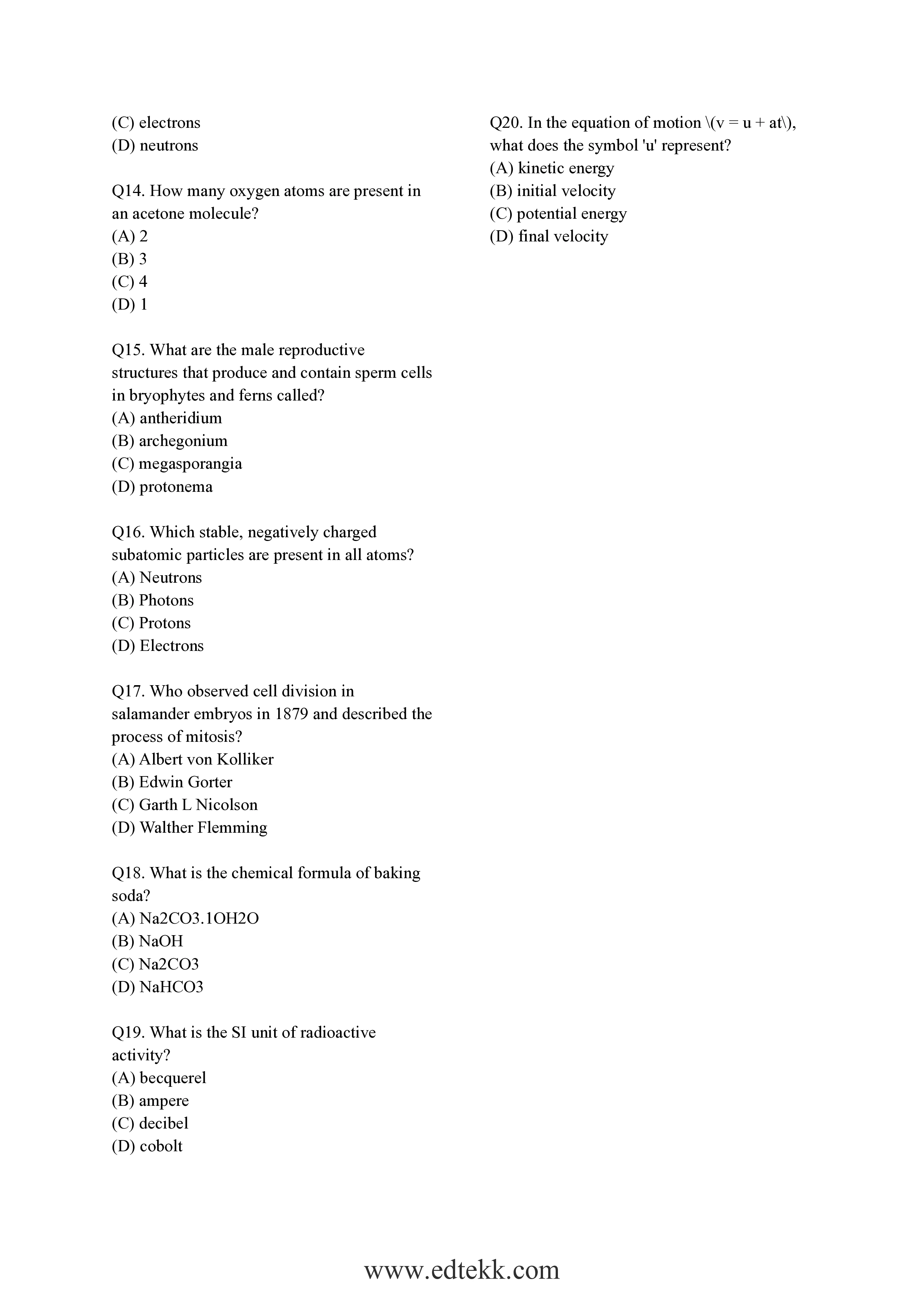
(C) electrons
(D) neutrons
Explanation: Cathode rays are streams of negatively charged electrons emitted from the cathode in a discharge tube under suitable conditions. They travel towards the anode and can be deflected by electric and magnetic fields. J. J. Thomson’s experiments with cathode rays in 1897 established the existence of electrons.
Q14. How many oxygen atoms are present in an acetone molecule?
(A) 2
(B) 3
(C) 4
(D) 1
Explanation: Acetone has the molecular formula C₃H₆O and is commonly written as CH₃COCH₃. Its structure contains a carbonyl group (C=O), which contributes exactly one oxygen atom to each molecule. Acetone is the simplest ketone and is widely used as an industrial solvent and cleaning agent.
Q15. What are the male reproductive structures that produce and contain sperm cells in bryophytes and ferns called?
(A) antheridium
(B) archegonium
(C) megasporangia
(D) protonema
Explanation: Antheridia are the male reproductive structures found in bryophytes and ferns. They produce and contain male gametes called antherozoids, which are generally flagellated and require water for fertilisation. Archegonia are the corresponding female reproductive structures that contain the egg cell.
Q16. Which stable, negatively charged subatomic particles are present in all atoms?
(A) Neutrons
(B) Photons
(C) Protons
(D) Electrons
Explanation: Electrons are stable, negatively charged subatomic particles present in all atoms. They occupy regions surrounding the nucleus and carry a charge of approximately −1.602 × 10⁻¹⁹ coulomb. Protons carry a positive charge, whereas neutrons have no electric charge. Photons are particles of electromagnetic radiation.
Q17. Who observed cell division in salamander embryos in 1879 and described the process of mitosis?
(A) Albert von Kolliker
(B) Edwin Gorter
(C) Garth L Nicolson
(D) Walther Flemming
Explanation: Walther Flemming systematically studied cell division in animal cells, particularly in salamander tissues, and described mitosis. His research, published in 1879, documented the behaviour of chromosomes during cell division. He is recognised as a pioneer in cytology and the study of chromosome dynamics.
Q18. What is the chemical formula of baking soda?
(A) Na2CO3.1OH2O
(B) NaOH
(C) Na2CO3
(D) NaHCO3
Explanation: Baking soda is sodium hydrogen carbonate, also known as sodium bicarbonate, with the chemical formula NaHCO₃. It acts as a leavening agent in baking by releasing carbon dioxide when it reacts with acids or decomposes on heating.
Q19. What is the SI unit of radioactive activity?
(A) becquerel
(B) ampere
(C) decibel
(D) cobolt
Explanation: The becquerel (Bq) is the SI unit of radioactivity, more precisely called radioactive activity. One becquerel corresponds to one nuclear disintegration per second. The ampere measures electric current, the decibel expresses a logarithmic level, and cobalt is a chemical element.
Q20. In the equation of motion (v = u + at), what does the symbol ‘u’ represent?
(A) kinetic energy
(B) initial velocity
(C) potential energy
(D) final velocity
Explanation: In the equation of motion (v = u + at), (u) represents initial velocity, (v) represents final velocity, (a) represents uniform acceleration and (t) represents the time interval. This equation applies to motion with constant acceleration.
Question Paper Images