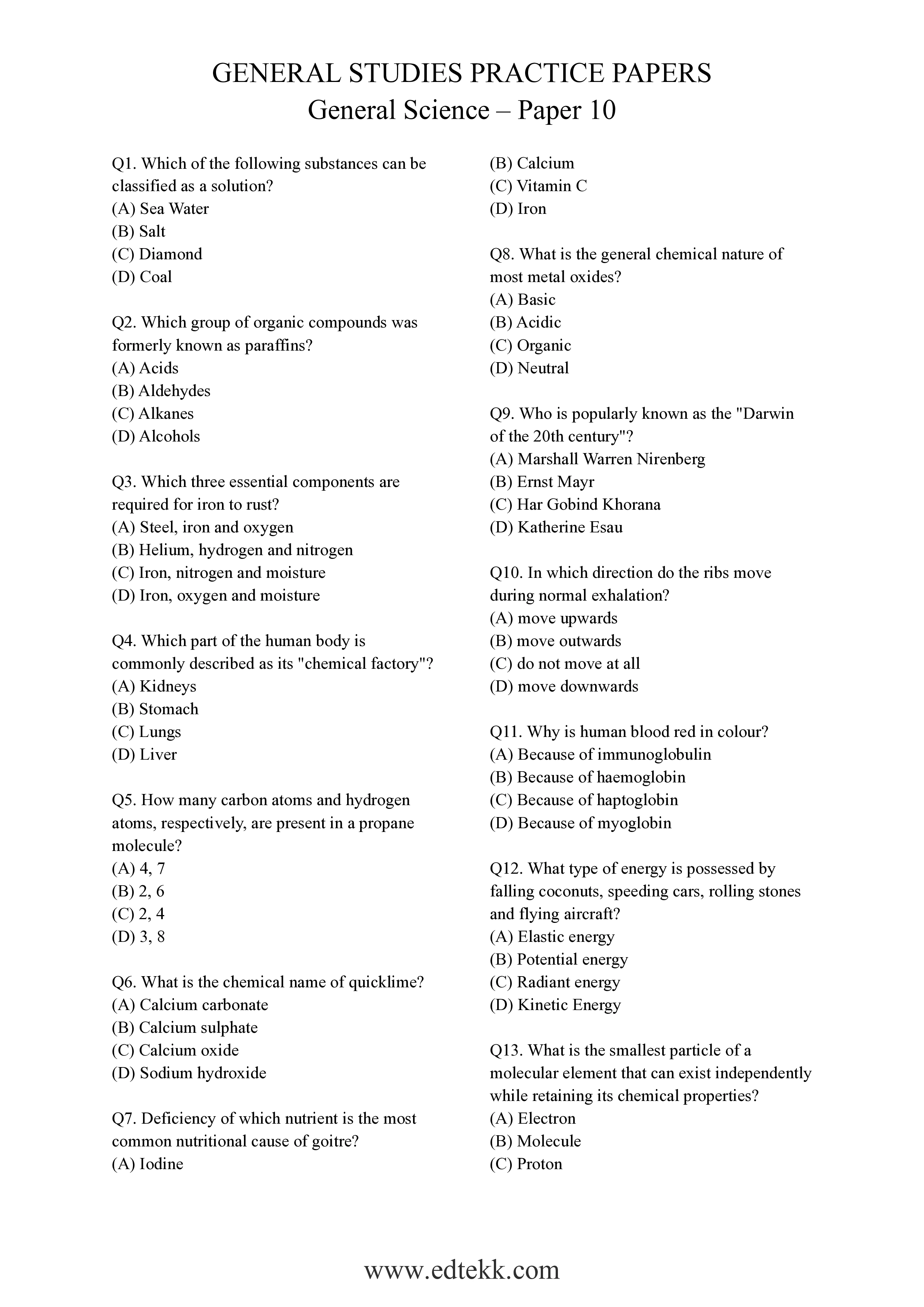
Complete another stage of your General Science revision with General Studies Practice Paper 10. This question set provides objective questions, answers and explanations for systematic practice and self-assessment. It is designed for aspirants preparing for SSC, Railway, State PSC, Police Constable and Police SI competitive examinations.
Test Details
Topic: General Science
Total Questions: 20
Question Format: MCQs – Single Correct Answer
Suitable for: SSC exams, Railway exams, State PSC, Police Constable, Police SI
Download All Papers in This Series (PDF)
Questions and Answers
Q1. Which of the following substances can be classified as a solution?
(A) Sea Water
(B) Salt
(C) Diamond
(D) Coal
Explanation: Sea water is considered a solution because it contains dissolved salts, primarily sodium chloride, uniformly distributed in water. It is a homogeneous mixture of dissolved substances. Diamond is a pure form of carbon, coal is a heterogeneous material, and ordinary solid salt is a chemical compound rather than a solution.
Q2. Which group of organic compounds was formerly known as paraffins?
(A) Acids
(B) Aldehydes
(C) Alkanes
(D) Alcohols
Explanation: Alkanes were historically known as paraffins. The term originates from the Latin words parum affinis, meaning little affinity, referring to their relatively low chemical reactivity. Alkanes are saturated hydrocarbons containing only carbon–carbon single bonds and generally follow the formula CₙH₂ₙ₊₂ for open-chain structures.
Q3. Which three essential components are required for iron to rust?
(A) Steel, iron and oxygen
(B) Helium, hydrogen and nitrogen
(C) Iron, nitrogen and moisture
(D) Iron, oxygen and moisture
Explanation: Rusting of iron requires three essential components: iron, oxygen and moisture. In the presence of water and oxygen, iron undergoes corrosion and forms hydrated iron(III) oxide, commonly known as rust. Preventing contact with moisture or oxygen can significantly slow down or prevent rust formation.
Q4. Which part of the human body is commonly described as its “chemical factory”?
(A) Kidneys
(B) Stomach
(C) Lungs
(D) Liver
Explanation: The liver is commonly described as the chemical factory of the human body because it performs numerous metabolic and biochemical functions. It processes nutrients, detoxifies many harmful substances, produces bile, synthesises important blood proteins and regulates the metabolism of carbohydrates, fats and proteins.
Q5. How many carbon atoms and hydrogen atoms, respectively, are present in a propane molecule?
(A) 4, 7
(B) 2, 6
(C) 2, 4
(D) 3, 8
Explanation: Propane has the molecular formula C₃H₈. Each molecule contains three carbon atoms and eight hydrogen atoms. It is the third member of the alkane series, which follows the general formula CₙH₂ₙ₊₂. Propane is widely used as a fuel and is a component of liquefied petroleum gas (LPG).
Q6. What is the chemical name of quicklime?
(A) Calcium carbonate
(B) Calcium sulphate
(C) Calcium oxide
(D) Sodium hydroxide
Explanation: Quicklime is the common name for calcium oxide (CaO). It is produced by heating limestone (calcium carbonate, CaCO₃) strongly through a process called calcination, releasing carbon dioxide (CO₂).
Q7. Deficiency of which nutrient is the most common nutritional cause of goitre?
(A) Iodine
(B) Calcium
(C) Vitamin C
(D) Iron
Explanation: Iodine deficiency is the most common nutritional cause of goitre worldwide. Iodine is essential for the production of thyroid hormones. Insufficient iodine intake can reduce thyroid hormone production and stimulate the thyroid gland to enlarge. However, goitre can also result from autoimmune disorders and other thyroid conditions.
Q8. What is the general chemical nature of most metal oxides?
(A) Basic
(B) Acidic
(C) Organic
(D) Neutral
Explanation: Most metal oxides are generally basic in nature and react with acids to produce salt and water. Magnesium oxide and calcium oxide are examples of basic oxides. However, some metal oxides, such as aluminium oxide and zinc oxide, are amphoteric because they react with both acids and bases.
Q9. Who is popularly known as the “Darwin of the 20th century”?
(A) Marshall Warren Nirenberg
(B) Ernst Mayr
(C) Har Gobind Khorana
(D) Katherine Esau
Explanation: Ernst Mayr was a prominent evolutionary biologist and a major contributor to the modern evolutionary synthesis. He is widely referred to as the Darwin of the 20th century for his contributions to evolutionary biology, speciation and systematics. His biological species concept significantly advanced the understanding of species formation and evolution.
Q10. In which direction do the ribs move during normal exhalation?
(A) move upwards
(B) move outwards
(C) do not move at all
(D) move downwards
Explanation: During normal exhalation, the diaphragm relaxes and moves upward, while the external intercostal muscles relax, allowing the ribs to move downward and inward. This decreases the volume of the thoracic cavity, increases intrapulmonary pressure and forces air out of the lungs. Forced exhalation additionally involves the internal intercostal and abdominal muscles.
Q11. Why is human blood red in colour?
(A) Because of immunoglobulin
(B) Because of haemoglobin
(C) Because of haptoglobin
(D) Because of myoglobin
Explanation: Haemoglobin is an iron-containing protein present in red blood cells that gives human blood its characteristic red colour. Its colour varies with oxygenation: oxygenated blood is bright red, whereas deoxygenated blood is darker red. Myoglobin, in contrast, is primarily an oxygen-binding protein found in muscle tissue.
Q12. What type of energy is possessed by falling coconuts, speeding cars, rolling stones and flying aircraft?
(A) Elastic energy
(B) Potential energy
(C) Radiant energy
(D) Kinetic Energy
Explanation: Kinetic energy is the energy possessed by an object due to its motion. Falling coconuts, speeding cars, rolling stones and flying aircraft all possess kinetic energy. It depends on the object’s mass and the square of its speed and is expressed as KE = ½mv², where m is mass and v is speed.
Q13. What is the smallest particle of a molecular element that can exist independently while retaining its chemical properties?
(A) Electron
(B) Molecule
(C) Proton
(D) Neutron
Explanation: A molecule is the smallest independently existing particle of a molecular element that retains its chemical properties. Molecules of elements may contain two or more chemically bonded atoms, such as oxygen (O₂), nitrogen (N₂) and hydrogen (H₂). However, not all elements exist as molecules; noble gases generally exist as individual atoms.
Q14. What is the frequency, in kilohertz, of an object that completes 10 oscillations per second?
(A) 1
(B) 0.1
(C) 0.01
(D) 10
Explanation: Frequency is the number of oscillations completed per second. An object executing 10 oscillations per second has a frequency of 10 Hz. Since 1 kHz equals 1,000 Hz, its frequency in kilohertz is (10/1000=0.01) kHz.
Q15. What is water that is safe and suitable for human consumption called?
(A) sanitary
(B) hygienic
(C) sparkling
(D) potable
Explanation: Potable water is water that is safe and suitable for human consumption. It should be free from harmful microorganisms and dangerous concentrations of chemical contaminants. Drinking water must meet prescribed quality standards to prevent waterborne diseases and protect human health.
Q16. Which of the following cells is amoeboid in shape?
(A) White blood cell
(B) Nerve cell
(C) Columnar epithelial cell
(D) Red blood cell
Explanation: White blood cells, also called leukocytes, are generally amoeboid in shape. They can change their shape and form temporary projections to move through tissues and reach sites of infection. This movement is called amoeboid movement. Red blood cells, in contrast, have a characteristic biconcave disc shape.
Q17. Which of the following substances is used as an alternative to chlorine for bleaching?
(A) Tetrachloroethene
(B) Ethanal
(C) Liquid carbon dioxide
(D) Hydrogen peroxide
Explanation: Hydrogen peroxide (H₂O₂) is used as an alternative to chlorine-based bleaching agents. It acts as an oxidising agent and is widely used in the textile and paper industries. Its decomposition primarily produces water and oxygen, avoiding the formation of persistent chlorinated organic by-products associated with some chlorine-based processes.
Q18. Which of the following is a biotic component of an ecosystem?
(A) Sunlight
(B) Temperature
(C) Air
(D) Decomposer
Explanation: Decomposers are biotic components of an ecosystem because they are living organisms. They include bacteria and fungi, which break down dead plants, animals and organic waste, thereby recycling nutrients. Sunlight, temperature and air are abiotic components because they are non-living environmental factors.
Q19. Which of the following can break down detritus into simpler inorganic substances?
(A) Phytoplankton
(B) Algae
(C) Lichens
(D) Fungal enzymes
Explanation: Decomposers, particularly fungi and bacteria, break down detritus (dead organic matter) into simpler substances through enzymatic activity. Fungal enzymes help decompose complex organic materials, facilitating mineralisation and the recycling of nutrients within ecosystems.
Q20. Which compound has the chemical formula CHCl₃ and a melting point of 209 K?
(A) Chloroethanol
(B) Chlorophenol
(C) Chloroform
(D) Carbon tetrachloride
Explanation: Chloroform (CHCl₃), also known as trichloromethane, has a melting point of approximately 209 K (−64 °C). It is a colourless, volatile liquid with a characteristic sweet smell. Although historically used as an anaesthetic, it is no longer commonly used for this purpose because of its toxicity.
Question Paper Images