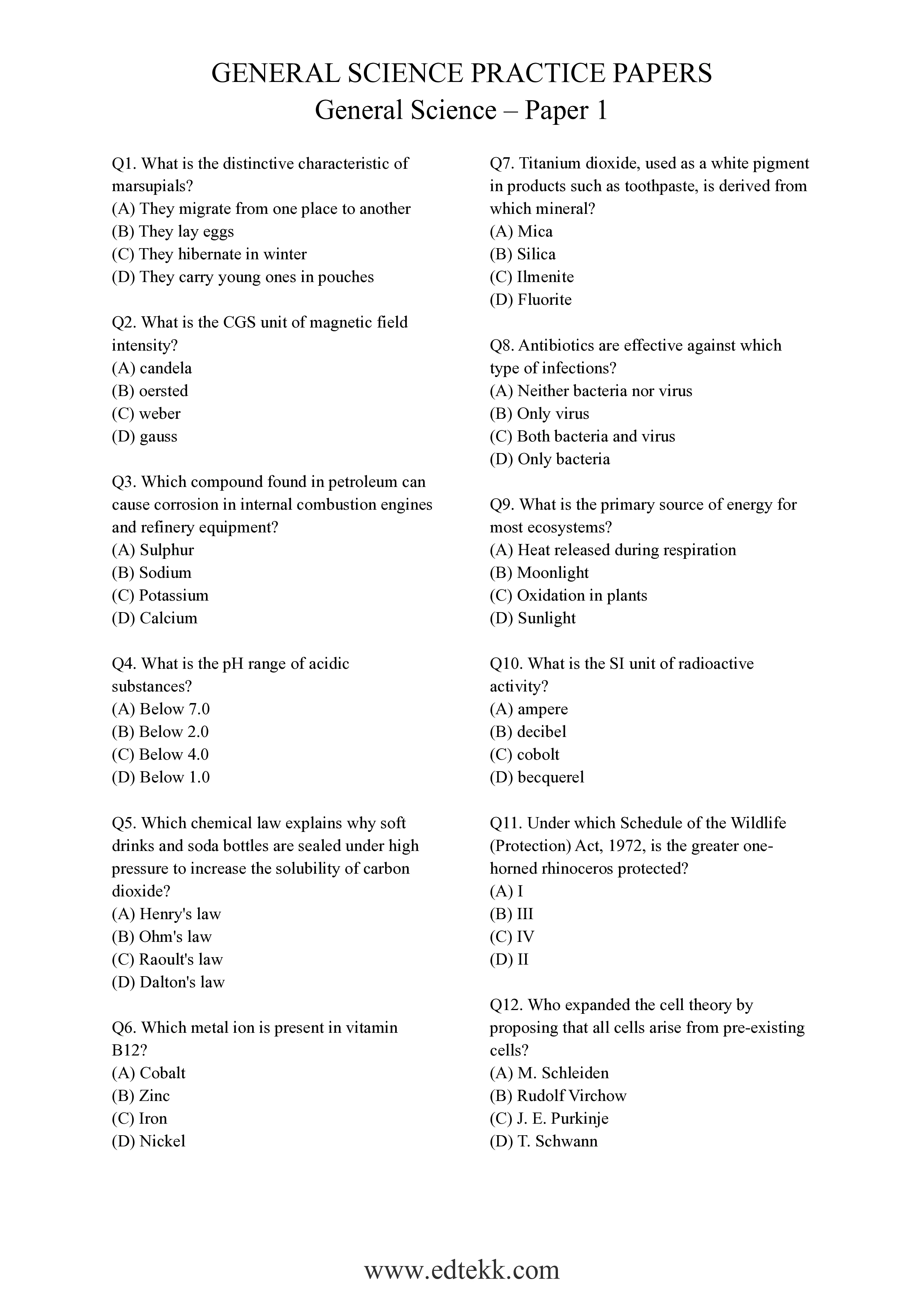
Strengthen your General Science preparation with Practice Paper 1, featuring 20 objective-type questions covering important science concepts. This practice set is useful for SSC, Railway, State PSC, Police Constable and Police SI examinations, with accurate answers and detailed explanations to improve conceptual understanding and exam readiness.
Test Details
Topic: General Science
Total Questions: 20
Question Format: MCQs – Single Correct Answer
Suitable for: SSC exams, Railway exams, State PSC, Police Constable, Police SI
Download All Papers in This Series (PDF)
Questions and Answers
Q1. What is the distinctive characteristic of marsupials?
(A) They migrate from one place to another
(B) They lay eggs
(C) They hibernate in winter
(D) They carry young ones in pouches
Explanation: Marsupials are mammals that generally give birth to relatively underdeveloped young. Their offspring continue developing after birth, usually attached to a teat and often protected inside a pouch called the marsupium. Kangaroos, koalas and wombats are well-known examples of marsupials.
Q2. What is the CGS unit of magnetic field intensity?
(A) candela
(B) oersted
(C) weber
(D) gauss
Explanation: Oersted (Oe) is the CGS unit of magnetic field intensity (magnetic field strength). Gauss (G) is the CGS unit of magnetic flux density, whereas weber (Wb) is the SI unit of magnetic flux. Candela (cd) is the SI base unit of luminous intensity.
Q3. Which compound found in petroleum can cause corrosion in internal combustion engines and refinery equipment?
(A) Sulphur
(B) Sodium
(C) Potassium
(D) Calcium
Explanation: Sulphur compounds present in petroleum can cause corrosion in internal combustion engines, pipelines and refinery equipment. During combustion, sulphur-containing compounds may produce sulphur oxides, which react with moisture to form corrosive acids. Petroleum refining therefore includes desulphurisation processes to reduce sulphur content and minimise corrosion and pollution.
Q4. What is the pH range of acidic substances?
(A) Below 7.0
(B) Below 2.0
(C) Below 4.0
(D) Below 1.0
Explanation: Acidic substances have a pH value below 7 at 25°C. A pH of 7 indicates neutrality, while values above 7 indicate basic or alkaline conditions. Generally, a lower pH indicates greater acidity. The pH of an acid also depends on its concentration and degree of ionisation.
Q5. Which chemical law explains why soft drinks and soda bottles are sealed under high pressure to increase the solubility of carbon dioxide?
(A) Henry’s law
(B) Ohm’s law
(C) Raoult’s law
(D) Dalton’s law
Explanation: Henry’s law states that, at constant temperature, the amount of a gas dissolved in a liquid is directly proportional to the partial pressure of that gas above the liquid. Soft drinks are bottled under high carbon dioxide pressure to increase the quantity of CO₂ dissolved in the beverage.
Q6. Which metal ion is present in vitamin B12?
(A) Cobalt
(B) Zinc
(C) Iron
(D) Nickel
Explanation: Vitamin B12, also known as cobalamin, contains cobalt as its central metal ion. This element forms an essential part of the vitamin’s molecular structure. Vitamin B12 is necessary for normal red blood cell formation, DNA synthesis and proper nervous system functioning.
Q7. Titanium dioxide, used as a white pigment in products such as toothpaste, is derived from which mineral?
(A) Mica
(B) Silica
(C) Ilmenite
(D) Fluorite
Explanation: Ilmenite (FeTiO₃) is an important naturally occurring mineral source of titanium dioxide (TiO₂). Titanium dioxide is widely used as a white pigment because of its high refractive index, brightness and opacity. It is used in paints, plastics, paper, cosmetics and certain toothpaste formulations.
Q8. Antibiotics are effective against which type of infections?
(A) Neither bacteria nor virus
(B) Only virus
(C) Both bacteria and virus
(D) Only bacteria
Explanation: Antibiotics are used to treat bacterial infections by interfering with processes such as bacterial cell-wall synthesis or protein production. They do not directly treat viral infections because viruses have different structures and replication mechanisms. Antibiotics should be used only when medically indicated.
Q9. What is the primary source of energy for most ecosystems?
(A) Heat released during respiration
(B) Moonlight
(C) Oxidation in plants
(D) Sunlight
Explanation: Sunlight is the primary energy source for most ecosystems. Green plants and other photosynthetic organisms capture solar energy and convert it into chemical energy stored in organic compounds. This energy is transferred through different trophic levels via food chains and food webs. However, some ecosystems, such as deep-sea hydrothermal vent ecosystems, depend on chemical energy rather than sunlight.
Q10. What is the SI unit of radioactive activity?
(A) ampere
(B) decibel
(C) cobolt
(D) becquerel
Explanation: The becquerel (Bq) is the SI unit of radioactivity, more precisely called radioactive activity. One becquerel corresponds to one nuclear disintegration per second. The ampere measures electric current, the decibel expresses a logarithmic level, and cobalt is a chemical element.
Q11. Under which Schedule of the Wildlife (Protection) Act, 1972, is the greater one-horned rhinoceros protected?
(A) I
(B) III
(C) IV
(D) II
Explanation: The greater one-horned rhinoceros (Rhinoceros unicornis) is listed under Schedule I of India’s Wildlife (Protection) Act, 1972, as amended. Schedule I provides the highest level of statutory protection to listed wildlife species. Hunting and other prohibited activities involving this species attract stringent legal penalties.
Q12. Who expanded the cell theory by proposing that all cells arise from pre-existing cells?
(A) M. Schleiden
(B) Rudolf Virchow
(C) J. E. Purkinje
(D) T. Schwann
Explanation: Rudolf Virchow expanded the cell theory by proposing that new cells arise from pre-existing cells. This principle is commonly expressed as “Omnis cellula e cellula”. It established that cells do not arise spontaneously but are produced through the division of existing cells.
Q13. Which of the following is NOT a form of cancer?
(A) Sarcoma
(B) Lymphoma
(C) Glaucoma
(D) Carcinoma
Explanation: Glaucoma is an eye disease that damages the optic nerve, often associated with increased intraocular pressure. It is not a form of cancer. In contrast, lymphoma, carcinoma and sarcoma are major categories of cancer. Lymphoma affects lymphatic tissues, carcinoma arises from epithelial cells, and sarcoma develops from connective or supporting tissues.
Q14. Which medical condition involves progressive damage to the optic nerve?
(A) Glaucoma
(B) Dry Eye
(C) Age-related Macular Degeneration (AMD)
(D) Cataract
Explanation: Glaucoma is a group of eye diseases characterised by progressive damage to the optic nerve, often associated with elevated intraocular pressure. However, increased eye pressure is not present in every case. Without appropriate treatment, glaucoma can cause irreversible vision loss, initially affecting peripheral vision and potentially progressing to blindness.
Q15. Which organ is the principal site of food digestion and nutrient absorption?
(A) Small intestine
(B) Stomach
(C) Liver
(D) Colon
Explanation: The small intestine is the principal site of chemical digestion and nutrient absorption in humans. It receives digestive enzymes from the pancreas and bile from the liver, facilitating the digestion of carbohydrates, proteins and fats. Its numerous villi and microvilli provide a large surface area for efficient nutrient absorption.
Q16. What type of motion occurs when an object covers unequal distances in equal intervals of time?
(A) non-uniform
(B) equilibrium
(C) linear
(D) uniform
Explanation: Non-uniform motion occurs when an object covers unequal distances in equal intervals of time or equal distances in unequal intervals of time. In contrast, uniform motion involves covering equal distances in equal intervals of time.
Q17. Which branch of zoology studies amphibians and reptiles?
(A) Morphology
(B) Mammalogy
(C) Herpetology
(D) Ethology
Explanation: Herpetology is the branch of zoology concerned with the scientific study of amphibians and reptiles. It includes the study of frogs, toads, salamanders, snakes and lizards. Ethology deals with animal behaviour, mammalogy focuses on mammals, and morphology examines the form and structure of organisms.
Q18. Which chemical substance causes the cell walls of sclerenchyma tissue to become thickened?
(A) Pectin
(B) Lignin
(C) Cellulose
(D) Hemicellulose
Explanation: Sclerenchyma cells have thick, rigid cell walls primarily due to the deposition of lignin. Lignification provides mechanical strength, rigidity and support to plant parts. Most mature sclerenchyma cells are dead and possess thick secondary walls, making them important in structural support and protection.
Q19. What is heavy water primarily used for?
(A) In both Nuclear reactors and Fire extinguisher
(B) In fire extinguisher
(C) In washing cloth
(D) In nuclear reactors
Explanation: Heavy water (D₂O) is primarily used as a neutron moderator in nuclear reactors. It slows down fast neutrons without absorbing many of them, thereby helping sustain the nuclear fission chain reaction. It is also used as a coolant in certain types of nuclear reactors.
Q20. Which of the following is a heterogeneous mixture?
(A) Solution
(B) Suspension
(C) Both Solution and Suspension
(D) Neither Solution nor Suspension
Explanation: A suspension is a heterogeneous mixture in which relatively large particles are dispersed throughout a medium without dissolving. These particles may settle on standing and can generally be separated by filtration. In contrast, a true solution is a homogeneous mixture in which the solute is uniformly distributed at the molecular or ionic level.
Question Paper Images