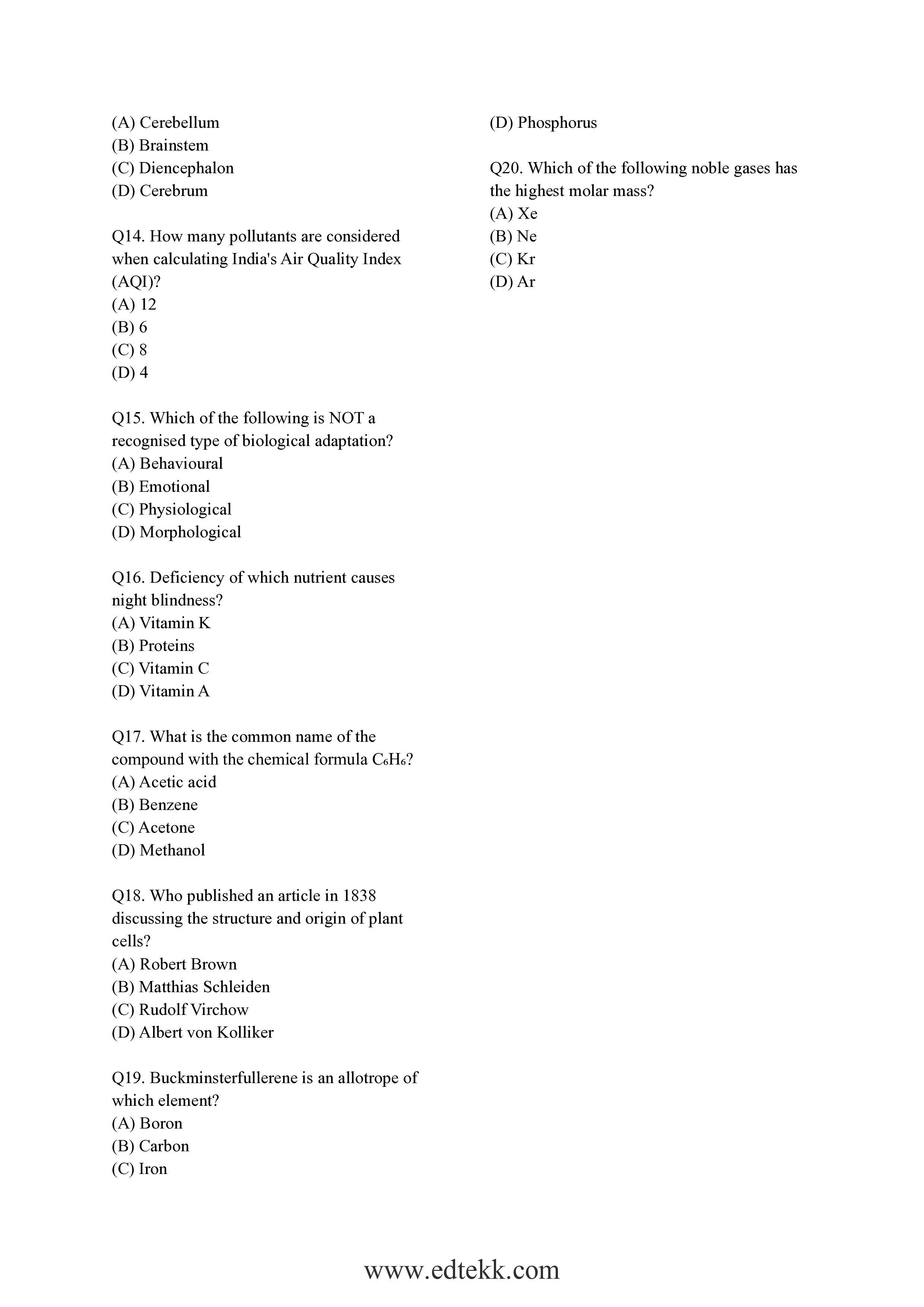
Prepare effectively for competitive examinations with General Science Practice Paper 2, containing 20 objective-type questions on essential science concepts. Designed for SSC, Railway, State PSC, Police Constable and Police SI aspirants, this practice set includes answers and explanations to strengthen subject knowledge and improve accuracy.
Test Details
Topic: General Science
Total Questions: 20
Question Format: MCQs – Single Correct Answer
Suitable for: SSC exams, Railway exams, State PSC, Police Constable, Police SI
Download All Papers in This Series (PDF)
Questions and Answers
Q1. What is formed when a neutral helium atom loses one electron?
(A) Negative helium ion
(B) Alpha particle
(C) Positive helium ion (He⁺)
(D) Proton
Explanation: A neutral helium atom contains two protons and two electrons. When it loses one electron, it forms a singly positively charged helium ion (He⁺), which retains one electron. An alpha particle, by contrast, is a helium-4 nucleus containing two protons and two neutrons but no electrons, with a charge of +2e.
Q2. What are the rhythmic muscle contractions of the alimentary canal that propel food forward called?
(A) Diffusion
(B) Guttation
(C) Peristalsis
(D) Segmentation
Explanation: Peristalsis refers to coordinated, wave-like contractions and relaxations of the smooth muscles lining the alimentary canal. These movements propel food through the digestive tract, moving it along the oesophagus and through the stomach and intestines. Peristalsis is essential for the onward transport of food during digestion.
Q3. What is the SI unit of speed?
(A) km/hr
(B) m/s
(C) m/hr
(D) km/s
Explanation: The SI unit of speed is metre per second (m/s). Speed is defined as the distance travelled per unit time. Although kilometres per hour (km/h) is commonly used in everyday life, it is not the SI unit of speed.
Q4. How many eyes does a typical adult bee have?
(A) Three
(B) Two
(C) Five
(D) Four
Explanation: A typical adult bee has five eyes: two large compound eyes and three small simple eyes called ocelli. The compound eyes help detect movement and form images, while the ocelli primarily detect light intensity and help maintain orientation.
Q5. What is the power of time (second) in the SI unit of acceleration?
(A) 1
(B) 0
(C) -1
(D) -2
Explanation: Acceleration is the rate of change of velocity with respect to time. Its SI unit is metre per second squared (m/s²), which can be expressed as (LT^{-2}). Therefore, the power of the second in the SI unit of acceleration is −2.
Q6. Solanum lycopersicum L. is the scientific name of which commonly consumed vegetable?
(A) Potato
(B) Tomato
(C) Onion
(D) Garlic
Explanation: Solanum lycopersicum L. is the scientific name of tomato, which belongs to the family Solanaceae. Although commonly used as a vegetable in cooking, tomato is botanically classified as a fruit because it develops from the ovary of a flower and contains seeds.
Q7. What is the colour of the light emitted by the Sun?
(A) White
(B) Yellow
(C) Red
(D) Orange
Explanation: The Sun emits light across a broad range of visible wavelengths, and their combination is perceived as white. From space, the Sun appears white. From Earth’s surface, atmospheric scattering can make it appear yellow, orange or red, particularly near the horizon. Therefore, white is the most appropriate answer.
Q8. Under what condition must charge transfer occur to obtain maximum electrical work from a galvanic cell?
(A) reversibly
(B) proportionately
(C) Inversely
(D) uniformly
Explanation: A galvanic cell delivers maximum useful electrical work when the charge is transferred reversibly. Reversible operation involves an infinitesimally small potential difference between the cell and the external circuit, minimising irreversible energy losses. Thus, reversible charge transfer is necessary to obtain maximum electrical work.
Q9. What are the embryonic seed leaves of angiosperms called?
(A) Cotyledon
(B) Spore
(C) Buds
(D) Sprout
Explanation: Cotyledons are embryonic seed leaves present in angiosperm embryos. Monocotyledonous plants possess one cotyledon, whereas dicotyledonous plants generally possess two. Cotyledons may store food or absorb and transfer nutrients from stored food reserves to the developing embryo.
Q10. In which year did Ernst Haeckel introduce ecology as a distinct field of study?
(A) 1880
(B) 1890
(C) 1866
(D) 1845
Explanation: Ernst Haeckel, a German zoologist, introduced the term ecology in 1866. He used it to describe the study of relationships between organisms and their surrounding environment. The term originates from the Greek words oikos (house or dwelling) and logos (study).
Q11. What type of motion does a freely falling body near Earth’s surface exhibit when air resistance is neglected?
(A) Zero acceleration
(B) Uniform acceleration
(C) Variable acceleration
(D) Non-uniform acceleration
Explanation: A freely falling body near Earth’s surface experiences approximately constant gravitational acceleration when air resistance is neglected and the distance travelled is relatively small. This acceleration is approximately 9.8 m/s², directed vertically downward. Hence, its motion is an example of uniformly accelerated motion.
Q12. According to the impulse–momentum theorem, which physical quantity changes when a force acts over a period of time?
(A) acceleration
(B) torque
(C) velocity
(D) momentum
Explanation: According to the impulse-momentum theorem, the impulse of the net force acting on a body equals the change in its momentum. Mathematically, (J=Delta p). For a constant net force, (FDelta t=Delta p), where (F) is the net force and (Delta t) is the time interval.
Q13. Which part of the brain controls posture, balance and equilibrium?
(A) Cerebellum
(B) Brainstem
(C) Diencephalon
(D) Cerebrum
Explanation: The cerebellum coordinates voluntary movements and plays a central role in maintaining posture, balance and equilibrium. It integrates information from the vestibular system, sensory receptors and other parts of the nervous system to produce smooth, coordinated movements. Damage to the cerebellum can cause impaired balance, uncoordinated movements and an unsteady gait.
Q14. How many pollutants are considered when calculating India’s Air Quality Index (AQI)?
(A) 12
(B) 6
(C) 8
(D) 4
Explanation: India’s National Air Quality Index (NAQI) considers eight pollutants: particulate matter (PM10 and PM2.5), nitrogen dioxide (NO2), sulphur dioxide (SO2), carbon monoxide (CO), ozone (O3), ammonia (NH3) and lead (Pb). Their concentrations are monitored to assess ambient air quality and communicate associated health risks.
Q15. Which of the following is NOT a recognised type of biological adaptation?
(A) Behavioural
(B) Emotional
(C) Physiological
(D) Morphological
Explanation: Biological adaptations are generally classified into three principal categories: morphological (structural), physiological (functional) and behavioural adaptations. These adaptations involve changes in body structure, internal functioning and behaviour, respectively, that improve an organism’s survival and reproductive success. Emotional adaptation is not recognised as a principal category of biological adaptation.
Q16. Deficiency of which nutrient causes night blindness?
(A) Vitamin K
(B) Proteins
(C) Vitamin C
(D) Vitamin A
Explanation: Vitamin A deficiency can cause night blindness, a condition characterised by difficulty seeing in dim light or darkness. Vitamin A is required for the formation of retinal, a component of rhodopsin, the light-sensitive pigment present in the rod cells of the retina. Prolonged deficiency can cause corneal damage and permanent blindness.
Q17. What is the common name of the compound with the chemical formula C₆H₆?
(A) Acetic acid
(B) Benzene
(C) Acetone
(D) Methanol
Explanation: Benzene is the common name of the compound with the molecular formula C₆H₆. It is an aromatic hydrocarbon consisting of a six-carbon ring with delocalised pi electrons. Benzene is an important industrial chemical used in the manufacture of plastics, synthetic fibres, detergents and other chemical products.
Q18. Who published an article in 1838 discussing the structure and origin of plant cells?
(A) Robert Brown
(B) Matthias Schleiden
(C) Rudolf Virchow
(D) Albert von Kolliker
Explanation: Matthias Schleiden, a German botanist, published his work on plant cells in 1838. He proposed that plants are composed of cells and that the cell is the basic structural unit of plant life. His work, together with Theodor Schwann’s subsequent studies on animals, contributed to the development of cell theory.
Q19. Buckminsterfullerene is an allotrope of which element?
(A) Boron
(B) Carbon
(C) Iron
(D) Phosphorus
Explanation: Buckminsterfullerene (C₆₀) is an allotrope of carbon belonging to the fullerene family. It consists of 60 carbon atoms arranged in a hollow spherical structure resembling a football, with 12 pentagonal and 20 hexagonal rings.
Q20. Which of the following noble gases has the highest molar mass?
(A) Xe
(B) Ne
(C) Kr
(D) Ar
Explanation: Xenon (Xe) has the highest molar mass among the four given noble gases, with a standard atomic mass of approximately 131.29 u. Krypton has an atomic mass of approximately 83.80 u, argon 39.95 u and neon 20.18 u.
Question Paper Images