Test your science knowledge with General Science Practice Paper 3, featuring 20 objective-type questions covering fundamental concepts. This question set supports preparation for SSC, Railway, State PSC, Police Constable and Police SI examinations, providing answers and explanations for effective revision, better accuracy and competitive-exam practice.
Test Details
Topic: General Science
Total Questions: 20
Question Format: MCQs – Single Correct Answer
Suitable for: SSC exams, Railway exams, State PSC, Police Constable, Police SI
Download All Papers in This Series (PDF)
Questions and Answers
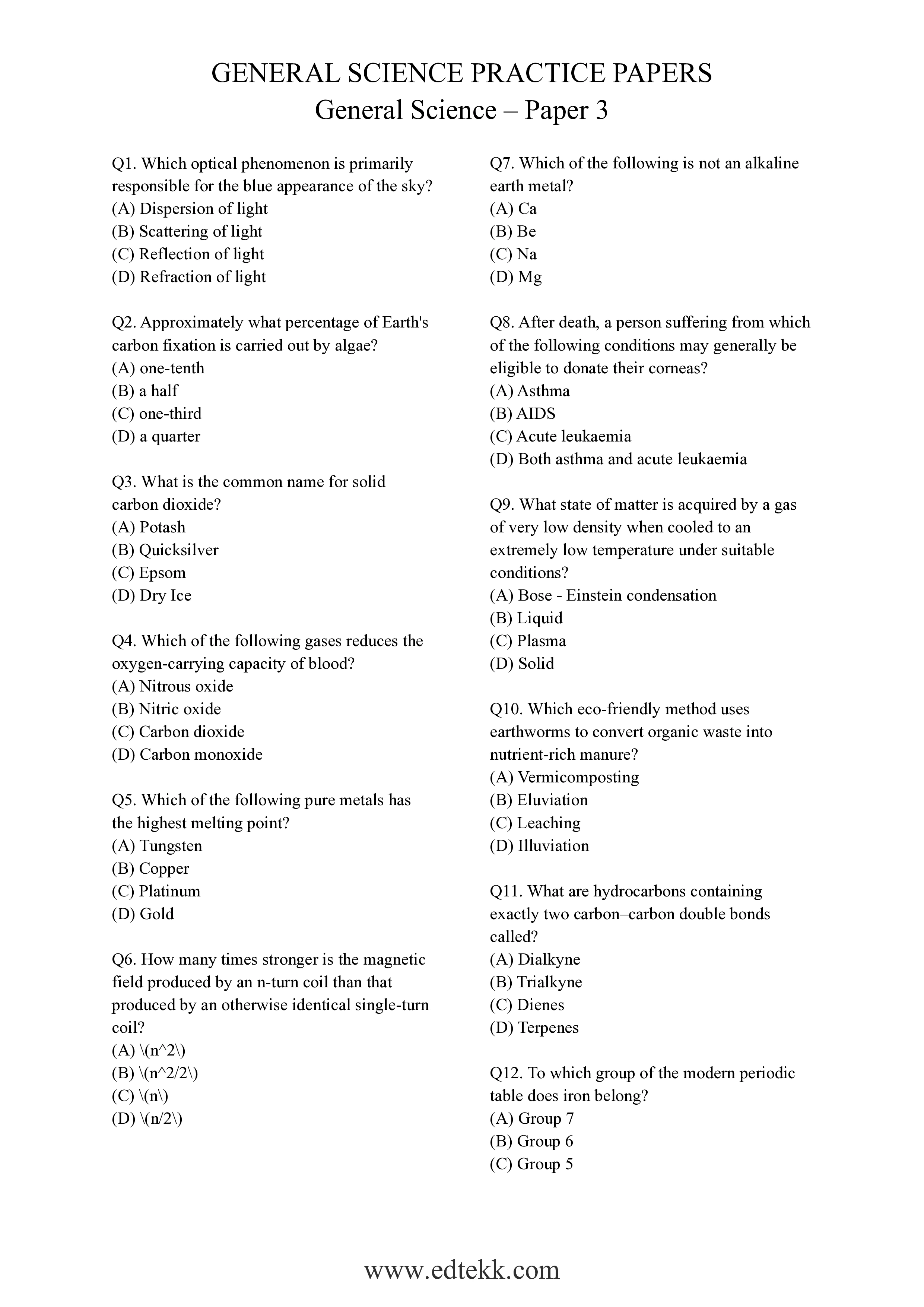
Q1. Which optical phenomenon is primarily responsible for the blue appearance of the sky?
(A) Dispersion of light
(B) Scattering of light
(C) Reflection of light
(D) Refraction of light
Explanation: The sky appears blue primarily because of Rayleigh scattering of sunlight by molecules in the atmosphere. Shorter visible wavelengths are scattered more strongly than longer wavelengths. Although violet light scatters even more strongly than blue light, the solar spectrum and the sensitivity of human vision contribute to the sky appearing blue.
Q2. Approximately what percentage of Earth’s carbon fixation is carried out by algae?
(A) one-tenth
(B) a half
(C) one-third
(D) a quarter
Explanation: Algae, particularly microscopic marine phytoplankton, play a major role in global photosynthesis and carbon fixation. They account for approximately half of the Earth’s photosynthetic carbon fixation. By utilising dissolved carbon dioxide during photosynthesis, they contribute significantly to the global carbon cycle.
Q3. What is the common name for solid carbon dioxide?
(A) Potash
(B) Quicksilver
(C) Epsom
(D) Dry Ice
Explanation: Solid carbon dioxide is commonly known as dry ice. Unlike ordinary ice, dry ice undergoes sublimation under normal atmospheric pressure, changing directly from a solid into a gas. It is widely used for refrigeration, food transportation and other cooling applications.
Q4. Which of the following gases reduces the oxygen-carrying capacity of blood?
(A) Nitrous oxide
(B) Nitric oxide
(C) Carbon dioxide
(D) Carbon monoxide
Explanation: Carbon monoxide reduces the oxygen-carrying capacity of blood by binding to haemoglobin with an affinity approximately 200–250 times greater than that of oxygen. This forms carboxyhaemoglobin, reducing oxygen transport and impairing oxygen release to tissues. Severe carbon monoxide poisoning can cause tissue hypoxia, unconsciousness and death.
Q5. Which of the following pure metals has the highest melting point?
(A) Tungsten
(B) Copper
(C) Platinum
(D) Gold
Explanation: Tungsten has the highest melting point among the listed metals, approximately 3,422°C. Its exceptionally high melting point makes it suitable for applications involving extreme temperatures. It was historically used in incandescent light-bulb filaments because it can withstand very high temperatures without melting.
Q6. How many times stronger is the magnetic field produced by an n-turn coil than that produced by an otherwise identical single-turn coil?
(A) (n^2)
(B) (n^2/2)
(C) (n)
(D) (n/2)
Explanation: The magnetic field at the centre of a circular coil is directly proportional to its number of turns, provided the current and radius remain constant. Therefore, an n-turn circular coil produces a magnetic field n times that of an otherwise identical single-turn coil carrying the same current.
Q7. Which of the following is not an alkaline earth metal?
(A) Ca
(B) Be
(C) Na
(D) Mg
Explanation: Sodium (Na) is not an alkaline earth metal; it is an alkali metal belonging to Group 1 of the periodic table. Magnesium (Mg), calcium (Ca) and beryllium (Be) are alkaline earth metals belonging to Group 2.
Q8. After death, a person suffering from which of the following conditions may generally be eligible to donate their corneas?
(A) Asthma
(B) AIDS
(C) Acute leukaemia
(D) Both asthma and acute leukaemia
Explanation: Asthma generally does not prevent cornea donation after death because it does not ordinarily compromise corneal tissue suitability. However, HIV/AIDS and certain malignancies, including acute leukaemia, may exclude a donor under applicable screening criteria. Final eligibility depends on medical history, tissue assessment and the eye bank’s protocols.
Q9. What state of matter is acquired by a gas of very low density when cooled to an extremely low temperature under suitable conditions?
(A) Bose – Einstein condensation
(B) Liquid
(C) Plasma
(D) Solid
Explanation: At sufficiently low temperatures and under suitable conditions, a dilute gas of bosonic particles can undergo Bose–Einstein condensation. In this state, a macroscopic number of particles occupy the same lowest-energy quantum state. Low temperature and low density alone are not sufficient; appropriate quantum and thermodynamic conditions are necessary.
Q10. Which eco-friendly method uses earthworms to convert organic waste into nutrient-rich manure?
(A) Vermicomposting
(B) Eluviation
(C) Leaching
(D) Illuviation
Explanation: Vermicomposting is an environmentally friendly method of converting organic waste into nutrient-rich manure using earthworms and microorganisms. It can process biodegradable household, agricultural and garden waste. The resulting vermicompost improves soil structure, fertility and water-retention capacity.
Q11. What are hydrocarbons containing exactly two carbon–carbon double bonds called?
(A) Dialkyne
(B) Trialkyne
(C) Dienes
(D) Terpenes
Explanation: Dienes are hydrocarbons containing two carbon–carbon double bonds (C=C). Depending on the arrangement of these bonds, they are classified as conjugated, isolated or cumulated dienes. Dialkynes, in contrast, contain two carbon–carbon triple bonds.
Q12. To which group of the modern periodic table does iron belong?
(A) Group 7
(B) Group 6
(C) Group 5
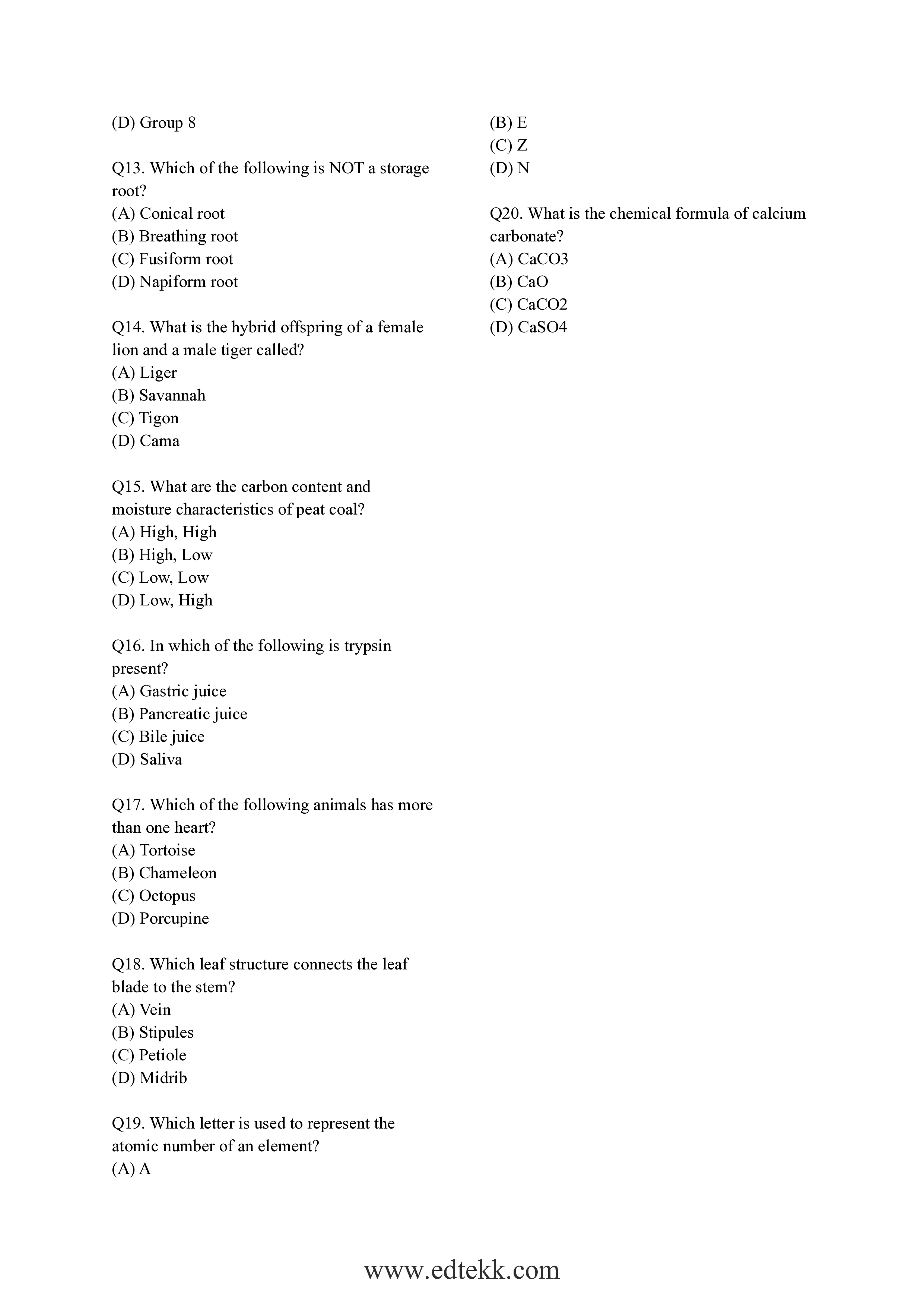
(D) Group 8
Explanation: Iron (Fe), with atomic number 26, belongs to Group 8 and Period 4 of the modern periodic table. It is a transition metal with the electronic configuration [Ar] 3d⁶ 4s².
Q13. Which of the following is NOT a storage root?
(A) Conical root
(B) Breathing root
(C) Fusiform root
(D) Napiform root
Explanation: Breathing roots, or pneumatophores, are specialised roots that grow upward from waterlogged, oxygen-deficient soil and facilitate gaseous exchange through lenticels. They occur in certain mangroves, such as Avicennia. Napiform, conical and fusiform roots are storage modifications of taproots. Therefore, breathing roots are not storage roots.
Q14. What is the hybrid offspring of a female lion and a male tiger called?
(A) Liger
(B) Savannah
(C) Tigon
(D) Cama
Explanation: A tigon is the hybrid offspring of a female lion and a male tiger. It may exhibit physical characteristics of both parent species. A tigon is different from a liger, which results from the mating of a male lion and a female tiger.
Q15. What are the carbon content and moisture characteristics of peat coal?
(A) High, High
(B) High, Low
(C) Low, Low
(D) Low, High
Explanation: Peat is the earliest stage of coal formation and contains a relatively low percentage of carbon compared with more mature coal varieties. It has a high moisture content and relatively low calorific value. With increasing burial, pressure and temperature, peat gradually transforms into lignite and higher grades of coal.
Q16. In which of the following is trypsin present?
(A) Gastric juice
(B) Pancreatic juice
(C) Bile juice
(D) Saliva
Explanation: Trypsin is a protein-digesting enzyme produced by the pancreas and released into pancreatic juice in its inactive form, trypsinogen. In the small intestine, trypsinogen is activated by enteropeptidase, and active trypsin helps digest proteins into smaller peptides. Trypsin functions optimally in the alkaline environment of the small intestine.
Q17. Which of the following animals has more than one heart?
(A) Tortoise
(B) Chameleon
(C) Octopus
(D) Porcupine
Explanation: An octopus possesses three hearts: two branchial hearts that pump blood through the gills and one systemic heart that circulates oxygenated blood throughout the body. Porcupines, chameleons and tortoises each possess a single heart. This three-heart arrangement is characteristic of octopuses and other cephalopods.
Q18. Which leaf structure connects the leaf blade to the stem?
(A) Vein
(B) Stipules
(C) Petiole
(D) Midrib
Explanation: The petiole is the stalk-like structure that connects the leaf blade (lamina) to the stem. It supports the leaf and provides a passage for vascular tissues that transport water, minerals and manufactured food. Some leaves are sessile and lack a petiole.
Q19. Which letter is used to represent the atomic number of an element?
(A) A
(B) E
(C) Z
(D) N
Explanation: The atomic number of an element is represented by the symbol Z. It equals the number of protons present in an atom’s nucleus and determines the identity of the element. In an electrically neutral atom, the number of electrons equals the atomic number. However, this equality does not hold for ions.
Q20. What is the chemical formula of calcium carbonate?
(A) CaCO3
(B) CaO
(C) CaCO2
(D) CaSO4
Explanation: Calcium carbonate has the chemical formula CaCO₃. It is the principal constituent of limestone, chalk and marble and is also found in materials such as eggshells and seashells.
Question Paper Images