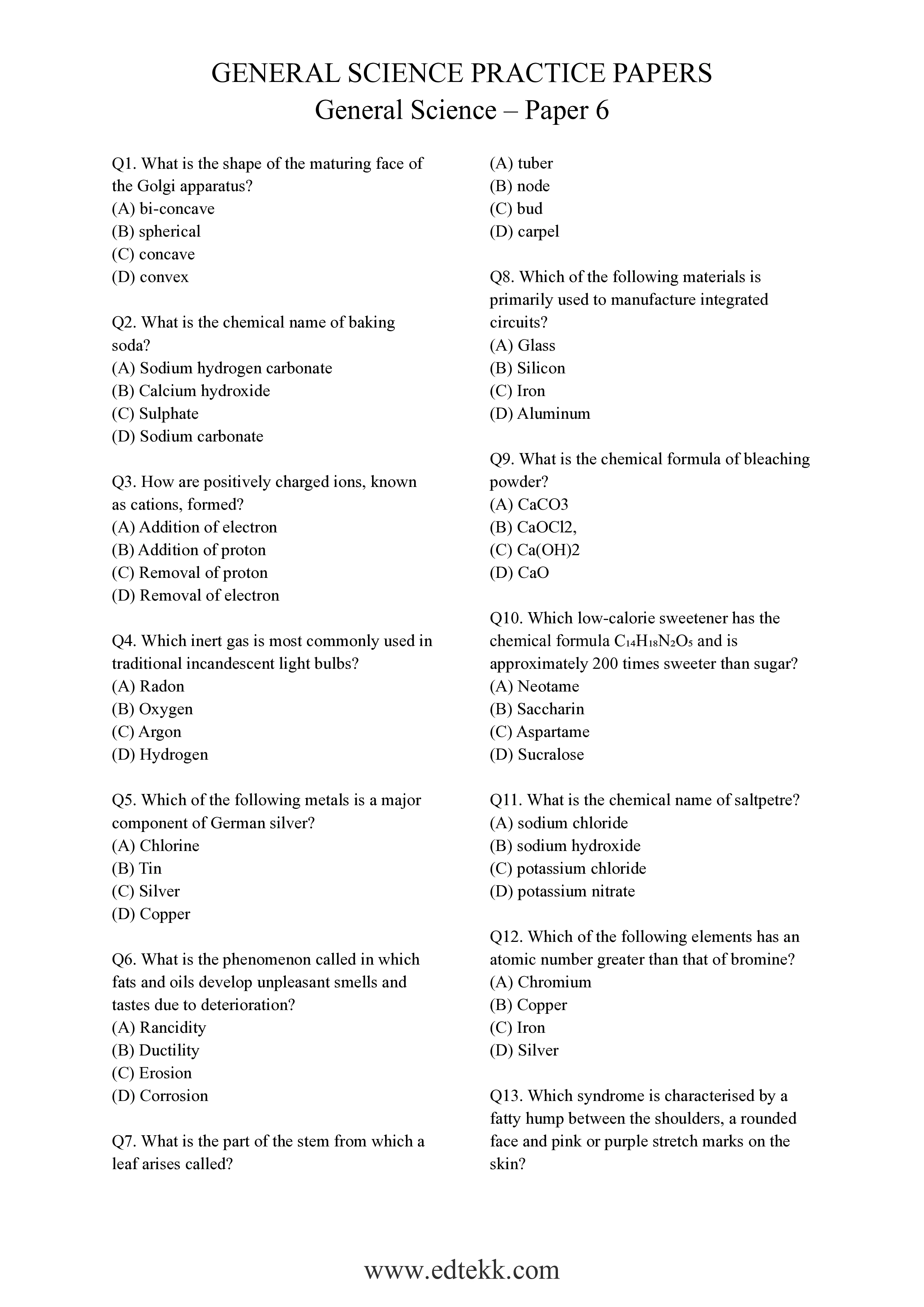
General Science Practice Paper 6 offers 20 objective-type questions to help candidates strengthen their understanding of important scientific concepts. Designed for SSC, Railway, State PSC, Police Constable and Police SI examinations, this practice set includes answers and explanations for systematic revision and improved exam preparation.
Test Details
Topic: General Science
Total Questions: 20
Question Format: MCQs – Single Correct Answer
Suitable for: SSC exams, Railway exams, State PSC, Police Constable, Police SI
Download All Papers in This Series (PDF)
Questions and Answers
Q1. What is the shape of the maturing face of the Golgi apparatus?
(A) bi-concave
(B) spherical
(C) concave
(D) convex
Explanation: The maturing face of the Golgi apparatus is generally convex in shape and is also called the trans face. It is usually directed towards the plasma membrane and is involved in sorting and packaging processed materials into vesicles for transport. The forming face, or cis face, is generally concave.
Q2. What is the chemical name of baking soda?
(A) Sodium hydrogen carbonate
(B) Calcium hydroxide
(C) Sulphate
(D) Sodium carbonate
Explanation: Baking soda is the common name for sodium hydrogen carbonate, also known as sodium bicarbonate. Its chemical formula is NaHCO₃. It is a mildly alkaline compound used as a leavening agent in baking. It releases carbon dioxide when heated or when it reacts with acids.
Q3. How are positively charged ions, known as cations, formed?
(A) Addition of electron
(B) Addition of proton
(C) Removal of proton
(D) Removal of electron
Explanation: Cations are positively charged ions commonly formed when neutral atoms lose one or more electrons. Electron loss leaves the species with more protons than electrons, producing a net positive charge. For example, sodium forms Na⁺ by losing one electron: Na → Na⁺ + e⁻. Electron gain generally produces anions.
Q4. Which inert gas is most commonly used in traditional incandescent light bulbs?
(A) Radon
(B) Oxygen
(C) Argon
(D) Hydrogen
Explanation: Argon is the inert gas most commonly used in traditional incandescent light bulbs. As a noble gas, it is chemically unreactive and helps protect the hot tungsten filament from oxidation while reducing its evaporation rate. This increases the operating life of the bulb.
Q5. Which of the following metals is a major component of German silver?
(A) Chlorine
(B) Tin
(C) Silver
(D) Copper
Explanation: German silver, also known as nickel silver, is an alloy primarily composed of copper, nickel and zinc. Despite its name, it does not contain actual silver. Copper is generally its major constituent, while nickel and zinc contribute to its strength, corrosion resistance and silvery appearance.
Q6. What is the phenomenon called in which fats and oils develop unpleasant smells and tastes due to deterioration?
(A) Rancidity
(B) Ductility
(C) Erosion
(D) Corrosion
Explanation: Rancidity is the deterioration of fats and oils that produces unpleasant smells and tastes. It commonly occurs through oxidation or hydrolysis, particularly when food containing fats is exposed to air, moisture, heat or light. Storing food in airtight containers and protecting it from excessive heat and light helps prevent rancidity.
Q7. What is the part of the stem from which a leaf arises called?
(A) tuber
(B) node
(C) bud
(D) carpel
Explanation: A node is the point on a plant stem from which leaves, branches or buds arise. The portion of the stem between two successive nodes is called an internode. Nodes are important locations for the development of new shoots and leaves.
Q8. Which of the following materials is primarily used to manufacture integrated circuits?
(A) Glass
(B) Silicon
(C) Iron
(D) Aluminum
Explanation: Silicon is the primary semiconductor material used in manufacturing integrated circuits. Its electrical conductivity can be controlled through doping and other fabrication techniques. Transistors, diodes and other electronic components are fabricated on a silicon substrate to form integrated circuits.
Q9. What is the chemical formula of bleaching powder?
(A) CaCO3
(B) CaOCl2,
(C) Ca(OH)2
(D) CaO
Explanation: Bleaching powder is conventionally represented by the chemical formula CaOCl₂ and is commonly known as calcium oxychloride. It is prepared by passing chlorine gas over dry slaked lime [Ca(OH)₂]. It is widely used for bleaching textiles and paper and for disinfecting drinking water.
Q10. Which low-calorie sweetener has the chemical formula C₁₄H₁₈N₂O₅ and is approximately 200 times sweeter than sugar?
(A) Neotame
(B) Saccharin
(C) Aspartame
(D) Sucralose
Explanation: Aspartame has the molecular formula C₁₄H₁₈N₂O₅ and is an artificial low-calorie sweetener approximately 200 times sweeter than sucrose. It is used in various sugar-free and reduced-calorie food products. Due to its high sweetness, only a small quantity is required compared with ordinary sugar.
Q11. What is the chemical name of saltpetre?
(A) sodium chloride
(B) sodium hydroxide
(C) potassium chloride
(D) potassium nitrate
Explanation: Saltpetre, also spelled saltpeter, is the common name for potassium nitrate (KNO₃). It is used in fertilisers and in the manufacture of explosives. Sodium chloride, in contrast, is commonly known as common salt.
Q12. Which of the following elements has an atomic number greater than that of bromine?
(A) Chromium
(B) Copper
(C) Iron
(D) Silver
Explanation: Silver has atomic number 47, which is greater than bromine’s atomic number of 35. Copper has atomic number 29, iron 26 and chromium 24. Atomic number is determined by the number of protons present in an atom’s nucleus.
Q13. Which syndrome is characterised by a fatty hump between the shoulders, a rounded face and pink or purple stretch marks on the skin?
(A) Down syndrome
(B) Marfan syndrome
(C) Angelman syndrome
(D) Cushing syndrome
Explanation: Cushing syndrome results from prolonged exposure to excessive cortisol. Its characteristic features include a rounded face (moon face), fat accumulation between the shoulders (buffalo hump) and pink or purple stretch marks (striae). Other symptoms may include weight gain, muscle weakness and high blood pressure.
Q14. What is the general formula of alkenes?
(A) CnH6n
(B) CnH3n
(C) CnH4n
(D) CnH2n
Explanation: The general molecular formula of open-chain alkenes containing one carbon–carbon double bond is CₙH₂ₙ, where n is at least 2. Alkenes are unsaturated hydrocarbons. For example, ethene (C₂H₄) and propene (C₃H₆) follow this formula. Cyclic alkenes and compounds with multiple double bonds have different general formulas.
Q15. What is the SI unit of luminous intensity?
(A) Ampere
(B) Candela
(C) Kelvin
(D) Mole
Explanation: The candela (cd) is the SI base unit of luminous intensity, which measures the intensity of light emitted in a particular direction. The mole measures the amount of substance, the ampere measures electric current, and the kelvin measures thermodynamic temperature.
Q16. What is the upward buoyant force exerted by a fluid on an object called?
(A) moment
(B) upthrust
(C) pressure
(D) torque
Explanation: An object immersed wholly or partially in a fluid experiences an upward force called upthrust or buoyant force. According to Archimedes’ principle, the magnitude of this force equals the weight of the fluid displaced by the object.
Q17. How many chambers are present in a crocodile’s heart?
(A) three
(B) five
(C) two
(D) four
Explanation: Crocodiles possess a four-chambered heart consisting of two atria and two ventricles. This distinguishes them from most other reptiles, which generally have a three-chambered heart. Crocodiles also possess specialised circulatory adaptations, including the ability to redirect blood through alternative pathways under particular physiological conditions.
Q18. Which of the following substances are present in a chromosome?
(A) RNA and sugar
(B) DNA and lipid
(C) RNA and amino acid
(D) DNA and protein
Explanation: Chromosomes consist primarily of DNA and proteins, particularly histones. DNA stores genetic information, while histone and other associated proteins help package and organise it into a compact structure. Although RNA may also be associated with chromosomes, DNA and proteins are their principal components.
Q19. Which of the following substances can be classified as a solution?
(A) Salt
(B) Sea Water
(C) Diamond
(D) Coal
Explanation: Sea water is considered a solution because it contains dissolved salts, primarily sodium chloride, uniformly distributed in water. It is a homogeneous mixture of dissolved substances. Diamond is a pure form of carbon, coal is a heterogeneous material, and ordinary solid salt is a chemical compound rather than a solution.
Q20. Which physical quantity is represented by the slope of a distance–time graph?
(A) mass
(B) acceleration
(C) momentum
(D) speed
Explanation: The slope of a distance–time graph represents speed. It is calculated as the change in distance divided by the corresponding time interval. A steeper slope indicates greater speed, while a horizontal line indicates that the object is at rest.
Question Paper Images