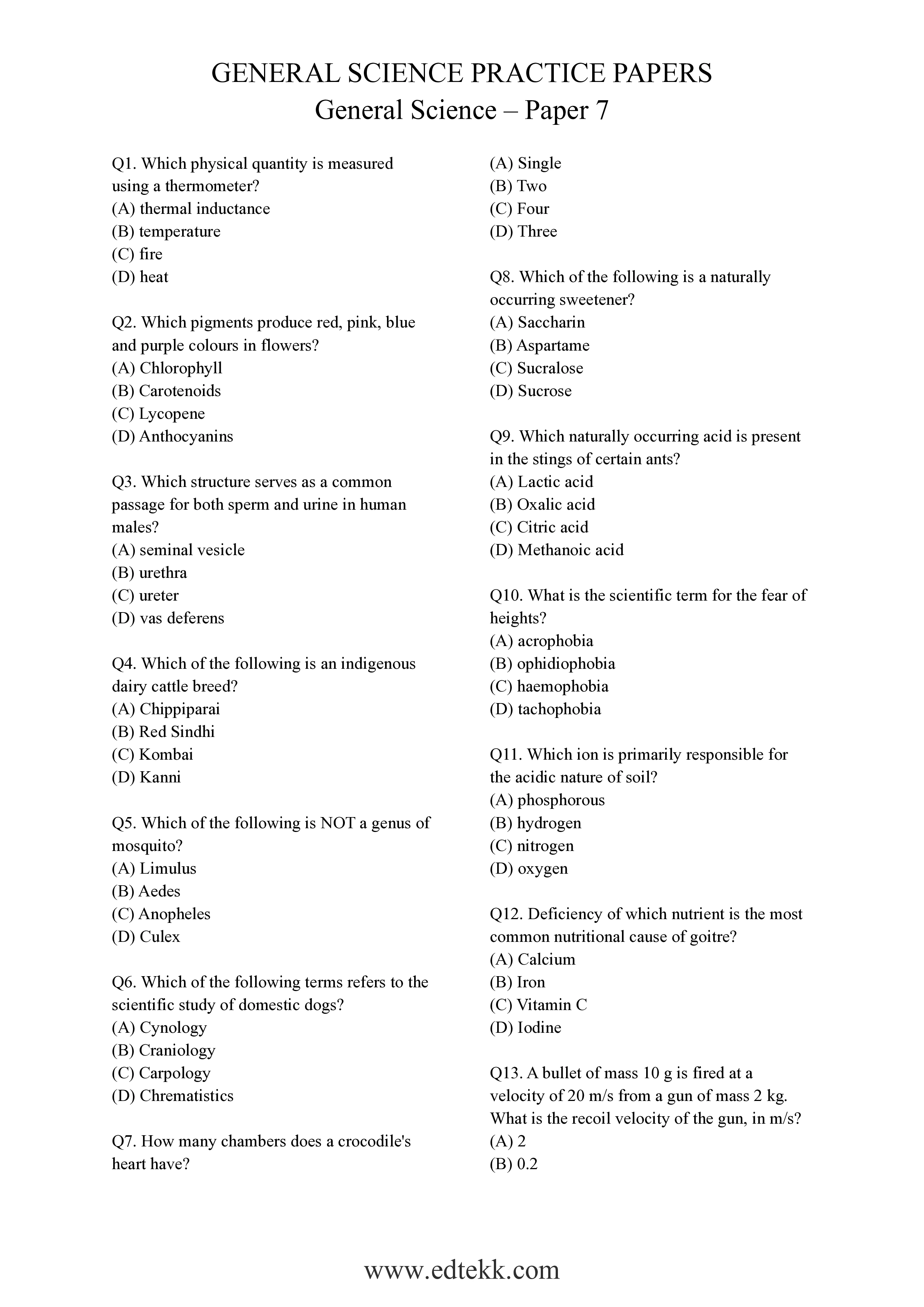
Assess your General Science knowledge with Practice Paper 7, comprising 20 multiple-choice questions on essential scientific concepts. This practice set is relevant for SSC, Railway, State PSC, Police Constable and Police SI aspirants. Detailed answers and explanations support concept revision, self-assessment and effective competitive-exam preparation.
Test Details
Topic: General Science
Total Questions: 20
Question Format: MCQs – Single Correct Answer
Suitable for: SSC exams, Railway exams, State PSC, Police Constable, Police SI
Download All Papers in This Series (PDF)
Questions and Answers
Q1. Which physical quantity is measured using a thermometer?
(A) thermal inductance
(B) temperature
(C) fire
(D) heat
Explanation: A thermometer is an instrument used to measure temperature, which indicates the degree of hotness or coldness of a body. Heat is energy transferred between bodies due to a temperature difference, whereas temperature is a measurable physical quantity.
Q2. Which pigments produce red, pink, blue and purple colours in flowers?
(A) Chlorophyll
(B) Carotenoids
(C) Lycopene
(D) Anthocyanins
Explanation: Anthocyanins are water-soluble pigments responsible for many red, pink, blue and purple colours in flowers. Their colour can vary depending on cellular pH, pigment concentration and interactions with metal ions and other compounds.
Q3. Which structure serves as a common passage for both sperm and urine in human males?
(A) seminal vesicle
(B) urethra
(C) ureter
(D) vas deferens
Explanation: The urethra is the common passage through which both urine and semen are discharged from the male body, although they do not normally pass simultaneously. Urine enters the urethra from the urinary bladder, while semen enters it through the ejaculatory ducts during ejaculation.
Q4. Which of the following is an indigenous dairy cattle breed?
(A) Chippiparai
(B) Red Sindhi
(C) Kombai
(D) Kanni
Explanation: Red Sindhi is an indigenous Indian dairy cattle breed originating from the Sindh region of the Indian subcontinent. It is valued for its heat tolerance, disease resistance and milk production. Chippiparai, Kanni and Kombai are indigenous Indian dog breeds rather than cattle breeds.
Q5. Which of the following is NOT a genus of mosquito?
(A) Limulus
(B) Aedes
(C) Anopheles
(D) Culex
Explanation: Limulus, commonly known as the horseshoe crab, belongs to the group Chelicerata and is not a mosquito. Culex, Aedes and Anopheles are mosquito genera, several species of which are vectors of diseases affecting humans.
Q6. Which of the following terms refers to the scientific study of domestic dogs?
(A) Cynology
(B) Craniology
(C) Carpology
(D) Chrematistics
Explanation: Cynology refers to the scientific study of domestic dogs, including their behaviour, genetics, anatomy, breeding and development. Craniology deals with the study of skulls, carpology concerns fruits and seeds, while chrematistics relates to the study of wealth and economic transactions.
Q7. How many chambers does a crocodile’s heart have?
(A) Single
(B) Two
(C) Four
(D) Three
Explanation: Crocodiles possess a four-chambered heart consisting of two atria and two ventricles. Unlike most reptiles, which generally have a three-chambered heart, crocodilians have complete separation between the right and left ventricles. However, specialised blood vessels permit controlled blood shunting under certain physiological conditions.
Q8. Which of the following is a naturally occurring sweetener?
(A) Saccharin
(B) Aspartame
(C) Sucralose
(D) Sucrose
Explanation: Sucrose is a naturally occurring disaccharide commonly known as table sugar. It is found naturally in sugarcane, sugar beet and several fruits. Aspartame, sucralose and saccharin are artificial sweeteners. Although sucrose is a natural sweetener, excessive consumption can contribute to obesity, dental caries and metabolic disorders.
Q9. Which naturally occurring acid is present in the stings of certain ants?
(A) Lactic acid
(B) Oxalic acid
(C) Citric acid
(D) Methanoic acid
Explanation: Methanoic acid, commonly known as formic acid, is naturally present in the venom of many ant species. It is responsible for the characteristic irritating sensation associated with certain ant stings. Its chemical formula is HCOOH. However, not all ant species use formic acid as their primary defensive chemical.
Q10. What is the scientific term for the fear of heights?
(A) acrophobia
(B) ophidiophobia
(C) haemophobia
(D) tachophobia
Explanation: Acrophobia is an excessive or irrational fear of heights. It is classified as a specific phobia and may cause anxiety, dizziness or panic when a person is exposed to elevated places. Ophidiophobia refers to the fear of snakes, haemophobia to the fear of blood and tachophobia to the fear of speed.
Q11. Which ion is primarily responsible for the acidic nature of soil?
(A) phosphorous
(B) hydrogen
(C) nitrogen
(D) oxygen
Explanation: Acidic soil is characterised by a relatively high concentration of hydrogen ions (H⁺), resulting in a pH below 7. As hydrogen ion activity increases, soil pH decreases and acidity increases. Soil pH influences nutrient availability and plant growth.
Q12. Deficiency of which nutrient is the most common nutritional cause of goitre?
(A) Calcium
(B) Iron
(C) Vitamin C
(D) Iodine
Explanation: Iodine deficiency is the most common nutritional cause of goitre worldwide. Iodine is essential for the production of thyroid hormones. Insufficient iodine intake can reduce thyroid hormone production and stimulate the thyroid gland to enlarge. However, goitre can also result from autoimmune disorders and other thyroid conditions.
Q13. A bullet of mass 10 g is fired at a velocity of 20 m/s from a gun of mass 2 kg. What is the recoil velocity of the gun, in m/s?
(A) 2
(B) 0.2
(C) 0.1
(D) 1
Explanation: According to the law of conservation of momentum, the initial total momentum of the gun–bullet system is zero. Therefore, (0.01 times 20 + 2v = 0), giving (v = -0.1text{ m/s}). The negative sign indicates that the gun recoils in the direction opposite to the bullet’s motion.
Q14. In which organ of the human body are alveoli located?
(A) lungs
(B) heart
(C) liver
(D) kidney
Explanation: Alveoli are tiny, balloon-like air sacs located within the lungs and serve as the primary sites of gaseous exchange. Oxygen diffuses across their thin walls into surrounding blood capillaries, while carbon dioxide diffuses from the blood into the alveoli and is subsequently expelled during exhalation.
Q15. A rectangular copper-wire coil rotates in a magnetic field. After how much rotation does the direction of the induced current reverse?
(A) One revolution
(B) Half revolution
(C) One fourth revolution
(D) Two revolutions
Explanation: The direction of induced current in a rotating rectangular coil reverses after every half revolution (180°). This occurs because the direction of motion of the coil’s sides relative to the magnetic field reverses. This principle is used in an alternating-current (AC) generator.
Q16. Which of the following statements about chordates is correct?
(A) A post anal tail is absent
(B) Notochord is present
(C) Double ventral solid nerve cord
(D) Heart is dorsal or laterally placed or absent
Explanation: Chordates are characterised by the presence of a notochord at least during some stage of their life cycle. Other defining characteristics include a dorsal hollow nerve cord, pharyngeal slits and a post-anal tail. The heart, when present, is generally ventrally positioned, and the nerve cord is dorsal rather than ventral.
Q17. What level of organisation is exhibited by protozoans such as Amoeba and Paramecium?
(A) protoplasmic
(B) tissue-organ
(C) cell-tissue
(D) cellular
Explanation: Protozoans such as Paramecium, Amoeba and Euglena exhibit protoplasmic-level organisation. Their bodies consist of a single cell in which the protoplasm performs all essential life functions. They lack specialised tissues and organs, although different cellular structures perform specific functions.
Q18. Which animal phylum is commonly known as the flatworms?
(A) Platyhelminthes
(B) Porifera
(C) Cnidaria
(D) Ctenophora
Explanation: Platyhelminthes is the phylum commonly known as flatworms because its members have dorsoventrally flattened bodies. They are bilaterally symmetrical, triploblastic and acoelomate animals. Examples include planarians, tapeworms and liver flukes. Many species are parasitic, while others are free-living.
Q19. Which enzyme in the human body helps break down carbohydrates?
(A) Peptidase
(B) Lipase
(C) Protease
(D) Amylase
Explanation: Amylase is an enzyme that breaks down starch into smaller carbohydrates, including maltose and oligosaccharides. It is produced primarily by the salivary glands and pancreas. Peptidases and proteases digest proteins, whereas lipase breaks down fats. Thus, amylase is the correct answer for carbohydrate digestion.
Q20. Which of the following algae is NOT marine?
(A) Chlorella
(B) Sargassum
(C) Porphyra
(D) Laminaria
Explanation: Chlorella is a unicellular green alga commonly found in freshwater and other non-marine environments. In contrast, Sargassum, Porphyra and Laminaria are predominantly marine algae. Chlorella is also studied for its nutritional value, high protein content and potential applications in biotechnology and biofuel production.
Question Paper Images