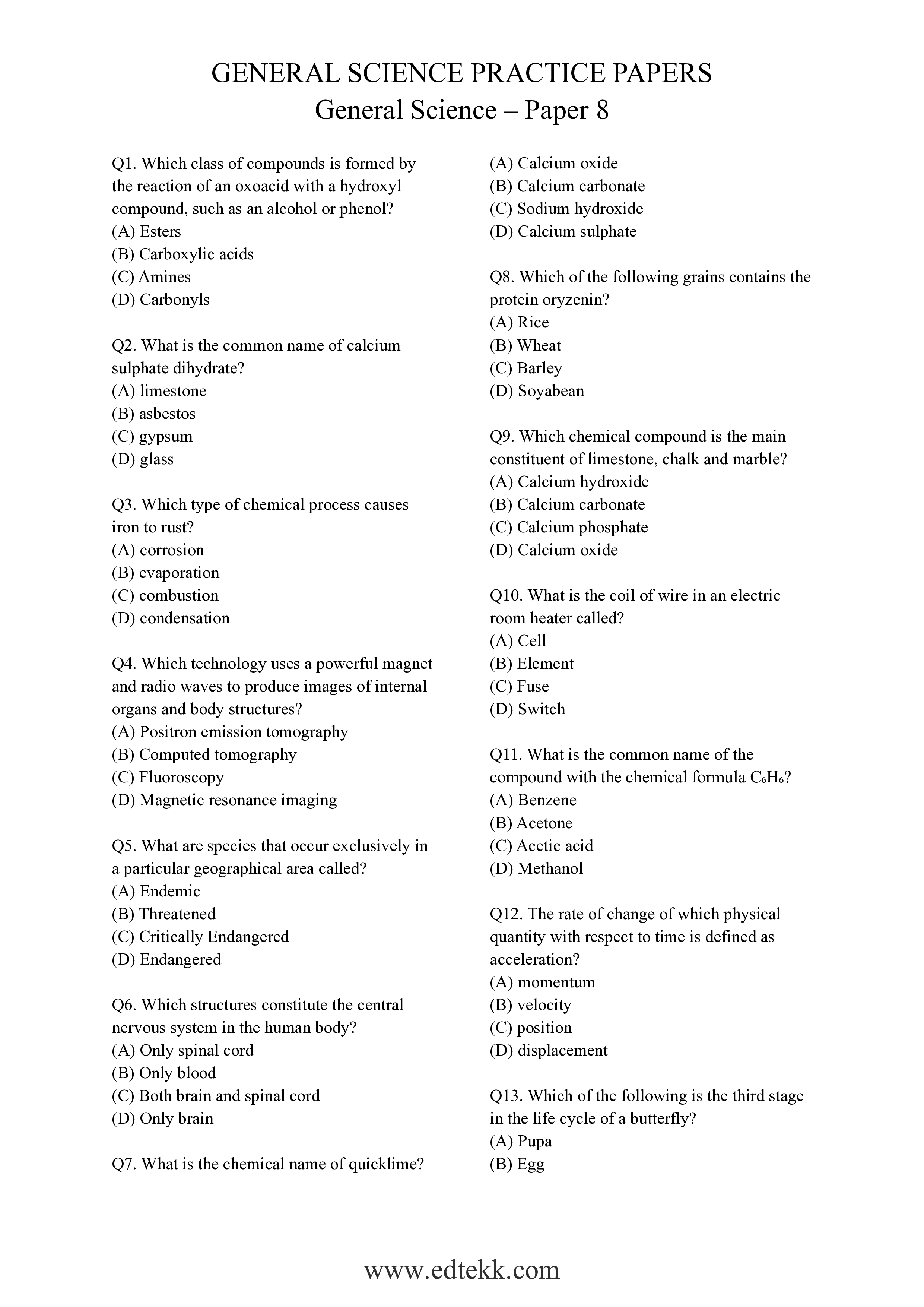
Prepare for government competitive examinations with General Science Practice Paper 8, featuring 20 objective-type questions on fundamental science concepts. Suitable for SSC, Railway, State PSC, Police Constable and Police SI aspirants, this paper provides answers and explanations to strengthen subject knowledge and support regular practice.
Test Details
Topic: General Science
Total Questions: 20
Question Format: MCQs – Single Correct Answer
Suitable for: SSC exams, Railway exams, State PSC, Police Constable, Police SI
Download All Papers in This Series (PDF)
Questions and Answers
Q1. Which class of compounds is formed by the reaction of an oxoacid with a hydroxyl compound, such as an alcohol or phenol?
(A) Esters
(B) Carboxylic acids
(C) Amines
(D) Carbonyls
Explanation: Esters are formed through esterification, a reaction between an oxoacid, commonly a carboxylic acid, and a hydroxyl-containing compound such as an alcohol or phenol. The reaction generally involves the elimination of water. Esters commonly have fruity odours and are widely used in perfumes, flavourings and solvents.
Q2. What is the common name of calcium sulphate dihydrate?
(A) limestone
(B) asbestos
(C) gypsum
(D) glass
Explanation: Calcium sulphate dihydrate (CaSO₄·2H₂O) is commonly known as gypsum. It is a naturally occurring mineral used in the manufacture of plaster of Paris, cement and various building materials.
Q3. Which type of chemical process causes iron to rust?
(A) corrosion
(B) evaporation
(C) combustion
(D) condensation
Explanation: Rusting of iron is an example of corrosion, which involves the gradual deterioration of a metal through chemical or electrochemical reactions with its surroundings. Iron reacts with oxygen and moisture to form hydrated iron(III) oxide, commonly called rust. Painting, galvanisation and protective coatings help prevent rusting.
Q4. Which technology uses a powerful magnet and radio waves to produce images of internal organs and body structures?
(A) Positron emission tomography
(B) Computed tomography
(C) Fluoroscopy
(D) Magnetic resonance imaging
Explanation: Magnetic resonance imaging (MRI) uses a strong magnetic field and radiofrequency waves to produce detailed images of internal organs, tissues and other body structures. Unlike computed tomography (CT), MRI does not use ionising X-ray radiation. It is particularly useful for examining soft tissues, the brain and spinal cord.
Q5. What are species that occur exclusively in a particular geographical area called?
(A) Endemic
(B) Threatened
(C) Critically Endangered
(D) Endangered
Explanation: Endemic species are plants or animals naturally restricted to a particular geographical region and not found naturally elsewhere. Their distribution may be limited to an island, mountain range, country or other specific area. Endemism describes geographical restriction and does not necessarily indicate that a species is endangered.
Q6. Which structures constitute the central nervous system in the human body?
(A) Only spinal cord
(B) Only blood
(C) Both brain and spinal cord
(D) Only brain
Explanation: The human central nervous system (CNS) consists of the brain and spinal cord. It receives and processes sensory information, coordinates responses and regulates various bodily functions. The peripheral nervous system comprises nerves and ganglia outside the CNS and connects it with the rest of the body.
Q7. What is the chemical name of quicklime?
(A) Calcium oxide
(B) Calcium carbonate
(C) Sodium hydroxide
(D) Calcium sulphate
Explanation: Quicklime is the common name for calcium oxide (CaO). It is produced by heating limestone (calcium carbonate, CaCO₃) strongly through a process called calcination, releasing carbon dioxide (CO₂).
Q8. Which of the following grains contains the protein oryzenin?
(A) Rice
(B) Wheat
(C) Barley
(D) Soyabean
Explanation: Oryzenin is the principal storage protein of rice and belongs to the glutelin group of proteins. It is found predominantly in the rice endosperm. Other cereals possess characteristic storage proteins, such as gliadins and glutenins in wheat and hordeins in barley.
Q9. Which chemical compound is the main constituent of limestone, chalk and marble?
(A) Calcium hydroxide
(B) Calcium carbonate
(C) Calcium phosphate
(D) Calcium oxide
Explanation: Limestone, chalk and marble are rocks composed predominantly of calcium carbonate (CaCO₃). They differ in geological origin, texture and crystallinity. Limestone and chalk are sedimentary rocks, whereas marble is formed through the metamorphism of carbonate rocks.
Q10. What is the coil of wire in an electric room heater called?
(A) Cell
(B) Element
(C) Fuse
(D) Switch
Explanation: The coil of wire in an electric room heater is called the heating element. It is generally made of a high-resistivity alloy such as nichrome. When electric current passes through it, electrical energy is converted into heat due to its resistance, producing the heating effect.
Q11. What is the common name of the compound with the chemical formula C₆H₆?
(A) Benzene
(B) Acetone
(C) Acetic acid
(D) Methanol
Explanation: Benzene (C₆H₆) is an aromatic hydrocarbon consisting of a six-carbon ring with delocalised pi electrons. It is a colourless, volatile liquid widely used as an industrial chemical feedstock. Its molecular formula is C₆H₆, distinguishing it from methanol, acetic acid and acetone.
Q12. The rate of change of which physical quantity with respect to time is defined as acceleration?
(A) momentum
(B) velocity
(C) position
(D) displacement
Explanation: Acceleration is the rate of change of velocity with respect to time. It is a vector quantity and is mathematically expressed as (a=Delta v/Delta t). Its SI unit is metre per second squared (m/s²).
Q13. Which of the following is the third stage in the life cycle of a butterfly?
(A) Pupa
(B) Egg
(C) Adult
(D) Larva
Explanation: The typical life cycle of a butterfly consists of four stages: egg, larva (caterpillar), pupa (chrysalis) and adult. The pupa is the third stage, during which extensive transformation occurs and the adult butterfly develops. This type of development is known as complete metamorphosis.
Q14. Which of the following is an example of an action-at-a-distance force?
(A) Tension
(B) Pull
(C) Gravitation
(D) Friction
Explanation: Gravitation is an action-at-a-distance force because it acts between objects without requiring direct physical contact. Every object having mass attracts every other object having mass. In contrast, friction and tension are contact forces that require physical interaction between objects.
Q15. Which type of acid is initially formed when the enzyme alliinase acts on amino acid sulfoxides in onions?
(A) Sulfenic acid
(B) Citric acid
(C) Nitric acid
(D) Sulphuric acid
Explanation: Sulfenic acid is initially formed when alliinase acts on S-alk(en)yl cysteine sulfoxides in onion tissues. These unstable intermediates undergo further reactions. In onions, the lachrymatory factor synthase converts 1-propenesulfenic acid into syn-propanethial-S-oxide, which causes eye irritation and tears.
Q16. How is a voltmeter connected between the two points across which the potential difference is to be measured?
(A) Along the same magnetic field
(B) In parallel
(C) In concentric circles
(D) Perpendicular to each other
Explanation: A voltmeter is connected in parallel across the two points between which the potential difference is to be measured. It has very high resistance, so it draws negligible current from the circuit and minimises disturbance to the potential difference being measured.
Q17. Which of the following is the correct chemical formula of nitromethane?
(A) CH3NO3
(B) CH3NO
(C) CH4NO2
(D) CH3NO2
Explanation: Nitromethane has the molecular formula CH₃NO₂. It consists of a methyl group (CH₃) attached to a nitro group (NO₂). It is the simplest organic nitro compound and is used as an industrial solvent and in specialised fuel applications.
Q18. Which of the following substances is used to remove the permanent hardness of water?
(A) Washing soda
(B) Baking soda
(C) Lime
(D) Bleaching powder
Explanation: Washing soda (Na₂CO₃·10H₂O), also known as hydrated sodium carbonate, is used to remove permanent hardness of water. It reacts with dissolved calcium and magnesium salts to form insoluble carbonates, which precipitate and can subsequently be removed.
Q19. What is the working principle of a mercury thermometer?
(A) Expansion of matter on heating
(B) Change in density of matter on heating
(C) Thermal resistance of matter
(D) Change in mass of matter on heating
Explanation: A mercury thermometer works on the principle of thermal expansion of matter. When temperature increases, mercury expands and rises through the narrow capillary tube. When temperature decreases, it contracts and its level falls. The change in mercury volume is used to indicate temperature.
Q20. Which gas can cause explosions in coal mines?
(A) Carbon dioxide
(B) Butane
(C) Nitrogen
(D) Methane
Explanation: Methane is the principal combustible component of firedamp, a gas mixture found in coal mines. When methane mixes with air in concentrations of approximately 5–15% by volume, it forms an explosive mixture. A spark or flame can ignite this mixture, causing dangerous explosions.
Question Paper Images