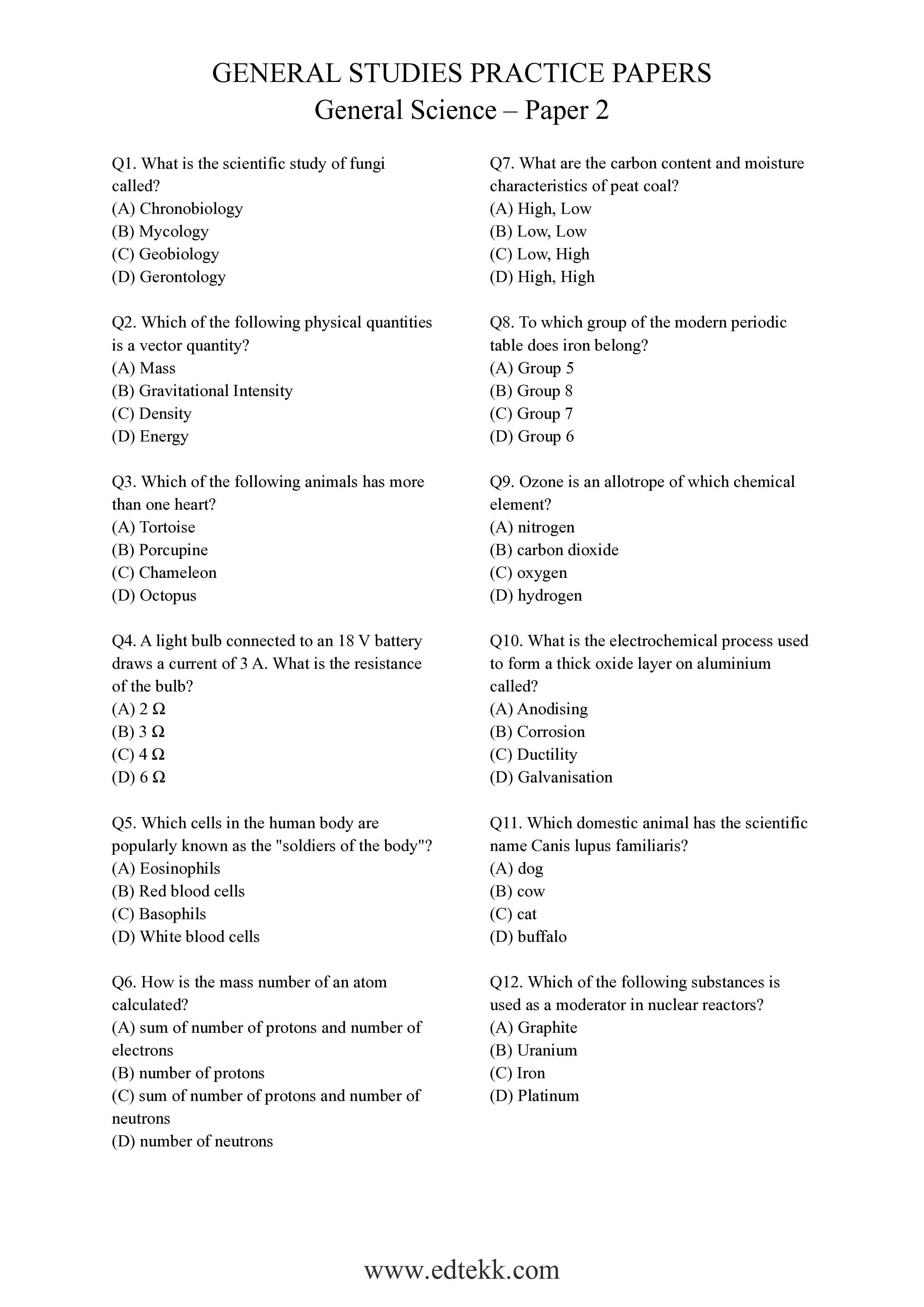
Strengthen your General Science preparation with General Studies Practice Paper 2. This question set helps revise essential scientific concepts through MCQs, correct answers and explanations. It is suitable for SSC, Railway, State PSC, Police Constable and Police SI competitive examinations.
Test Details
Topic: General Science
Total Questions: 20
Question Format: MCQs – Single Correct Answer
Suitable for: SSC exams, Railway exams, State PSC, Police Constable, Police SI
Download All Papers in This Series (PDF)
Questions and Answers
Q1. What is the scientific study of fungi called?
(A) Chronobiology
(B) Mycology
(C) Geobiology
(D) Gerontology
Explanation: Mycology is the branch of biology concerned with the study of fungi, including yeasts, moulds and mushrooms. It deals with their classification, structure, reproduction, physiology and ecological roles. Mycology also examines fungal diseases and the economic importance of fungi in agriculture, medicine and industry.
Q2. Which of the following physical quantities is a vector quantity?
(A) Mass
(B) Gravitational Intensity
(C) Density
(D) Energy
Explanation: Gravitational intensity, also known as gravitational field strength, is a vector quantity because it has both magnitude and direction. It represents the gravitational force experienced per unit mass at a given point. Energy, mass and density are scalar quantities.
Q3. Which of the following animals has more than one heart?
(A) Tortoise
(B) Porcupine
(C) Chameleon
(D) Octopus
Explanation: An octopus possesses three hearts: two branchial hearts that pump blood through the gills and one systemic heart that circulates oxygenated blood throughout the body. Porcupines, chameleons and tortoises each possess a single heart. This three-heart arrangement is characteristic of octopuses and other cephalopods.
Q4. A light bulb connected to an 18 V battery draws a current of 3 A. What is the resistance of the bulb?
(A) 2 Ω
(B) 3 Ω
(C) 4 Ω
(D) 6 Ω
Explanation: According to Ohm’s law, V = IR, where V represents potential difference, I represents current and R represents resistance. Given V = 18 V and I = 3 A, resistance R = V/I = 18/3 = 6 Ω. Therefore, the bulb’s resistance under the given operating conditions is 6 ohms.
Q5. Which cells in the human body are popularly known as the “soldiers of the body”?
(A) Eosinophils
(B) Red blood cells
(C) Basophils
(D) White blood cells
Explanation: White blood cells, also known as leukocytes, are popularly called the soldiers of the human body because they protect the body against infections and foreign substances. Different types of white blood cells perform specialised immune functions, including engulfing pathogens, producing antibodies and coordinating immune responses.
Q6. How is the mass number of an atom calculated?
(A) sum of number of protons and number of electrons
(B) number of protons
(C) sum of number of protons and number of neutrons
(D) number of neutrons
Explanation: The mass number (A) of an atom equals the total number of protons (Z) and neutrons (N) in its nucleus: A = Z + N. Electrons are not included in the mass number. For example, carbon-12 contains six protons and six neutrons, giving A = 12.
Q7. What are the carbon content and moisture characteristics of peat coal?
(A) High, Low
(B) Low, Low
(C) Low, High
(D) High, High
Explanation: Peat is the earliest stage of coal formation and contains a relatively low percentage of carbon compared with more mature coal varieties. It has a high moisture content and relatively low calorific value. With increasing burial, pressure and temperature, peat gradually transforms into lignite and higher grades of coal.
Q8. To which group of the modern periodic table does iron belong?
(A) Group 5
(B) Group 8
(C) Group 7
(D) Group 6
Explanation: Iron (Fe), with atomic number 26, belongs to Group 8 and Period 4 of the modern periodic table. It is a transition metal with the electronic configuration [Ar] 3d⁶ 4s².
Q9. Ozone is an allotrope of which chemical element?
(A) nitrogen
(B) carbon dioxide
(C) oxygen
(D) hydrogen
Explanation: Ozone (O₃) is an allotrope of oxygen. Allotropy refers to the existence of an element in two or more different structural forms. Oxygen also exists as diatomic oxygen (O₂), which is essential for respiration.
Q10. What is the electrochemical process used to form a thick oxide layer on aluminium called?
(A) Anodising
(B) Corrosion
(C) Ductility
(D) Galvanisation
Explanation: Anodising is an electrochemical process used to form a thick, protective aluminium oxide layer on the surface of aluminium. It improves corrosion resistance, increases surface hardness and provides a suitable surface for colouring.
Q11. Which domestic animal has the scientific name Canis lupus familiaris?
(A) dog
(B) cow
(C) cat
(D) buffalo
Explanation: The domestic dog is scientifically classified as Canis lupus familiaris, a subspecies of the grey wolf (Canis lupus) under a widely accepted taxonomic classification. It belongs to the family Canidae and the order Carnivora.
Q12. Which of the following substances is used as a moderator in nuclear reactors?
(A) Graphite
(B) Uranium
(C) Iron
(D) Platinum
Explanation: Graphite is used as a neutron moderator in several nuclear reactors. It slows down fast neutrons to thermal energies without absorbing a significant number of them. These slow neutrons increase the probability of further nuclear fission, thereby helping sustain the chain reaction.
Q13. Which membrane-bound organelles in animal cells are generally small and help store waste products?
(A) Vacuoles
(B) Golgi apparatus
(C) Cytosols
(D) Plastids
Explanation: Vacuoles are membrane-bound organelles that are generally smaller and more numerous in animal cells than in plant cells. They help store water, nutrients and waste materials and participate in intracellular transport and waste management. In contrast, mature plant cells typically possess a large central vacuole.
Q14. Which of the following is an example of an action-at-a-distance force?
(A) Pull
(B) Gravitation
(C) Tension
(D) Friction
Explanation: Gravitation is an action-at-a-distance force because it acts between objects without requiring direct physical contact. Every object having mass attracts every other object having mass. In contrast, friction and tension are contact forces that require physical interaction between objects.
Q15. What is the chemical name of saltpetre?
(A) potassium nitrate
(B) sodium hydroxide
(C) potassium chloride
(D) sodium chloride
Explanation: Saltpetre, also spelled saltpeter, is the common name for potassium nitrate (KNO₃). It is used in fertilisers and in the manufacture of explosives. Sodium chloride, in contrast, is commonly known as common salt.
Q16. Which of the following structures is absent in a prokaryotic cell?
(A) Nucleus
(B) Cell membrane
(C) Ribosomes
(D) DNA
Explanation: Prokaryotic cells lack a membrane-bound nucleus. Their genetic material is located in a region called the nucleoid. However, they possess DNA, ribosomes and a cell membrane. Bacteria and archaea are examples of prokaryotic organisms.
Q17. Which element did Mendeleev find difficult to assign a definite position in his periodic table?
(A) Carbon
(B) Hydrogen
(C) Nitrogen
(D) Oxygen
Explanation: Hydrogen was difficult for Dmitri Mendeleev to assign a definite position in his periodic table because it exhibits similarities with both alkali metals and halogens. Like alkali metals, it has one electron in its outermost shell, but it can also gain an electron to form a negative ion, resembling halogens.
Q18. Which of the following ions is a cation?
(A) Chloride
(B) Iodide
(C) Fluoride
(D) Ammonium
Explanation: Ammonium (NH₄⁺) is a positively charged polyatomic ion and is therefore classified as a cation. Iodide (I⁻), fluoride (F⁻) and chloride (Cl⁻) are negatively charged ions and are classified as anions.
Q19. Where is sodium located in the periodic table?
(A) On the right side
(B) Bottom of the table
(C) Top period
(D) On the left side
Explanation: Sodium (Na), with atomic number 11, is located on the left side of the periodic table in Group 1 and Period 3. It is an alkali metal with one electron in its outermost shell and readily loses this electron to form a positively charged sodium ion (Na⁺).
Q20. Which force helps swimmers remain afloat in water?
(A) Muscular force
(B) Buoyant force
(C) Frictional force.
(D) Magnetic force
Explanation: Buoyant force is the upward force exerted by a fluid on an object partially or completely immersed in it. It helps swimmers remain afloat by opposing their weight. According to Archimedes’ principle, the buoyant force is equal to the weight of the fluid displaced by the immersed object.
Question Paper Images