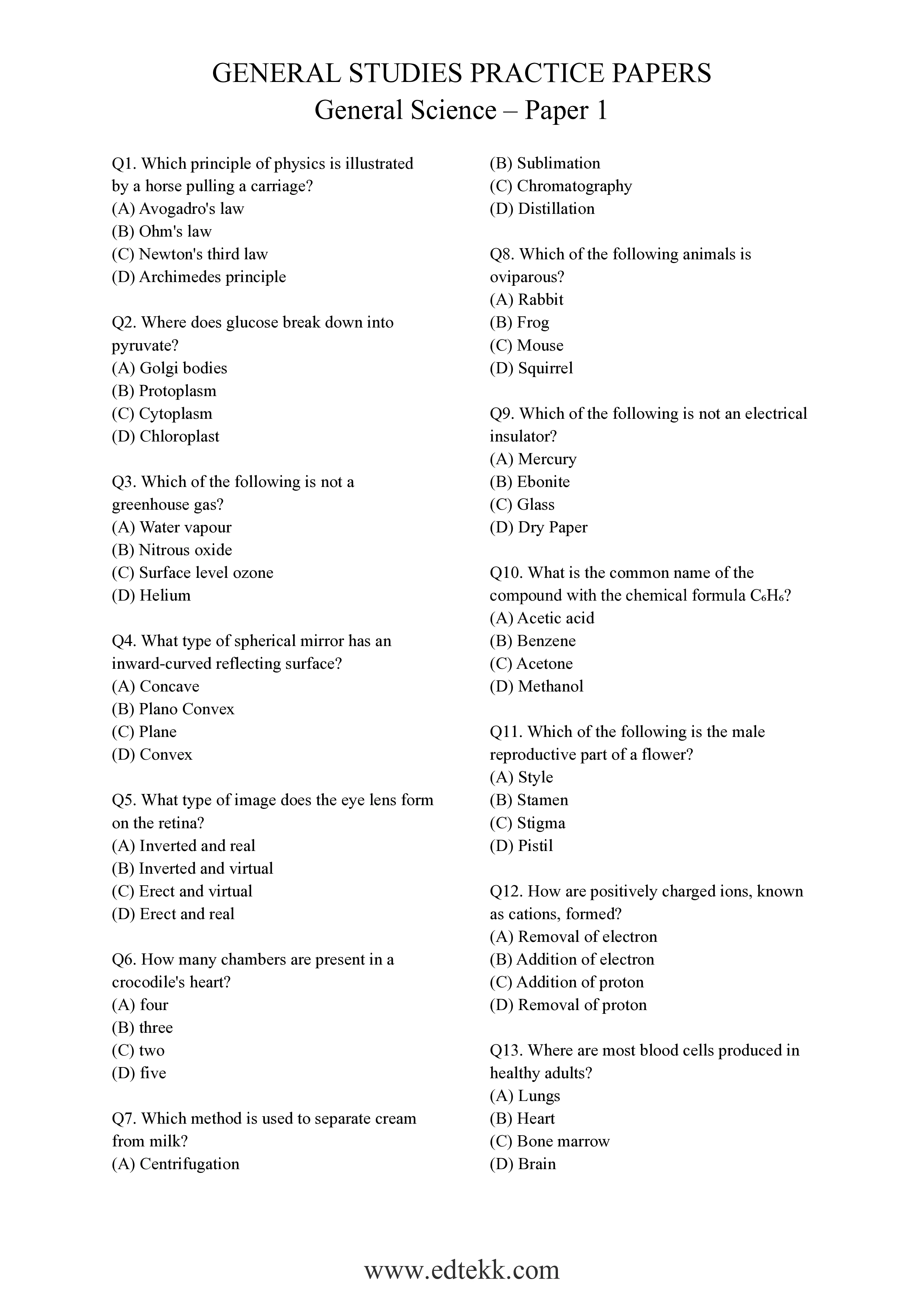
Prepare for competitive examinations with General Science Practice Paper 1. This practice set covers important General Science concepts through objective questions, answers and detailed explanations. It is useful for SSC, Railway, State PSC, Police Constable and Police SI examinations.
Test Details
Topic: General Science
Total Questions: 20
Question Format: MCQs – Single Correct Answer
Suitable for: SSC exams, Railway exams, State PSC, Police Constable, Police SI
Download All Papers in This Series (PDF)
Questions and Answers
Q1. Which principle of physics is illustrated by a horse pulling a carriage?
(A) Avogadro’s law
(B) Ohm’s law
(C) Newton’s third law
(D) Archimedes principle
Explanation: A horse pulling a carriage illustrates Newton’s third law of motion. The horse pushes the ground backwards, and the ground exerts an equal and opposite forward frictional force on the horse. This forward force enables the horse to pull the carriage. The action and reaction forces act on different bodies.
Q2. Where does glucose break down into pyruvate?
(A) Golgi bodies
(B) Protoplasm
(C) Cytoplasm
(D) Chloroplast
Explanation: Glycolysis is the metabolic pathway in which one molecule of glucose is converted into two molecules of pyruvate. It occurs in the cytoplasm of cells and does not directly require oxygen. The process produces a net gain of two ATP molecules and two NADH molecules per glucose molecule and constitutes the first stage of cellular respiration.
Q3. Which of the following is not a greenhouse gas?
(A) Water vapour
(B) Nitrous oxide
(C) Surface level ozone
(D) Helium
Explanation: Helium is not a greenhouse gas because it does not significantly absorb outgoing infrared radiation. It is a chemically inert noble gas belonging to Group 18. In contrast, water vapour, surface-level ozone and nitrous oxide absorb infrared radiation and contribute to the greenhouse effect.
Q4. What type of spherical mirror has an inward-curved reflecting surface?
(A) Concave
(B) Plano Convex
(C) Plane
(D) Convex
Explanation: A spherical mirror whose reflecting surface curves inward is called a concave mirror. It converges parallel incident rays towards its principal focus and can form real or virtual images depending on the object’s position. A convex mirror has an outward-curving reflecting surface, whereas a plane mirror has a flat reflecting surface.
Q5. What type of image does the eye lens form on the retina?
(A) Inverted and real
(B) Inverted and virtual
(C) Erect and virtual
(D) Erect and real
Explanation: The eye lens forms a real, inverted image of an object on the retina. The lens refracts incoming light rays and focuses them onto the light-sensitive retinal surface. Although the retinal image is inverted, the brain processes visual information to enable our perception of the surrounding world in its normal orientation.
Q6. How many chambers are present in a crocodile’s heart?
(A) four
(B) three
(C) two
(D) five
Explanation: Crocodiles possess a four-chambered heart consisting of two atria and two ventricles. This distinguishes them from most other reptiles, which generally have a three-chambered heart. Crocodiles also possess specialised circulatory adaptations, including the ability to redirect blood through alternative pathways under particular physiological conditions.
Q7. Which method is used to separate cream from milk?
(A) Centrifugation
(B) Sublimation
(C) Chromatography
(D) Distillation
Explanation: Centrifugation separates cream from milk based on differences in density. During rapid rotation, the denser aqueous portion moves outward more strongly, while the less dense fat-rich portion collects closer to the axis of rotation. This technique is widely used in dairy processing to separate cream from skimmed milk.
Q8. Which of the following animals is oviparous?
(A) Rabbit
(B) Frog
(C) Mouse
(D) Squirrel
Explanation: Frogs are oviparous animals, meaning they reproduce by laying eggs. Most frogs lay their eggs in water, where fertilisation generally occurs externally. Rabbits, mice and squirrels are mammals that give birth to live young. Therefore, frog is the correct answer.
Q9. Which of the following is not an electrical insulator?
(A) Mercury
(B) Ebonite
(C) Glass
(D) Dry Paper
Explanation: Mercury is a metal and an electrical conductor; therefore, it is not an insulator. It is liquid at room temperature and allows electric current to pass through it. Dry paper, glass and ebonite are generally electrical insulators because they do not allow electric current to flow easily under ordinary conditions.
Q10. What is the common name of the compound with the chemical formula C₆H₆?
(A) Acetic acid
(B) Benzene
(C) Acetone
(D) Methanol
Explanation: Benzene is the common name of the compound with the molecular formula C₆H₆. It is an aromatic hydrocarbon consisting of a six-carbon ring with delocalised pi electrons. Benzene is an important industrial chemical used in the manufacture of plastics, synthetic fibres, detergents and other chemical products.
Q11. Which of the following is the male reproductive part of a flower?
(A) Style
(B) Stamen
(C) Stigma
(D) Pistil
Explanation: The stamen is the male reproductive organ of a flower. It generally consists of an anther and a filament. The anther produces pollen grains containing male gametophytes, which give rise to male gametes. The stigma, style and ovary are components of the female reproductive structure, the pistil.
Q12. How are positively charged ions, known as cations, formed?
(A) Removal of electron
(B) Addition of electron
(C) Addition of proton
(D) Removal of proton
Explanation: Cations are positively charged ions commonly formed when neutral atoms lose one or more electrons. Electron loss leaves the species with more protons than electrons, producing a net positive charge. For example, sodium forms Na⁺ by losing one electron: Na → Na⁺ + e⁻. Electron gain generally produces anions.
Q13. Where are most blood cells produced in healthy adults?
(A) Lungs
(B) Heart
(C) Bone marrow
(D) Brain
Explanation: Bone marrow is the primary site of blood cell production in healthy adults. This process is called haematopoiesis. Red bone marrow produces red blood cells, white blood cells and platelets from haematopoietic stem cells. In adults, active red bone marrow is mainly found in the pelvis, sternum, ribs and vertebrae.
Q14. Which part of the human body is affected by osteoporosis?
(A) Bones
(B) Kidney
(C) Brain
(D) Lungs
Explanation: Osteoporosis is a skeletal disorder characterised by reduced bone density and deterioration of bone tissue. It makes bones weak, brittle and more susceptible to fractures, particularly in the hip, spine and wrist.
Q15. Which of the following physical quantities has the same dimensions as energy?
(A) Moment of inertia
(B) Angular momentum
(C) Torque
(D) Linear Momentum
Explanation: Torque and energy have the same dimensions, (ML^2T^{-2}). Torque is the product of force and perpendicular distance, whereas work is the product of force and displacement in the direction of the force. However, they represent different physical quantities: torque is expressed in N·m and energy in joules (J).
Q16. How many hearts does an octopus have?
(A) two
(B) three
(C) one
(D) four
Explanation: Octopuses possess three hearts. Two branchial hearts pump blood through the gills for oxygenation, while one systemic heart pumps oxygenated blood to the rest of the body. Their blood contains haemocyanin, a copper-containing respiratory pigment that gives it a bluish colour.
Q17. What is the chemical formula of calcium carbonate?
(A) CaSO4
(B) CaO
(C) CaCO3
(D) CaCO2
Explanation: Calcium carbonate has the chemical formula CaCO₃. It is the principal constituent of limestone, chalk and marble and is also found in materials such as eggshells and seashells.
Q18. Which of the following is not an SI base unit?
(A) kelvin
(B) ampere
(C) tesla
(D) candela
Explanation: Tesla (T) is a derived SI unit used to measure magnetic flux density, not an SI base unit. The seven SI base units include kelvin for thermodynamic temperature, candela for luminous intensity and ampere for electric current. Therefore, tesla is the correct answer.
Q19. Which muscles in the skin contract to make the hairs stand upright, producing goosebumps when we are cold or frightened?
(A) Arrector pili
(B) Epidermis
(C) Elastin
(D) Collagen
Explanation: Arrector pili are small, involuntary smooth muscles attached to hair follicles. When these muscles contract, they pull the hairs upright and produce small elevations on the skin, commonly known as goosebumps. This response occurs during exposure to cold or in response to emotional stimuli such as fear.
Q20. Who proposed that all plants and animals are composed of cells and that the cell is the basic unit of life?
(A) Virchow
(B) M. Schleiden and T. Schwann
(C) Leeuwenhoek
(D) J. E. Purkinje
Explanation: Matthias Schleiden and Theodor Schwann jointly developed the classical cell theory. Schleiden established that plants are composed of cells, while Schwann extended this principle to animals. Their work established the cell as the fundamental structural and functional unit of living organisms.
Question Paper Images