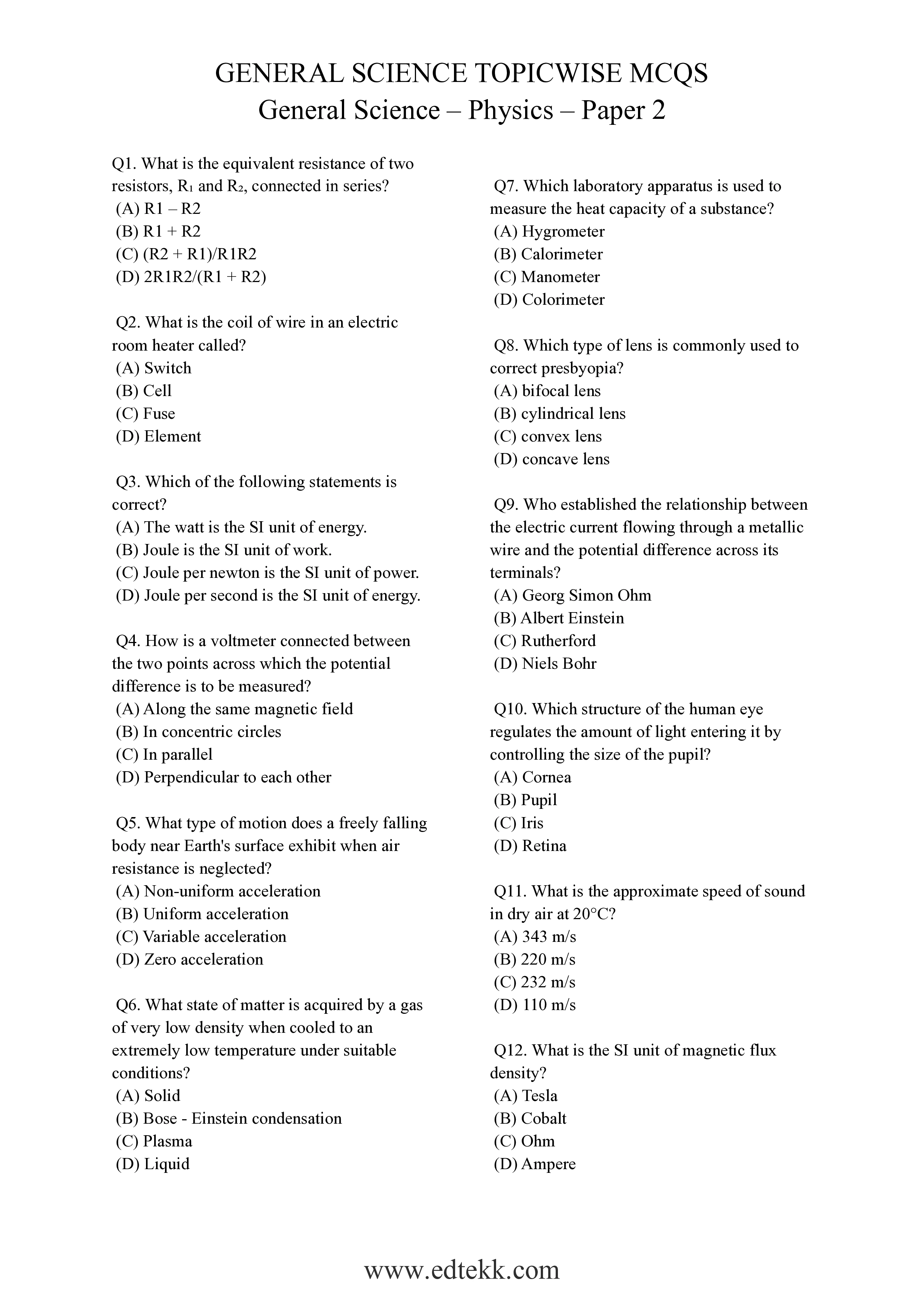
Improve your General Science preparation with Physics topicwise MCQs – Paper 2. This practice set features objective questions covering important Physics concepts, along with correct answers and explanations. It is useful for candidates preparing for SSC exams, Railway exams, State PSC, Police Constable and Police SI recruitment examinations.
Test Details
Topic: Physics
Total Questions: 20
Question Format: MCQs – Single Correct Answer
Suitable for: SSC exams, Railway exams, State PSC, Police Constable, Police SI
Download All Papers in This Series (PDF)
Questions and Answers
Q1. What is the equivalent resistance of two resistors, R₁ and R₂, connected in series?
(A) R1 – R2
(B) R1 + R2
(C) (R2 + R1)/R1R2
(D) 2R1R2/(R1 + R2)
Explanation: When two resistors are connected in series, their equivalent resistance is the sum of their individual resistances: R = R₁ + R₂. The same current flows through both resistors, while the total potential difference across the combination equals the sum of the potential differences across the individual resistors.
Q2. What is the coil of wire in an electric room heater called?
(A) Switch
(B) Cell
(C) Fuse
(D) Element
Explanation: The coil of wire in an electric room heater is called the heating element. It is generally made of a high-resistivity alloy such as nichrome. When electric current passes through it, electrical energy is converted into heat due to its resistance, producing the heating effect.
Q3. Which of the following statements is correct?
(A) The watt is the SI unit of energy.
(B) Joule is the SI unit of work.
(C) Joule per newton is the SI unit of power.
(D) Joule per second is the SI unit of energy.
Explanation: The joule (J) is the SI unit of work and energy. One joule of work is done when a force of one newton moves an object one metre in the direction of the force. The watt (W), equivalent to one joule per second, is the SI unit of power.
Q4. How is a voltmeter connected between the two points across which the potential difference is to be measured?
(A) Along the same magnetic field
(B) In concentric circles
(C) In parallel
(D) Perpendicular to each other
Explanation: A voltmeter is connected in parallel across the two points between which the potential difference is to be measured. It has very high resistance, so it draws negligible current from the circuit and minimises disturbance to the potential difference being measured.
Q5. What type of motion does a freely falling body near Earth’s surface exhibit when air resistance is neglected?
(A) Non-uniform acceleration
(B) Uniform acceleration
(C) Variable acceleration
(D) Zero acceleration
Explanation: A freely falling body near Earth’s surface experiences approximately constant gravitational acceleration when air resistance is neglected and the distance travelled is relatively small. This acceleration is approximately 9.8 m/s², directed vertically downward. Hence, its motion is an example of uniformly accelerated motion.
Q6. What state of matter is acquired by a gas of very low density when cooled to an extremely low temperature under suitable conditions?
(A) Solid
(B) Bose – Einstein condensation
(C) Plasma
(D) Liquid
Explanation: At sufficiently low temperatures and under suitable conditions, a dilute gas of bosonic particles can undergo Bose–Einstein condensation. In this state, a macroscopic number of particles occupy the same lowest-energy quantum state. Low temperature and low density alone are not sufficient; appropriate quantum and thermodynamic conditions are necessary.
Q7. Which laboratory apparatus is used to measure the heat capacity of a substance?
(A) Hygrometer
(B) Calorimeter
(C) Manometer
(D) Colorimeter
Explanation: A calorimeter is an apparatus used to measure the heat absorbed or released during physical and chemical processes. It is also used to determine the specific heat capacity of substances. A hygrometer measures humidity, a manometer measures pressure, and a colorimeter measures light absorption by a solution.
Q8. Which type of lens is commonly used to correct presbyopia?
(A) bifocal lens
(B) cylindrical lens
(C) convex lens
(D) concave lens
Explanation: Presbyopia is an age-related reduction in the eye’s ability to accommodate, making it difficult to focus on nearby objects. Bifocal lenses provide separate optical powers for distance and near vision. Progressive lenses are another common option, providing a gradual change in optical power without a visible dividing line.
Q9. Who established the relationship between the electric current flowing through a metallic wire and the potential difference across its terminals?
(A) Georg Simon Ohm
(B) Albert Einstein
(C) Rutherford
(D) Niels Bohr
Explanation: Georg Simon Ohm established the relationship between electric current and potential difference in a conductor. His work led to Ohm’s law, which states that current through a conductor is directly proportional to the potential difference across it, provided temperature and other physical conditions remain constant.
Q10. Which structure of the human eye regulates the amount of light entering it by controlling the size of the pupil?
(A) Cornea
(B) Pupil
(C) Iris
(D) Retina
Explanation: The iris regulates the amount of light entering the human eye by controlling the diameter of the pupil. In bright conditions, the pupil constricts to reduce incoming light. In dim conditions, it dilates to allow more light to enter. The pupil is the opening, whereas the iris is the structure that controls its size.
Q11. What is the approximate speed of sound in dry air at 20°C?
(A) 343 m/s
(B) 220 m/s
(C) 232 m/s
(D) 110 m/s
Explanation: The approximate speed of sound in dry air at 20°C under ordinary atmospheric conditions is 343 m/s. Sound travels through air as a longitudinal mechanical wave consisting of successive compressions and rarefactions. Its speed depends primarily on temperature and increases as the temperature of air rises.
Q12. What is the SI unit of magnetic flux density?
(A) Tesla
(B) Cobalt
(C) Ohm
(D) Ampere
Explanation: Tesla (T) is the SI unit of magnetic flux density, commonly called the magnetic field in elementary physics. One tesla is equivalent to one weber per square metre (Wb/m²). It is named after the scientist and inventor Nikola Tesla.
Q13. What is the rate of doing work called?
(A) impulse
(B) force
(C) power
(D) energy
Explanation: Power is defined as the rate of doing work or transferring energy per unit time. Mathematically, average power is expressed as (P=W/t), where (W) represents the work done and (t) represents the time taken. Its SI unit is the watt (W), equivalent to one joule per second.
Q14. Magnetic confinement of plasma is the scientific principle used in which of the following techniques?
(A) Fusion reactor
(B) Particle accelerators
(C) Giant Metrewave Radio Telescope
(D) Electric generator
Explanation: Magnetic confinement uses powerful magnetic fields to confine extremely hot plasma and prevent direct contact with reactor walls. This technique is employed in fusion devices such as tokamaks and stellarators to maintain conditions suitable for controlled nuclear fusion reactions.
Q15. What type of expansion causes the Eiffel Tower to become taller during summer?
(A) Gradient
(B) Thermal
(C) Gravitational
(D) Chemical
Explanation: Thermal expansion refers to the increase in the dimensions of a material when its temperature rises. The Eiffel Tower, which is primarily made of iron, expands during summer due to higher temperatures, resulting in a slight increase in its height. It contracts again when temperatures decrease.
Q16. Which of the following materials has the highest electrical resistivity?
(A) Nichrome
(B) Silver
(C) Chromium
(D) Iron
Explanation: Among silver, chromium, iron and nichrome, nichrome has the highest electrical resistivity. Nichrome is an alloy primarily composed of nickel and chromium. Its high resistivity, oxidation resistance and ability to withstand elevated temperatures make it suitable for heating elements in electric heaters, toasters and other electrical appliances.
Q17. What type of motion occurs when an object covers unequal distances in equal intervals of time?
(A) non-uniform
(B) uniform
(C) linear
(D) equilibrium
Explanation: Non-uniform motion occurs when an object covers unequal distances in equal intervals of time or equal distances in unequal intervals of time. In contrast, uniform motion involves covering equal distances in equal intervals of time.
Q18. What is the SI unit of speed?
(A) km/s
(B) km/hr
(C) m/s
(D) m/hr
Explanation: The SI unit of speed is metre per second (m/s). Speed is defined as the distance travelled per unit time. Although kilometres per hour (km/h) is commonly used in everyday life, it is not the SI unit of speed.
Q19. Which of the following is the equivalent SI unit expression for one pascal (Pa)?
(A) N m²
(B) N m
(C) N m⁻²
(D) N m⁻¹
Explanation: One pascal (Pa) is the SI unit of pressure and is defined as one newton of force acting perpendicularly over an area of one square metre. Therefore, (1text{ Pa} = 1text{ N/m}^2 = 1text{ N m}^{-2}).
Q20. On what basis is the current rating of a fuse used in a household electrical circuit determined?
(A) Voltage
(B) Resistance
(C) Power
(D) Current
Explanation: A household electric fuse is rated according to the maximum current it can safely carry. If the current exceeds its rated value for sufficient time, the fuse wire heats up and melts, breaking the circuit. Fuse ratings are expressed in amperes and are selected according to the electrical load and circuit requirements.
Question Paper Images