Enhance your General Science preparation with Biology Paper 4, a topicwise MCQ practice set for competitive-exam aspirants. Test your knowledge of important Biology concepts through objective questions with correct answers and explanations. This set supports preparation for SSC, Railway, State PSC, Police Constable and Police SI examinations.
Test Details
Topic: Biology
Total Questions: 20
Question Format: MCQs – Single Correct Answer
Suitable for: SSC exams, Railway exams, State PSC, Police Constable, Police SI
Download All Papers in This Series (PDF)
Questions and Answers
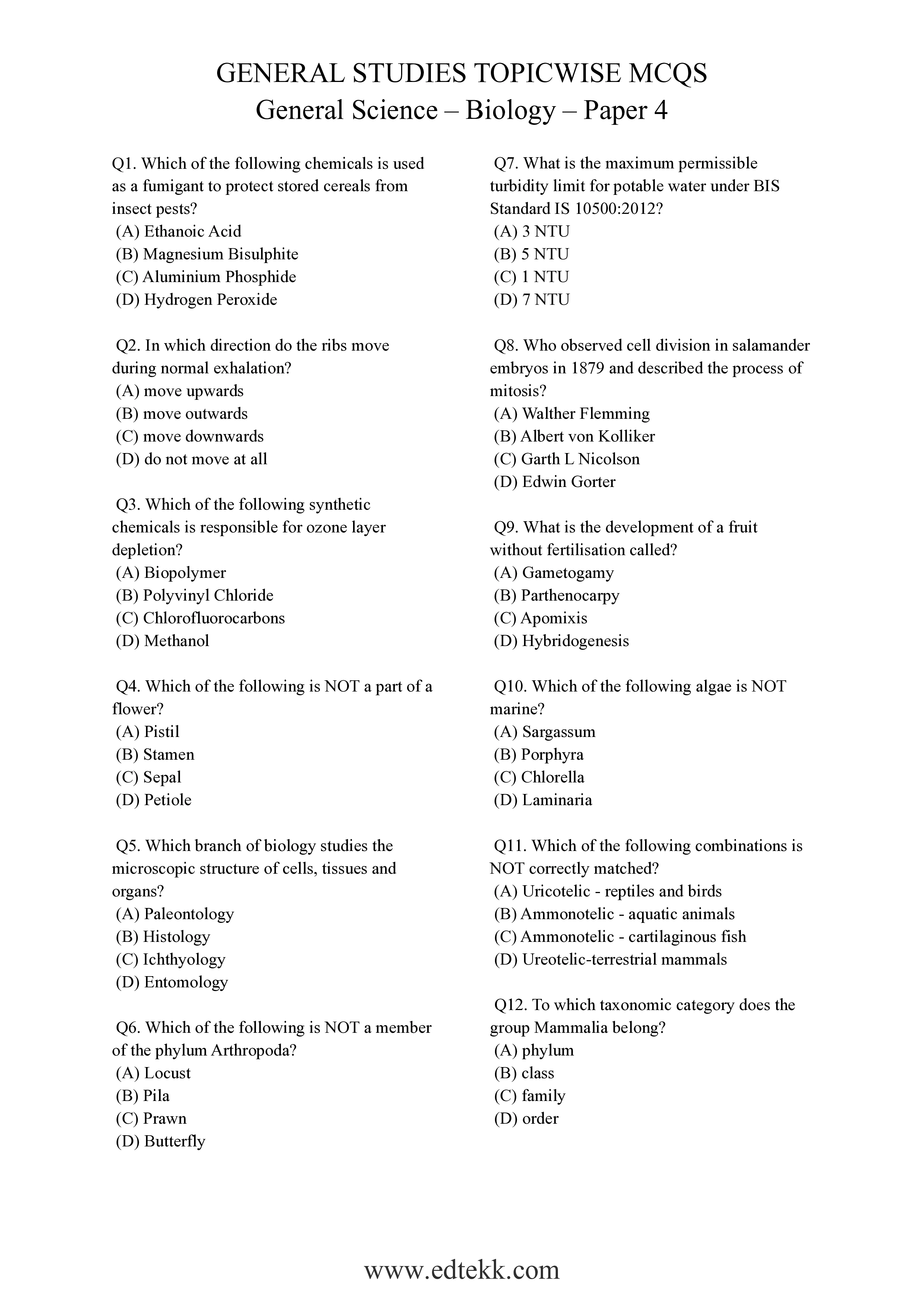
Q1. Which of the following chemicals is used as a fumigant to protect stored cereals from insect pests?
(A) Ethanoic Acid
(B) Magnesium Bisulphite
(C) Aluminium Phosphide
(D) Hydrogen Peroxide
Explanation: Aluminium phosphide is used as a fumigant to protect stored cereals and other agricultural commodities against insect pests. On exposure to moisture, it releases phosphine gas, which is highly toxic to insects. However, phosphine is also extremely poisonous to humans and animals, so its application requires strict safety precautions and regulatory compliance.
Q2. In which direction do the ribs move during normal exhalation?
(A) move upwards
(B) move outwards
(C) move downwards
(D) do not move at all
Explanation: During normal exhalation, the diaphragm relaxes and moves upward, while the external intercostal muscles relax, allowing the ribs to move downward and inward. This decreases the volume of the thoracic cavity, increases intrapulmonary pressure and forces air out of the lungs. Forced exhalation additionally involves the internal intercostal and abdominal muscles.
Q3. Which of the following synthetic chemicals is responsible for ozone layer depletion?
(A) Biopolymer
(B) Polyvinyl Chloride
(C) Chlorofluorocarbons
(D) Methanol
Explanation: Chlorofluorocarbons (CFCs) are synthetic chemical compounds that contribute significantly to ozone layer depletion. In the stratosphere, ultraviolet radiation breaks down CFC molecules, releasing chlorine atoms that catalytically destroy ozone molecules. Their production and consumption have been substantially phased out under the Montreal Protocol.
Q4. Which of the following is NOT a part of a flower?
(A) Pistil
(B) Stamen
(C) Sepal
(D) Petiole
Explanation: A petiole is the stalk that connects a leaf blade to the stem. It is not a floral part. The four principal floral whorls are calyx (sepals), corolla (petals), androecium (stamens) and gynoecium (carpels or pistil).
Q5. Which branch of biology studies the microscopic structure of cells, tissues and organs?
(A) Paleontology
(B) Histology
(C) Ichthyology
(D) Entomology
Explanation: Histology is the branch of biology concerned primarily with the microscopic study of tissues and their organisation. It examines tissue structure and the relationship between structure and function using microscopes. It is particularly important in anatomy, pathology and medical diagnosis.
Q6. Which of the following is NOT a member of the phylum Arthropoda?
(A) Locust
(B) Pila
(C) Prawn
(D) Butterfly
Explanation: Pila, commonly known as the apple snail, belongs to the phylum Mollusca and is therefore not an arthropod. Locusts and butterflies belong to the class Insecta, while prawns are crustaceans. All three belong to the phylum Arthropoda.
Q7. What is the maximum permissible turbidity limit for potable water under BIS Standard IS 10500:2012?
(A) 3 NTU
(B) 5 NTU
(C) 1 NTU
(D) 7 NTU
Explanation: Turbidity measures the cloudiness of water caused by suspended particles. Under BIS IS 10500:2012, the acceptable limit for drinking water is 1 NTU, while the permissible limit in the absence of an alternative source is 5 NTU. Therefore, 5 NTU is the correct answer because the question asks for the maximum permissible limit.
Q8. Who observed cell division in salamander embryos in 1879 and described the process of mitosis?
(A) Walther Flemming
(B) Albert von Kolliker
(C) Garth L Nicolson
(D) Edwin Gorter
Explanation: Walther Flemming systematically studied cell division in animal cells, particularly in salamander tissues, and described mitosis. His research, published in 1879, documented the behaviour of chromosomes during cell division. He is recognised as a pioneer in cytology and the study of chromosome dynamics.
Q9. What is the development of a fruit without fertilisation called?
(A) Gametogamy
(B) Parthenocarpy
(C) Apomixis
(D) Hybridogenesis
Explanation: Parthenocarpy is the development of a fruit without fertilisation, generally resulting in seedless fruits. It may occur naturally or be induced by plant growth regulators. Certain bananas and pineapples are examples. In contrast, apomixis refers to asexual seed formation without fertilisation.
Q10. Which of the following algae is NOT marine?
(A) Sargassum
(B) Porphyra
(C) Chlorella
(D) Laminaria
Explanation: Chlorella is a unicellular green alga commonly found in freshwater and other non-marine environments. In contrast, Sargassum, Porphyra and Laminaria are predominantly marine algae. Chlorella is also studied for its nutritional value, high protein content and potential applications in biotechnology and biofuel production.
Q11. Which of the following combinations is NOT correctly matched?
(A) Uricotelic – reptiles and birds
(B) Ammonotelic – aquatic animals
(C) Ammonotelic – cartilaginous fish
(D) Ureotelic-terrestrial mammals
Explanation: Cartilaginous fishes, including sharks and rays, are predominantly ureotelic because they excrete nitrogenous waste mainly as urea. Many aquatic animals, especially freshwater bony fishes, are ammonotelic. Birds and most reptiles are uricotelic, while terrestrial mammals are generally ureotelic. Therefore, the incorrectly matched pair is Ammonotelic – cartilaginous fish.
Q12. To which taxonomic category does the group Mammalia belong?
(A) phylum
(B) class
(C) family
(D) order
Explanation: Mammalia is a class in the taxonomic hierarchy. It includes humans, whales, bats and elephants. Mammals are characterised by mammary glands, hair at some stage of life, and three middle-ear bones. Most mammals possess external ears (pinnae), although these are absent in some groups, such as whales.
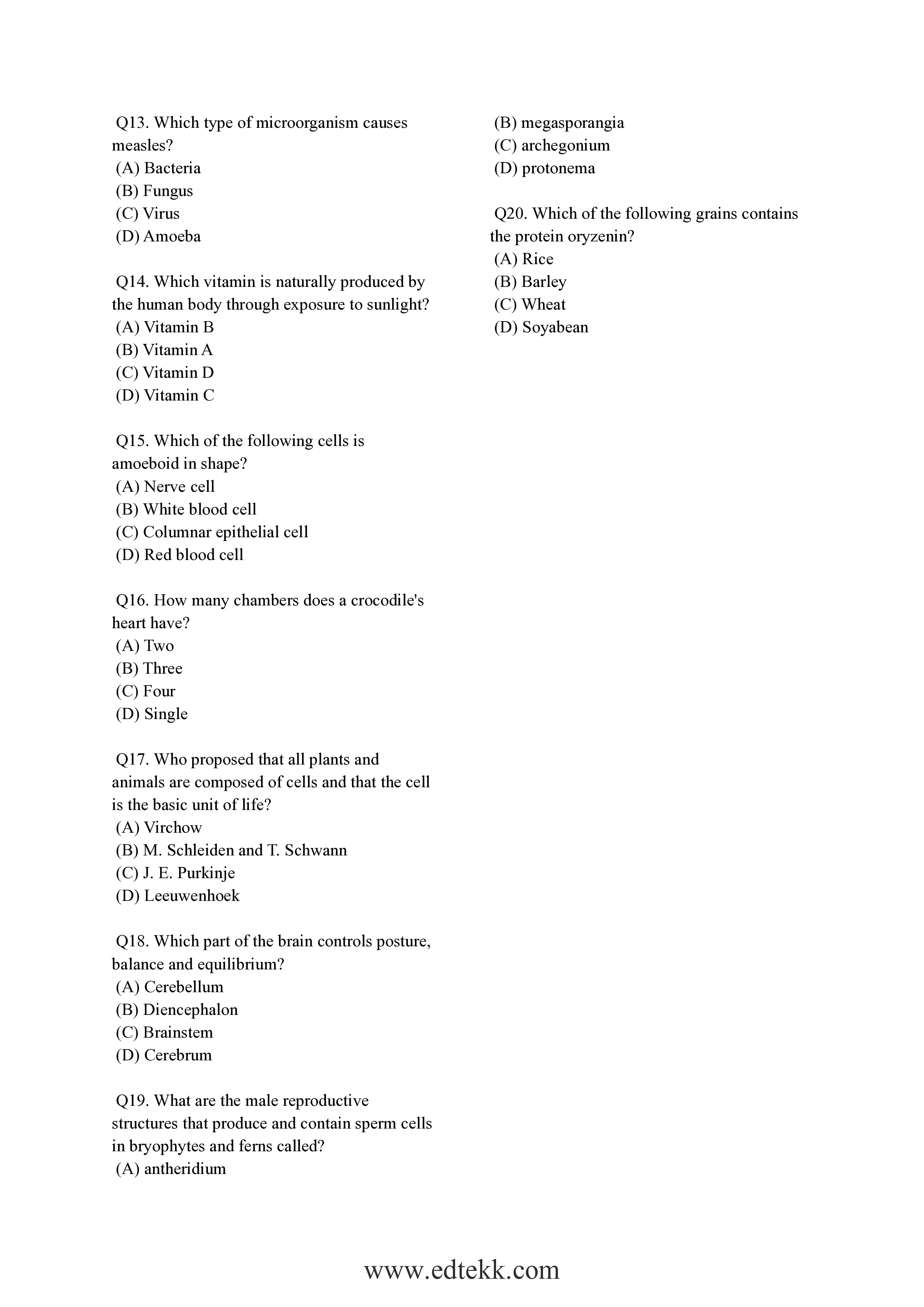
Q13. Which type of microorganism causes measles?
(A) Bacteria
(B) Fungus
(C) Virus
(D) Amoeba
Explanation: Measles is a highly contagious viral disease caused by the measles virus, which belongs to the genus Morbillivirus. It spreads primarily through airborne particles and respiratory secretions. Common symptoms include fever, cough, runny nose, conjunctivitis and a characteristic skin rash. Vaccination provides effective protection against measles.
Q14. Which vitamin is naturally produced by the human body through exposure to sunlight?
(A) Vitamin B
(B) Vitamin A
(C) Vitamin D
(D) Vitamin C
Explanation: Sunlight is the primary natural source that enables the human body to produce vitamin D. When ultraviolet B (UVB) radiation reaches the skin, it converts 7-dehydrocholesterol into previtamin D3, which subsequently forms vitamin D3. Vitamin D is essential for calcium absorption and maintaining healthy bones.
Q15. Which of the following cells is amoeboid in shape?
(A) Nerve cell
(B) White blood cell
(C) Columnar epithelial cell
(D) Red blood cell
Explanation: White blood cells, also called leukocytes, are generally amoeboid in shape. They can change their shape and form temporary projections to move through tissues and reach sites of infection. This movement is called amoeboid movement. Red blood cells, in contrast, have a characteristic biconcave disc shape.
Q16. How many chambers does a crocodile’s heart have?
(A) Two
(B) Three
(C) Four
(D) Single
Explanation: Crocodiles possess a four-chambered heart consisting of two atria and two ventricles. Unlike most reptiles, which generally have a three-chambered heart, crocodilians have complete separation between the right and left ventricles. However, specialised blood vessels permit controlled blood shunting under certain physiological conditions.
Q17. Who proposed that all plants and animals are composed of cells and that the cell is the basic unit of life?
(A) Virchow
(B) M. Schleiden and T. Schwann
(C) J. E. Purkinje
(D) Leeuwenhoek
Explanation: Matthias Schleiden and Theodor Schwann jointly developed the classical cell theory. Schleiden established that plants are composed of cells, while Schwann extended this principle to animals. Their work established the cell as the fundamental structural and functional unit of living organisms.
Q18. Which part of the brain controls posture, balance and equilibrium?
(A) Cerebellum
(B) Diencephalon
(C) Brainstem
(D) Cerebrum
Explanation: The cerebellum coordinates voluntary movements and plays a central role in maintaining posture, balance and equilibrium. It integrates information from the vestibular system, sensory receptors and other parts of the nervous system to produce smooth, coordinated movements. Damage to the cerebellum can cause impaired balance, uncoordinated movements and an unsteady gait.
Q19. What are the male reproductive structures that produce and contain sperm cells in bryophytes and ferns called?
(A) antheridium
(B) megasporangia
(C) archegonium
(D) protonema
Explanation: Antheridia are the male reproductive structures found in bryophytes and ferns. They produce and contain male gametes called antherozoids, which are generally flagellated and require water for fertilisation. Archegonia are the corresponding female reproductive structures that contain the egg cell.
Q20. Which of the following grains contains the protein oryzenin?
(A) Rice
(B) Barley
(C) Wheat
(D) Soyabean
Explanation: Oryzenin is the principal storage protein of rice and belongs to the glutelin group of proteins. It is found predominantly in the rice endosperm. Other cereals possess characteristic storage proteins, such as gliadins and glutenins in wheat and hordeins in barley.
Question Paper Images