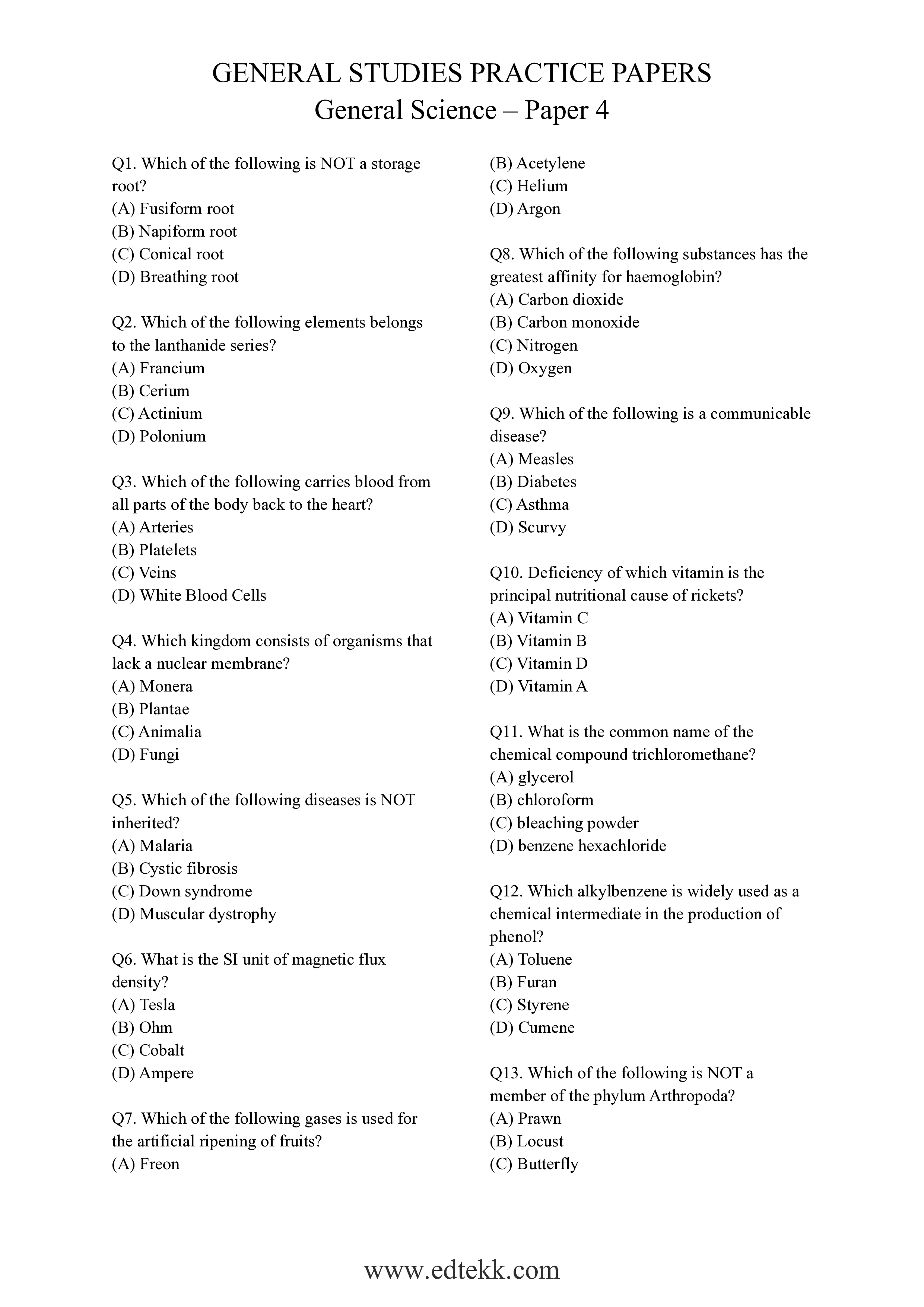
Test and strengthen your understanding of General Science with General Studies Practice Paper 4. This question set includes objective practice questions, answers and explanations to support systematic revision for SSC, Railway, State PSC, Police Constable and Police SI examinations.
Test Details
Topic: General Science
Total Questions: 20
Question Format: MCQs – Single Correct Answer
Suitable for: SSC exams, Railway exams, State PSC, Police Constable, Police SI
Download All Papers in This Series (PDF)
Questions and Answers
Q1. Which of the following is NOT a storage root?
(A) Fusiform root
(B) Napiform root
(C) Conical root
(D) Breathing root
Explanation: Breathing roots, or pneumatophores, are specialised roots that grow upward from waterlogged, oxygen-deficient soil and facilitate gaseous exchange through lenticels. They occur in certain mangroves, such as Avicennia. Napiform, conical and fusiform roots are storage modifications of taproots. Therefore, breathing roots are not storage roots.
Q2. Which of the following elements belongs to the lanthanide series?
(A) Francium
(B) Cerium
(C) Actinium
(D) Polonium
Explanation: Cerium (Ce), with atomic number 58, belongs to the lanthanide series of the periodic table. Lanthanides generally extend from lanthanum (atomic number 57) to lutetium (atomic number 71). They are classified as rare-earth elements and are associated with the filling of the 4f subshell.
Q3. Which of the following carries blood from all parts of the body back to the heart?
(A) Arteries
(B) Platelets
(C) Veins
(D) White Blood Cells
Explanation: Veins generally carry blood from body tissues towards the heart. Most veins transport deoxygenated blood, although pulmonary veins carry oxygenated blood from the lungs to the heart. In contrast, arteries carry blood away from the heart, while white blood cells and platelets are components of blood.
Q4. Which kingdom consists of organisms that lack a nuclear membrane?
(A) Monera
(B) Plantae
(C) Animalia
(D) Fungi
Explanation: Monera includes prokaryotic organisms such as bacteria, which lack a membrane-bound nucleus. Their genetic material is located in a region called the nucleoid rather than being enclosed within a nuclear membrane. In contrast, organisms belonging to Fungi, Animalia and Plantae are eukaryotic and possess a true nucleus.
Q5. Which of the following diseases is NOT inherited?
(A) Malaria
(B) Cystic fibrosis
(C) Down syndrome
(D) Muscular dystrophy
Explanation: Malaria is an infectious disease caused by Plasmodium parasites and transmitted primarily through the bites of infected female Anopheles mosquitoes. It is acquired through infection rather than inherited genetically. Cystic fibrosis and muscular dystrophy are inherited genetic disorders, while Down syndrome usually results from a chromosomal abnormality.
Q6. What is the SI unit of magnetic flux density?
(A) Tesla
(B) Ohm
(C) Cobalt
(D) Ampere
Explanation: Tesla (T) is the SI unit of magnetic flux density, commonly called the magnetic field in elementary physics. One tesla is equivalent to one weber per square metre (Wb/m²). It is named after the scientist and inventor Nikola Tesla.
Q7. Which of the following gases is used for the artificial ripening of fruits?
(A) Freon
(B) Acetylene
(C) Helium
(D) Argon
Explanation: Acetylene can induce fruit ripening because it produces effects similar to ethylene, the natural plant-ripening hormone. It may be released through the reaction of calcium carbide with moisture. However, calcium carbide is prohibited for artificial fruit ripening in India because of associated health risks. Ethylene gas is the approved alternative when used under prescribed conditions.
Q8. Which of the following substances has the greatest affinity for haemoglobin?
(A) Carbon dioxide
(B) Carbon monoxide
(C) Nitrogen
(D) Oxygen
Explanation: Haemoglobin has a much greater affinity for carbon monoxide than for oxygen, approximately 200–250 times greater under commonly cited physiological conditions. Carbon monoxide forms carboxyhaemoglobin, reducing the blood’s oxygen-carrying capacity and impairing oxygen release to tissues. Exposure can cause severe, potentially fatal poisoning.
Q9. Which of the following is a communicable disease?
(A) Measles
(B) Diabetes
(C) Asthma
(D) Scurvy
Explanation: Measles is a highly contagious viral disease that spreads primarily through airborne particles released by infected individuals while breathing, coughing or sneezing. Scurvy results from vitamin C deficiency, asthma is a chronic respiratory condition, and diabetes is a metabolic disorder. These three conditions are not communicable diseases.
Q10. Deficiency of which vitamin is the principal nutritional cause of rickets?
(A) Vitamin C
(B) Vitamin B
(C) Vitamin D
(D) Vitamin A
Explanation: Vitamin D deficiency is the principal nutritional cause of rickets, a disease affecting bone mineralisation in children. Inadequate vitamin D reduces the absorption of calcium and phosphate, resulting in weak, soft bones that may become deformed. Insufficient calcium or phosphate can also cause rickets, but vitamin D is the correct answer among the given options.
Q11. What is the common name of the chemical compound trichloromethane?
(A) glycerol
(B) chloroform
(C) bleaching powder
(D) benzene hexachloride
Explanation: Trichloromethane (CHCl₃) is the IUPAC name of chloroform. It is a colourless, volatile liquid historically used as an anaesthetic and now mainly used as an industrial solvent and chemical intermediate. Its molecule contains one carbon atom, one hydrogen atom and three chlorine atoms.
Q12. Which alkylbenzene is widely used as a chemical intermediate in the production of phenol?
(A) Toluene
(B) Furan
(C) Styrene
(D) Cumene
Explanation: Cumene, also known as isopropylbenzene, is an alkylbenzene widely used as an industrial chemical intermediate. It is converted into cumene hydroperoxide through oxidation, followed by acid-catalysed cleavage to produce phenol and acetone. This industrial manufacturing method is known as the cumene process.
Q13. Which of the following is NOT a member of the phylum Arthropoda?
(A) Prawn
(B) Locust
(C) Butterfly
(D) Pila
Explanation: Pila, commonly known as the apple snail, belongs to the phylum Mollusca and is therefore not an arthropod. Locusts and butterflies belong to the class Insecta, while prawns are crustaceans. All three belong to the phylum Arthropoda.
Q14. What type of expansion causes the Eiffel Tower to become taller during summer?
(A) Gravitational
(B) Thermal
(C) Chemical
(D) Gradient
Explanation: Thermal expansion refers to the increase in the dimensions of a material when its temperature rises. The Eiffel Tower, which is primarily made of iron, expands during summer due to higher temperatures, resulting in a slight increase in its height. It contracts again when temperatures decrease.
Q15. According to the impulse–momentum theorem, which physical quantity changes when a force acts over a period of time?
(A) momentum
(B) acceleration
(C) torque
(D) velocity
Explanation: According to the impulse-momentum theorem, the impulse of the net force acting on a body equals the change in its momentum. Mathematically, (J=Delta p). For a constant net force, (FDelta t=Delta p), where (F) is the net force and (Delta t) is the time interval.
Q16. What is formed when a neutral helium atom loses one electron?
(A) Positive helium ion (He⁺)
(B) Alpha particle
(C) Negative helium ion
(D) Proton
Explanation: A neutral helium atom contains two protons and two electrons. When it loses one electron, it forms a singly positively charged helium ion (He⁺), which retains one electron. An alpha particle, by contrast, is a helium-4 nucleus containing two protons and two neutrons but no electrons, with a charge of +2e.
Q17. Which eco-friendly method uses earthworms to convert organic waste into nutrient-rich manure?
(A) Illuviation
(B) Eluviation
(C) Vermicomposting
(D) Leaching
Explanation: Vermicomposting is an environmentally friendly method of converting organic waste into nutrient-rich manure using earthworms and microorganisms. It can process biodegradable household, agricultural and garden waste. The resulting vermicompost improves soil structure, fertility and water-retention capacity.
Q18. Which of the following is not a naturally occurring greenhouse gas?
(A) Carbon dioxide
(B) Nitrogen
(C) Methane
(D) Water vapour
Explanation: Nitrogen (N₂) is not a greenhouse gas because its homonuclear diatomic molecules do not absorb infrared radiation effectively. In contrast, carbon dioxide, water vapour and methane absorb outgoing infrared radiation and contribute to the greenhouse effect.
Q19. Which naturally occurring acid is present in the stings of certain ants?
(A) Methanoic acid
(B) Oxalic acid
(C) Citric acid
(D) Lactic acid
Explanation: Methanoic acid, commonly known as formic acid, is naturally present in the venom of many ant species. It is responsible for the characteristic irritating sensation associated with certain ant stings. Its chemical formula is HCOOH. However, not all ant species use formic acid as their primary defensive chemical.
Q20. Which of the following is the primary constituent of pearls?
(A) Calcium carbonate
(B) Calcium sulphate
(C) Sodium bicarbonate
(D) Magnesium peroxide
Explanation: Pearls consist predominantly of calcium carbonate (CaCO₃), mainly in the crystalline form of aragonite, along with small amounts of calcite. These mineral components are embedded in an organic protein matrix called conchiolin, making calcium carbonate their principal inorganic constituent.
Question Paper Images