Enhance your preparation for Police Constable and Police SI examinations with General Science Practice Paper 5. This paper offers multiple-choice questions to help aspirants test their understanding of General Science, practise objective-type questions and strengthen their exam readiness with answers and explanations.
Test Details
Topic: General Science
Total Questions: 20
Question Format: MCQs – Single Correct Answer
Suitable for: Police Constable, Police SI
Download All Papers in This Series (PDF)
Questions and Answers
Q1. What is the process involving the successive stages of vaporisation and condensation called?
(A) Crystallisation
(B) Sublimation
(C) Distillation
(D) Chromatography
Explanation: Distillation is a separation process involving vaporisation followed by condensation. The liquid mixture is heated to convert a component into vapour, which is subsequently cooled to obtain it in liquid form. It is commonly used to separate liquids with different boiling points or recover a solvent from a solution.
Q2. Who coined the term “mitochondria”?
(A) Carl Benda
(B) Charles Laveran
(C) J E Salk
(D) Antonie van Leeuwenhoek
Explanation: The term mitochondria was coined by German anatomist Carl Benda in 1898. The word is derived from Greek terms meaning thread and granule, reflecting the appearance of these structures under a microscope. Mitochondria are membrane-bound organelles involved in cellular energy production, particularly through aerobic respiration and oxidative phosphorylation.
Q3. Which of Newton’s laws provides a quantitative definition of force?
(A) Second law of motion
(B) Third law of motion
(C) First law of motion
(D) Universal law of gravitation
Explanation: Newton’s second law provides a quantitative relationship between net force and the rate of change of momentum. For an object of constant mass, it is expressed as (F=ma). Newton’s first law explains inertia, while the third law describes action–reaction pairs. The law of universal gravitation explains gravitational attraction between masses.
Q4. Which vitamin is naturally produced by the human body through exposure to sunlight?
(A) Vitamin C
(B) Vitamin A
(C) Vitamin B
(D) Vitamin D
Explanation: Sunlight is the primary natural source that enables the human body to produce vitamin D. When ultraviolet B (UVB) radiation reaches the skin, it converts 7-dehydrocholesterol into previtamin D3, which subsequently forms vitamin D3. Vitamin D is essential for calcium absorption and maintaining healthy bones.
Q5. What is the process of treating domestic wastewater commonly called?
(A) sewage
(B) bacteria
(C) microbe
(D) pollutant
Explanation: Domestic wastewater is commonly referred to as sewage, and its treatment is called sewage treatment. It involves physical, biological and sometimes chemical processes to remove suspended solids, organic matter, harmful microorganisms and other pollutants before the treated water is discharged or reused.
Q6. What is the name of the compound with the chemical formula CH₃CH₂OH?
(A) Ethanol
(B) Methane
(C) Acetic Acid
(D) Chloroform
Explanation: CH₃CH₂OH is the chemical formula of ethanol, a two-carbon alcohol containing a hydroxyl group (-OH). It is also known as ethyl alcohol and is the characteristic alcohol present in alcoholic beverages.
Q7. What are the symbiotic organisms that form slow-growing coloured patches on tree bark called?
(A) Aphids
(B) Lichens
(C) Egrets
(D) Shrimps
Explanation: Lichens are associations between a fungus and a photosynthetic partner, usually a green alga or cyanobacterium. They commonly grow slowly on tree bark, rocks and other surfaces, forming coloured patches. The fungal partner provides structural support and helps retain moisture, while the photosynthetic partner produces organic nutrients.
Q8. Which of the following materials is primarily used to manufacture integrated circuits?
(A) Glass
(B) Iron
(C) Silicon
(D) Aluminum
Explanation: Silicon is the primary semiconductor material used in manufacturing integrated circuits. Its electrical conductivity can be controlled through doping and other fabrication techniques. Transistors, diodes and other electronic components are fabricated on a silicon substrate to form integrated circuits.
Q9. What is the chemical name of baking soda?
(A) Sodium carbonate
(B) Calcium hydroxide
(C) Sodium hydrogen carbonate
(D) Sulphate
Explanation: Baking soda is the common name for sodium hydrogen carbonate, also known as sodium bicarbonate. Its chemical formula is NaHCO₃. It is a mildly alkaline compound used as a leavening agent in baking. It releases carbon dioxide when heated or when it reacts with acids.
Q10. What is the size of the image formed by a concave mirror when an object is placed between its pole and principal focus?
(A) Diminished
(B) Same Size
(C) Enlarged
(D) Point Size
Explanation: When an object is placed between the pole and principal focus of a concave mirror, the reflected rays diverge and their extensions meet behind the mirror. The resulting image is virtual, erect and enlarged. This property makes concave mirrors useful in shaving and makeup mirrors.
Q11. Which branch of biology studies the microscopic structure of cells, tissues and organs?
(A) Entomology
(B) Ichthyology
(C) Histology
(D) Paleontology
Explanation: Histology is the branch of biology concerned primarily with the microscopic study of tissues and their organisation. It examines tissue structure and the relationship between structure and function using microscopes. It is particularly important in anatomy, pathology and medical diagnosis.
Q12. Where does internal fertilisation take place?
(A) Inside the male’s body
(B) Inside the female’s reproductive tract
(C) Outside the male’s body
(D) Outside the female’s body
Explanation: Internal fertilisation occurs when male and female gametes fuse within the female reproductive tract. It occurs in humans and many other animals, including birds, reptiles and mammals. In humans, fertilisation normally takes place in the fallopian tube, usually in its ampullary region. In external fertilisation, gamete fusion occurs outside the female’s body.
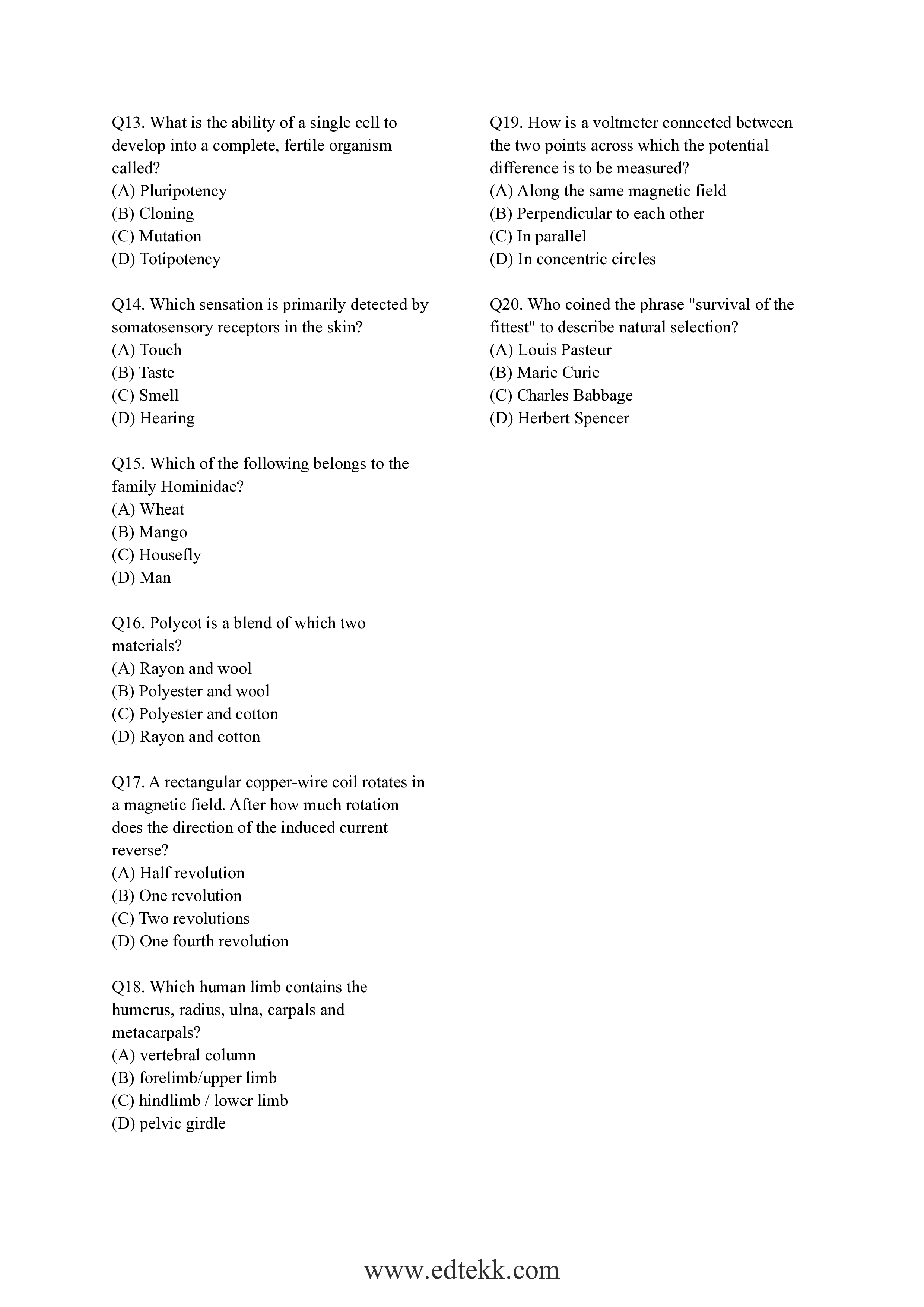
Q13. What is the ability of a single cell to develop into a complete, fertile organism called?
(A) Pluripotency
(B) Cloning
(C) Mutation
(D) Totipotency
Explanation: Totipotency is the ability of a single cell to develop into a complete organism under suitable conditions. A totipotent cell can give rise to all cell types, including embryonic and extraembryonic tissues. The zygote is a classic example of a totipotent cell.
Q14. Which sensation is primarily detected by somatosensory receptors in the skin?
(A) Touch
(B) Taste
(C) Smell
(D) Hearing
Explanation: Touch is detected by somatosensory receptors in the skin, including mechanoreceptors that respond to pressure, vibration and skin deformation. Other sensory receptors detect temperature and potentially damaging stimuli. Taste, smell and hearing depend on specialised receptors located primarily in the tongue, nasal cavity and inner ear, respectively.
Q15. Which of the following belongs to the family Hominidae?
(A) Wheat
(B) Mango
(C) Housefly
(D) Man
Explanation: Humans belong to the family Hominidae, which includes the great apes, namely chimpanzees, gorillas, orangutans and humans. Mango and wheat are plants, while houseflies belong to the phylum Arthropoda.
Q16. Polycot is a blend of which two materials?
(A) Rayon and wool
(B) Polyester and wool
(C) Polyester and cotton
(D) Rayon and cotton
Explanation: Polycot, also known as polycotton, is a blended fabric made from polyester and cotton fibres. Polyester provides strength, durability and wrinkle resistance, while cotton contributes softness, comfort and moisture absorption. The blend combines the useful properties of both fibres.
Q17. A rectangular copper-wire coil rotates in a magnetic field. After how much rotation does the direction of the induced current reverse?
(A) Half revolution
(B) One revolution
(C) Two revolutions
(D) One fourth revolution
Explanation: The direction of induced current in a rotating rectangular coil reverses after every half revolution (180°). This occurs because the direction of motion of the coil’s sides relative to the magnetic field reverses. This principle is used in an alternating-current (AC) generator.
Q18. Which human limb contains the humerus, radius, ulna, carpals and metacarpals?
(A) vertebral column
(B) forelimb/upper limb
(C) hindlimb / lower limb
(D) pelvic girdle
Explanation: The forelimb, or upper limb, includes the humerus, radius, ulna, carpals, metacarpals and phalanges. The humerus forms the upper arm, while the radius and ulna form the forearm. Carpals constitute the wrist bones, and metacarpals form the framework of the palm.
Q19. How is a voltmeter connected between the two points across which the potential difference is to be measured?
(A) Along the same magnetic field
(B) Perpendicular to each other
(C) In parallel
(D) In concentric circles
Explanation: A voltmeter is connected in parallel across the two points between which the potential difference is to be measured. It has very high resistance, so it draws negligible current from the circuit and minimises disturbance to the potential difference being measured.
Q20. Who coined the phrase “survival of the fittest” to describe natural selection?
(A) Louis Pasteur
(B) Marie Curie
(C) Charles Babbage
(D) Herbert Spencer
Explanation: The phrase “survival of the fittest” was coined by Herbert Spencer in his work on evolutionary theory. Charles Darwin subsequently adopted the expression in the fifth edition of On the Origin of Species (1869). It describes the differential survival and reproductive success of organisms better adapted to their environments.
Question Paper Images