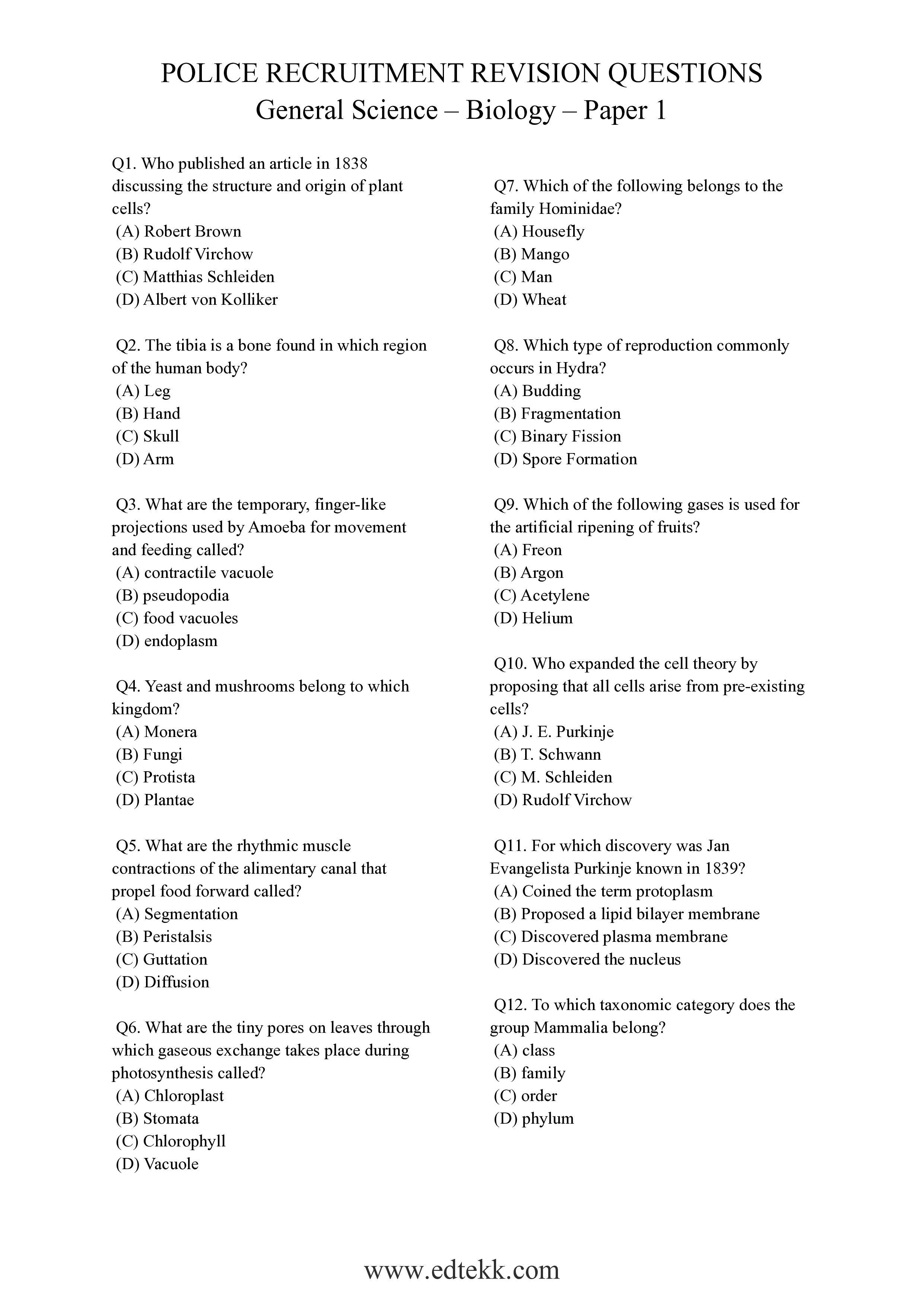
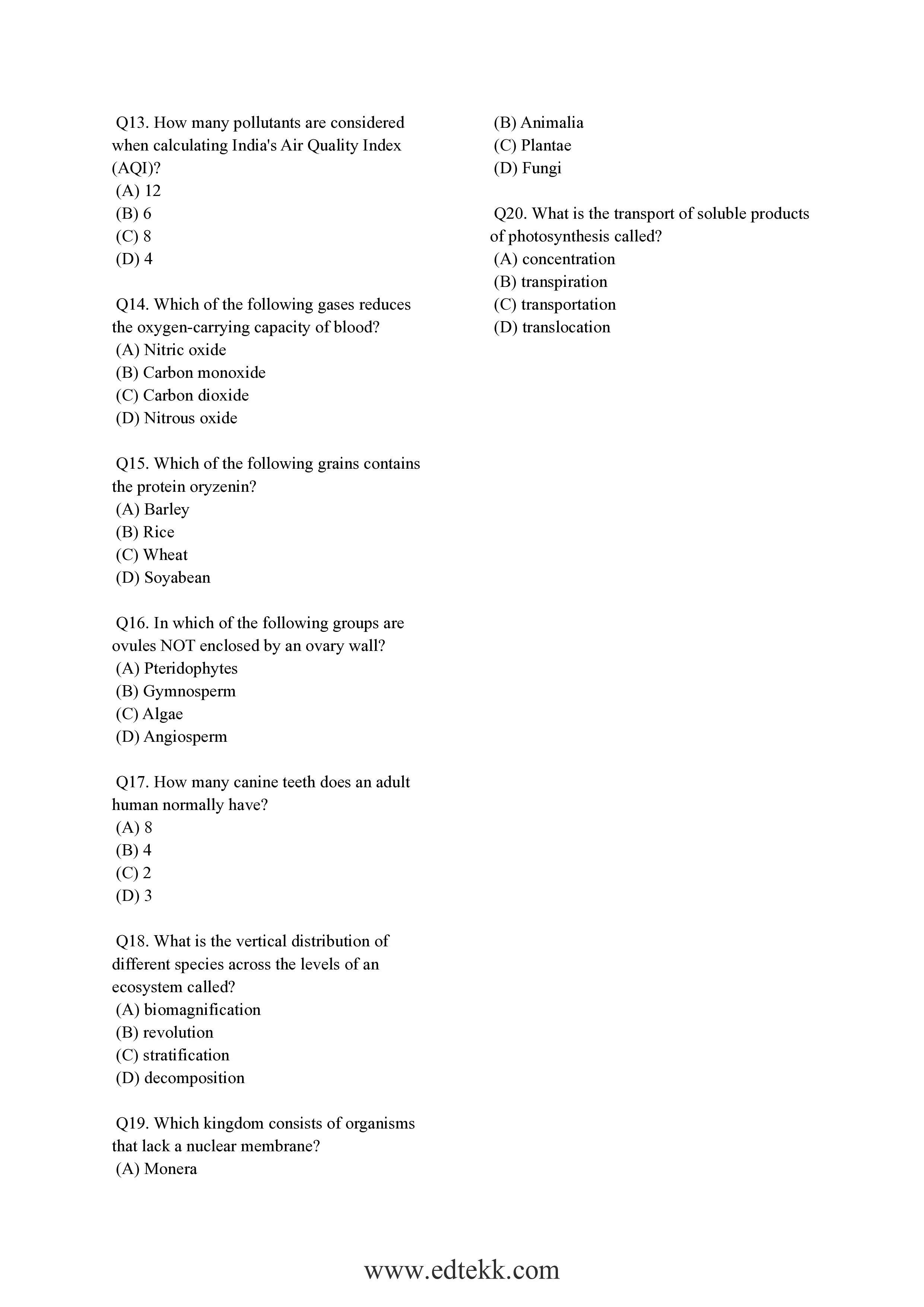
Build a strong foundation in Biology for Police Constable and Police SI recruitment examinations with this General Science revision paper. It includes 20 objective-type MCQs covering important Biology concepts, accompanied by correct answers and explanations for effective revision and better understanding of fundamental topics.
Test Details
Topic: Biology
Total Questions: 20
Question Format: MCQs – Single Correct Answer
Suitable for: Police Constable, Police SI
Download All Papers in This Series (PDF)
Questions and Answers
Q1. Who published an article in 1838 discussing the structure and origin of plant cells?
(A) Robert Brown
(B) Rudolf Virchow
(C) Matthias Schleiden
(D) Albert von Kolliker
Explanation: Matthias Schleiden, a German botanist, published his work on plant cells in 1838. He proposed that plants are composed of cells and that the cell is the basic structural unit of plant life. His work, together with Theodor Schwann’s subsequent studies on animals, contributed to the development of cell theory.
Q2. The tibia is a bone found in which region of the human body?
(A) Leg
(B) Hand
(C) Skull
(D) Arm
Explanation: The tibia, commonly known as the shinbone, is the larger weight-bearing bone of the lower leg. It extends from the knee to the ankle and lies alongside the smaller fibula. It forms part of both the knee and ankle joints.
Q3. What are the temporary, finger-like projections used by Amoeba for movement and feeding called?
(A) contractile vacuole
(B) pseudopodia
(C) food vacuoles
(D) endoplasm
Explanation: Pseudopodia are temporary, finger-like projections of the cytoplasm formed by Amoeba. The term literally means ‘false feet’. They help the organism move and capture food through phagocytosis. During feeding, pseudopodia surround food particles and enclose them within food vacuoles for digestion.
Q4. Yeast and mushrooms belong to which kingdom?
(A) Monera
(B) Fungi
(C) Protista
(D) Plantae
Explanation: Yeast and mushrooms belong to kingdom Fungi. Fungi are eukaryotic, heterotrophic organisms that obtain nutrients through absorption. Yeast is generally unicellular and reproduces mainly by budding, whereas mushrooms are multicellular fungi with specialised reproductive structures.
Q5. What are the rhythmic muscle contractions of the alimentary canal that propel food forward called?
(A) Segmentation
(B) Peristalsis
(C) Guttation
(D) Diffusion
Explanation: Peristalsis refers to coordinated, wave-like contractions and relaxations of the smooth muscles lining the alimentary canal. These movements propel food through the digestive tract, moving it along the oesophagus and through the stomach and intestines. Peristalsis is essential for the onward transport of food during digestion.
Q6. What are the tiny pores on leaves through which gaseous exchange takes place during photosynthesis called?
(A) Chloroplast
(B) Stomata
(C) Chlorophyll
(D) Vacuole
Explanation: Stomata are microscopic pores found mainly on the epidermis of leaves. They facilitate gaseous exchange, allowing carbon dioxide to enter for photosynthesis and oxygen and water vapour to move out. Each stoma is surrounded by specialised guard cells.
Q7. Which of the following belongs to the family Hominidae?
(A) Housefly
(B) Mango
(C) Man
(D) Wheat
Explanation: Humans belong to the family Hominidae, which includes the great apes, namely chimpanzees, gorillas, orangutans and humans. Mango and wheat are plants, while houseflies belong to the phylum Arthropoda.
Q8. Which type of reproduction commonly occurs in Hydra?
(A) Budding
(B) Fragmentation
(C) Binary Fission
(D) Spore Formation
Explanation: Hydra commonly reproduces asexually through budding. A small outgrowth develops on the parent’s body through repeated cell division, gradually forming a mouth and tentacles. Once fully developed, the bud separates from the parent and becomes an independent individual. Hydra can also reproduce sexually under certain environmental conditions.
Q9. Which of the following gases is used for the artificial ripening of fruits?
(A) Freon
(B) Argon
(C) Acetylene
(D) Helium
Explanation: Acetylene can induce fruit ripening because it produces effects similar to ethylene, the natural plant-ripening hormone. It may be released through the reaction of calcium carbide with moisture. However, calcium carbide is prohibited for artificial fruit ripening in India because of associated health risks. Ethylene gas is the approved alternative when used under prescribed conditions.
Q10. Who expanded the cell theory by proposing that all cells arise from pre-existing cells?
(A) J. E. Purkinje
(B) T. Schwann
(C) M. Schleiden
(D) Rudolf Virchow
Explanation: Rudolf Virchow expanded the cell theory by proposing that new cells arise from pre-existing cells. This principle is commonly expressed as “Omnis cellula e cellula”. It established that cells do not arise spontaneously but are produced through the division of existing cells.
Q11. For which discovery was Jan Evangelista Purkinje known in 1839?
(A) Coined the term protoplasm
(B) Proposed a lipid bilayer membrane
(C) Discovered plasma membrane
(D) Discovered the nucleus
Explanation: Jan Evangelista Purkinje introduced the term protoplasm in 1839 to describe the living substance within cells. The term subsequently became important in cell biology for referring to the living contents of a cell. Purkinje also made significant contributions to physiology and the study of nervous tissue.
Q12. To which taxonomic category does the group Mammalia belong?
(A) class
(B) family
(C) order
(D) phylum
Explanation: Mammalia is a class in the taxonomic hierarchy. It includes humans, whales, bats and elephants. Mammals are characterised by mammary glands, hair at some stage of life, and three middle-ear bones. Most mammals possess external ears (pinnae), although these are absent in some groups, such as whales.
Q13. How many pollutants are considered when calculating India’s Air Quality Index (AQI)?
(A) 12
(B) 6
(C) 8
(D) 4
Explanation: India’s National Air Quality Index (NAQI) considers eight pollutants: particulate matter (PM10 and PM2.5), nitrogen dioxide (NO2), sulphur dioxide (SO2), carbon monoxide (CO), ozone (O3), ammonia (NH3) and lead (Pb). Their concentrations are monitored to assess ambient air quality and communicate associated health risks.
Q14. Which of the following gases reduces the oxygen-carrying capacity of blood?
(A) Nitric oxide
(B) Carbon monoxide
(C) Carbon dioxide
(D) Nitrous oxide
Explanation: Carbon monoxide reduces the oxygen-carrying capacity of blood by binding to haemoglobin with an affinity approximately 200–250 times greater than that of oxygen. This forms carboxyhaemoglobin, reducing oxygen transport and impairing oxygen release to tissues. Severe carbon monoxide poisoning can cause tissue hypoxia, unconsciousness and death.
Q15. Which of the following grains contains the protein oryzenin?
(A) Barley
(B) Rice
(C) Wheat
(D) Soyabean
Explanation: Oryzenin is the principal storage protein of rice and belongs to the glutelin group of proteins. It is found predominantly in the rice endosperm. Other cereals possess characteristic storage proteins, such as gliadins and glutenins in wheat and hordeins in barley.
Q16. In which of the following groups are ovules NOT enclosed by an ovary wall?
(A) Pteridophytes
(B) Gymnosperm
(C) Algae
(D) Angiosperm
Explanation: Gymnosperms possess naked ovules that are not enclosed within an ovary wall. Their seeds develop exposed on specialised structures, commonly associated with cones. This distinguishes them from angiosperms, in which ovules are enclosed within an ovary that generally develops into a fruit after fertilisation.
Q17. How many canine teeth does an adult human normally have?
(A) 8
(B) 4
(C) 2
(D) 3
Explanation: An adult human normally has four canine teeth: two in the upper jaw and two in the lower jaw. Canines are pointed teeth located between the incisors and premolars. They help tear food and contribute to the alignment and guidance of teeth during jaw movements.
Q18. What is the vertical distribution of different species across the levels of an ecosystem called?
(A) biomagnification
(B) revolution
(C) stratification
(D) decomposition
Explanation: Stratification refers to the vertical distribution of different species or communities at different levels in an ecosystem. For example, forest vegetation may be arranged into distinct layers, including the canopy, understory, shrub layer and forest floor.
Q19. Which kingdom consists of organisms that lack a nuclear membrane?
(A) Monera
(B) Animalia
(C) Plantae
(D) Fungi
Explanation: Monera includes prokaryotic organisms such as bacteria, which lack a membrane-bound nucleus. Their genetic material is located in a region called the nucleoid rather than being enclosed within a nuclear membrane. In contrast, organisms belonging to Fungi, Animalia and Plantae are eukaryotic and possess a true nucleus.
Q20. What is the transport of soluble products of photosynthesis called?
(A) concentration
(B) transpiration
(C) transportation
(D) translocation
Explanation: Translocation is the movement of soluble products of photosynthesis, particularly sucrose, from source regions such as leaves to sink regions such as roots, fruits and growing tissues. This transport occurs through the phloem.
Question Paper Images