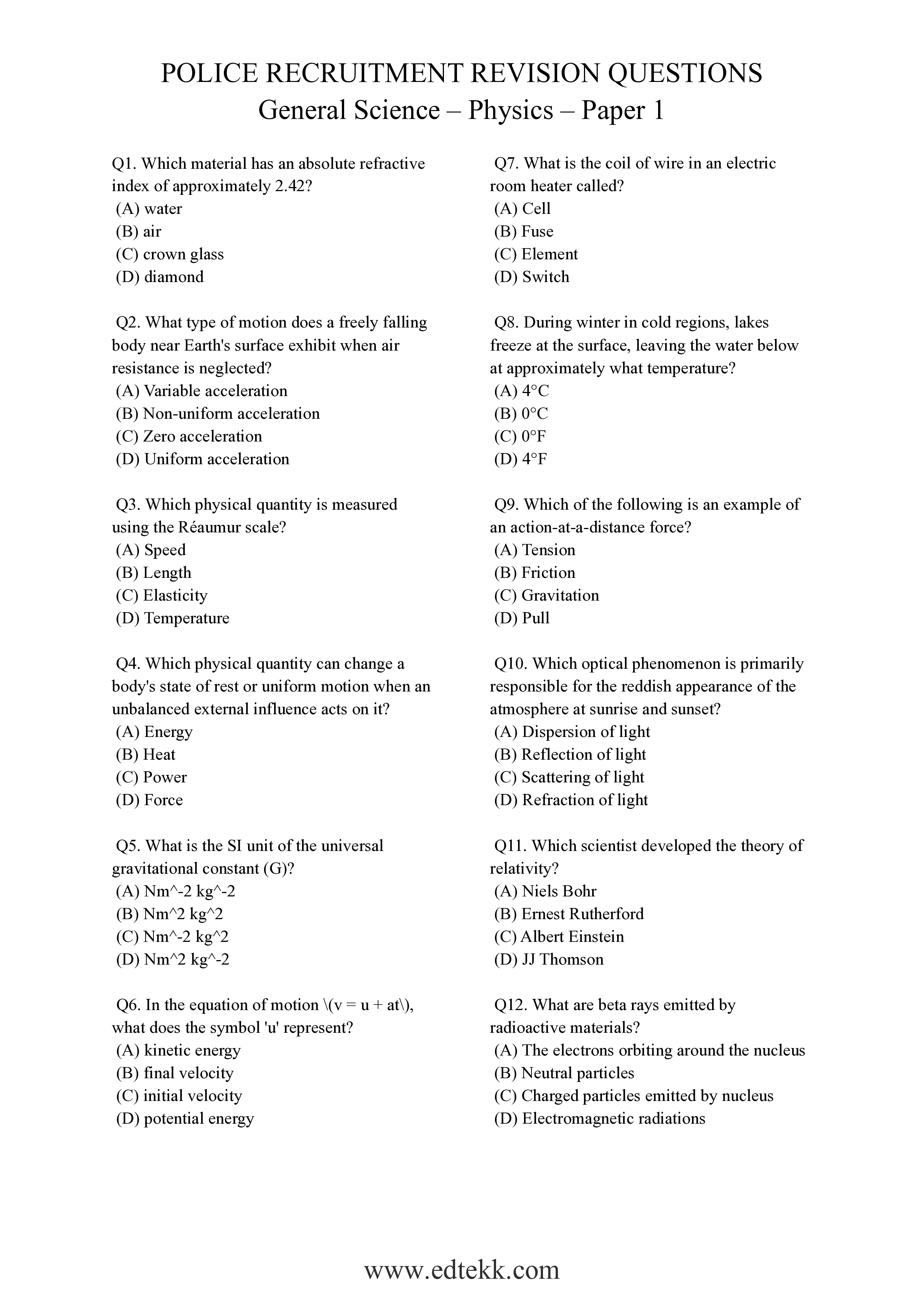
Prepare for Police Constable and Police SI examinations with this General Science Physics revision practice set. This paper covers important Physics concepts through 20 objective-type MCQs, along with correct answers and detailed explanations to strengthen conceptual understanding and improve examination readiness.
Test Details
Topic: Physics
Total Questions: 20
Question Format: MCQs – Single Correct Answer
Suitable for: Police Constable, Police SI
Download All Papers in This Series (PDF)
Questions and Answers
Q1. Which material has an absolute refractive index of approximately 2.42?
(A) water
(B) air
(C) crown glass
(D) diamond
Explanation: Diamond has an absolute refractive index of approximately 2.42. The absolute refractive index of a medium is the ratio of the speed of light in vacuum to its speed in that medium. Diamond has a high refractive index because light travels considerably slower through it than through air or water.
Q2. What type of motion does a freely falling body near Earth’s surface exhibit when air resistance is neglected?
(A) Variable acceleration
(B) Non-uniform acceleration
(C) Zero acceleration
(D) Uniform acceleration
Explanation: A freely falling body near Earth’s surface experiences approximately constant gravitational acceleration when air resistance is neglected and the distance travelled is relatively small. This acceleration is approximately 9.8 m/s², directed vertically downward. Hence, its motion is an example of uniformly accelerated motion.
Q3. Which physical quantity is measured using the Réaumur scale?
(A) Speed
(B) Length
(C) Elasticity
(D) Temperature
Explanation: The Réaumur scale is a historical temperature scale in which the freezing point of water is 0°Ré and its boiling point is 80°Ré at standard atmospheric pressure. It was formerly used in some European countries but has largely been replaced by the Celsius scale.
Q4. Which physical quantity can change a body’s state of rest or uniform motion when an unbalanced external influence acts on it?
(A) Energy
(B) Heat
(C) Power
(D) Force
Explanation: Force is an external influence that can change an object’s state of rest or uniform motion. An unbalanced net force produces acceleration, resulting in a change in speed, direction or both. According to Newton’s second law, acceleration is directly proportional to the net force and inversely proportional to the object’s mass.
Q5. What is the SI unit of the universal gravitational constant (G)?
(A) Nm^-2 kg^-2
(B) Nm^2 kg^2
(C) Nm^-2 kg^2
(D) Nm^2 kg^-2
Explanation: The SI unit of the universal gravitational constant ((G)) is N m² kg⁻². According to Newton’s law of universal gravitation, it relates the gravitational force between two masses to their masses and the square of the distance between them. Its approximate value is (6.674 times 10^{-11}) N m² kg⁻².
Q6. In the equation of motion (v = u + at), what does the symbol ‘u’ represent?
(A) kinetic energy
(B) final velocity
(C) initial velocity
(D) potential energy
Explanation: In the equation of motion (v = u + at), (u) represents initial velocity, (v) represents final velocity, (a) represents uniform acceleration and (t) represents the time interval. This equation applies to motion with constant acceleration.
Q7. What is the coil of wire in an electric room heater called?
(A) Cell
(B) Fuse
(C) Element
(D) Switch
Explanation: The coil of wire in an electric room heater is called the heating element. It is generally made of a high-resistivity alloy such as nichrome. When electric current passes through it, electrical energy is converted into heat due to its resistance, producing the heating effect.
Q8. During winter in cold regions, lakes freeze at the surface, leaving the water below at approximately what temperature?
(A) 4°C
(B) 0°C
(C) 0°F
(D) 4°F
Explanation: Water has maximum density at approximately 4°C. During winter, water colder than 4°C becomes less dense and remains near the surface, eventually freezing. Consequently, the deeper water generally remains close to 4°C, allowing aquatic organisms to survive beneath the ice.
Q9. Which of the following is an example of an action-at-a-distance force?
(A) Tension
(B) Friction
(C) Gravitation
(D) Pull
Explanation: Gravitation is an action-at-a-distance force because it acts between objects without requiring direct physical contact. Every object having mass attracts every other object having mass. In contrast, friction and tension are contact forces that require physical interaction between objects.
Q10. Which optical phenomenon is primarily responsible for the reddish appearance of the atmosphere at sunrise and sunset?
(A) Dispersion of light
(B) Reflection of light
(C) Scattering of light
(D) Refraction of light
Explanation: The redness of the sky at sunrise and sunset is primarily caused by the scattering of sunlight in the atmosphere. Sunlight travels through a longer atmospheric path, causing shorter wavelengths, particularly blue light, to be scattered more strongly out of the direct beam. Consequently, the transmitted sunlight appears richer in red and orange wavelengths.
Q11. Which scientist developed the theory of relativity?
(A) Niels Bohr
(B) Ernest Rutherford
(C) Albert Einstein
(D) JJ Thomson
Explanation: Albert Einstein developed the special theory of relativity in 1905 and the general theory of relativity, published in its final form in 1915. These theories revolutionised the understanding of space, time, gravity and motion. Niels Bohr, Ernest Rutherford and J. J. Thomson contributed significantly to atomic physics.
Q12. What are beta rays emitted by radioactive materials?
(A) The electrons orbiting around the nucleus
(B) Neutral particles
(C) Charged particles emitted by nucleus
(D) Electromagnetic radiations
Explanation: Beta rays consist of high-speed charged particles emitted during radioactive decay. Beta-minus (β⁻) particles are electrons, while beta-plus (β⁺) particles are positrons. These particles are produced during nuclear transformations and are not ordinary orbital electrons. Unlike gamma rays, beta rays are particulate radiation rather than electromagnetic radiation.
Q13. What state of matter is acquired by a gas of very low density when cooled to an extremely low temperature under suitable conditions?
(A) Liquid
(B) Plasma
(C) Bose – Einstein condensation
(D) Solid
Explanation: At sufficiently low temperatures and under suitable conditions, a dilute gas of bosonic particles can undergo Bose–Einstein condensation. In this state, a macroscopic number of particles occupy the same lowest-energy quantum state. Low temperature and low density alone are not sufficient; appropriate quantum and thermodynamic conditions are necessary.
Q14. How is a voltmeter connected between the two points across which the potential difference is to be measured?
(A) Along the same magnetic field
(B) In parallel
(C) In concentric circles
(D) Perpendicular to each other
Explanation: A voltmeter is connected in parallel across the two points between which the potential difference is to be measured. It has very high resistance, so it draws negligible current from the circuit and minimises disturbance to the potential difference being measured.
Q15. Which colour in the VIBGYOR spectrum has the lowest energy?
(A) Green
(B) Violet
(C) Red
(D) Yellow
Explanation: Red light has the longest wavelength and the lowest frequency among the seven colours of visible light (VIBGYOR). Since the energy of a photon is directly proportional to its frequency, according to E = hν, red light has the minimum energy, whereas violet light has the maximum energy.
Q16. Which type of lens is commonly used to correct presbyopia?
(A) concave lens
(B) cylindrical lens
(C) convex lens
(D) bifocal lens
Explanation: Presbyopia is an age-related reduction in the eye’s ability to accommodate, making it difficult to focus on nearby objects. Bifocal lenses provide separate optical powers for distance and near vision. Progressive lenses are another common option, providing a gradual change in optical power without a visible dividing line.
Q17. How much heat energy, in joules, is released by a 20 W heating filament operating for 2 seconds?
(A) 80
(B) 10
(C) 20
(D) 40
Explanation: The heat energy produced by an electrical device is calculated using the formula (H=Ptimes t). Here, power is 20 W and time is 2 seconds. Therefore, (H=20times2=40) joules. This assumes that the filament operates at its rated power and all electrical energy is converted into heat.
Q18. Which of the following equations represents Ohm’s law?
(A) R = V × I
(B) V = I + R
(C) I = V × R
(D) V = IR
Explanation: Ohm’s law states that the potential difference across a conductor is directly proportional to the electric current flowing through it, provided its temperature and other physical conditions remain constant. Mathematically, it is expressed as V = IR, where V represents voltage, I represents current and R represents resistance.
Q19. What is the frequency range of ultrasonic sound?
(A) higher than 40 kHz
(B) higher than 20 kHz
(C) higher than 50 kHz
(D) higher than 30 kHz
Explanation: Ultrasonic sounds are sound waves having frequencies greater than 20,000 Hz (20 kHz), approximately the upper limit of normal human hearing. Humans generally cannot hear these frequencies. Ultrasound is widely used in medical imaging, industrial testing and distance measurement.
Q20. Which of the following is the SI unit of temperature?
(A) Kelvin
(B) Reaumur scale
(C) Candela
(D) Ampere
Explanation: The kelvin (K) is the SI base unit of thermodynamic temperature. It is used in scientific measurements and is distinct from the Celsius and Fahrenheit scales commonly used for everyday temperature measurements.
Question Paper Images