Improve your preparation for Police Constable and Police SI examinations with General Science Practice Paper 2. This question set provides multiple-choice practice on General Science, helping candidates revise essential concepts, assess their knowledge and understand correct answers through detailed explanations.
Test Details
Topic: General Science
Total Questions: 20
Question Format: MCQs – Single Correct Answer
Suitable for: Police Constable, Police SI
Download All Papers in This Series (PDF)
Questions and Answers
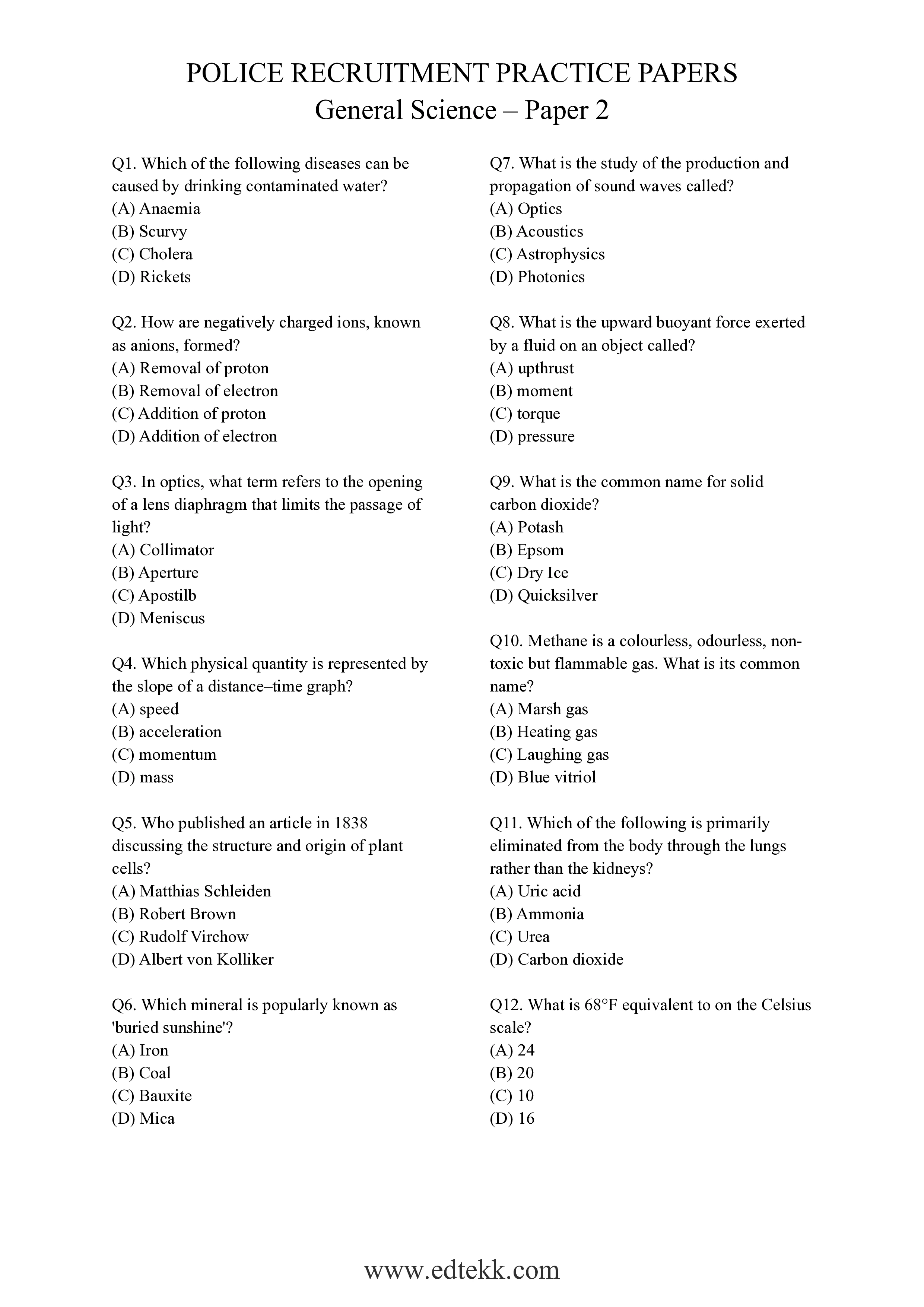
Q1. Which of the following diseases can be caused by drinking contaminated water?
(A) Anaemia
(B) Scurvy
(C) Cholera
(D) Rickets
Explanation: Cholera is an infectious disease caused by the bacterium Vibrio cholerae. It commonly spreads through drinking water or consuming food contaminated with the bacterium. The disease causes severe watery diarrhoea and vomiting, which can lead to dangerous dehydration and electrolyte loss if left untreated.
Q2. How are negatively charged ions, known as anions, formed?
(A) Removal of proton
(B) Removal of electron
(C) Addition of proton
(D) Addition of electron
Explanation: Anions are negatively charged ions commonly formed when neutral atoms gain one or more electrons. The additional electrons produce a net negative charge. For example, chlorine gains an electron to form chloride: Cl + e⁻ → Cl⁻. Conversely, the loss of electrons generally produces positively charged cations.
Q3. In optics, what term refers to the opening of a lens diaphragm that limits the passage of light?
(A) Collimator
(B) Aperture
(C) Apostilb
(D) Meniscus
Explanation: Aperture refers to the opening in an optical instrument through which light enters or passes. It determines the amount of light admitted by the optical system. A larger aperture generally allows more light to enter, while the diaphragm can regulate the effective aperture.
Q4. Which physical quantity is represented by the slope of a distance–time graph?
(A) speed
(B) acceleration
(C) momentum
(D) mass
Explanation: The slope of a distance–time graph represents speed. It is calculated as the change in distance divided by the corresponding time interval. A steeper slope indicates greater speed, while a horizontal line indicates that the object is at rest.
Q5. Who published an article in 1838 discussing the structure and origin of plant cells?
(A) Matthias Schleiden
(B) Robert Brown
(C) Rudolf Virchow
(D) Albert von Kolliker
Explanation: Matthias Schleiden, a German botanist, published his work on plant cells in 1838. He proposed that plants are composed of cells and that the cell is the basic structural unit of plant life. His work, together with Theodor Schwann’s subsequent studies on animals, contributed to the development of cell theory.
Q6. Which mineral is popularly known as ‘buried sunshine’?
(A) Iron
(B) Coal
(C) Bauxite
(D) Mica
Explanation: Coal is popularly known as buried sunshine because it originated from ancient plant matter that captured solar energy through photosynthesis. Over millions of years, heat and pressure transformed this buried organic material into coal, preserving energy originally derived from sunlight.
Q7. What is the study of the production and propagation of sound waves called?
(A) Optics
(B) Acoustics
(C) Astrophysics
(D) Photonics
Explanation: Acoustics is the branch of physics concerned with the production, transmission, propagation and effects of sound waves. It includes phenomena such as reflection, absorption, resonance and interference of sound. Optics deals with light, while astrophysics studies physical processes in celestial objects.
Q8. What is the upward buoyant force exerted by a fluid on an object called?
(A) upthrust
(B) moment
(C) torque
(D) pressure
Explanation: An object immersed wholly or partially in a fluid experiences an upward force called upthrust or buoyant force. According to Archimedes’ principle, the magnitude of this force equals the weight of the fluid displaced by the object.
Q9. What is the common name for solid carbon dioxide?
(A) Potash
(B) Epsom
(C) Dry Ice
(D) Quicksilver
Explanation: Solid carbon dioxide is commonly known as dry ice. Unlike ordinary ice, dry ice undergoes sublimation under normal atmospheric pressure, changing directly from a solid into a gas. It is widely used for refrigeration, food transportation and other cooling applications.
Q10. Methane is a colourless, odourless, non-toxic but flammable gas. What is its common name?
(A) Marsh gas
(B) Heating gas
(C) Laughing gas
(D) Blue vitriol
Explanation: Methane (CH₄) is commonly known as marsh gas because it is naturally produced in marshes, swamps and other oxygen-deficient environments through the anaerobic decomposition of organic matter by microorganisms. It is colourless, odourless in its pure form and highly flammable.
Q11. Which of the following is primarily eliminated from the body through the lungs rather than the kidneys?
(A) Uric acid
(B) Ammonia
(C) Urea
(D) Carbon dioxide
Explanation: Carbon dioxide is primarily eliminated through the lungs during exhalation. It is produced during cellular respiration and transported in the blood mainly as bicarbonate ions. In the lungs, bicarbonate is converted back into carbon dioxide, which diffuses into the alveoli and is exhaled. Urea and uric acid are eliminated mainly through the kidneys.
Q12. What is 68°F equivalent to on the Celsius scale?
(A) 24
(B) 20
(C) 10
(D) 16
Explanation: Fahrenheit temperature is converted into Celsius using the formula (C=(F-32)times5/9). Substituting 68°F gives ((68-32)times5/9=20°C). Therefore, 68 degrees Fahrenheit is equivalent to 20 degrees Celsius.
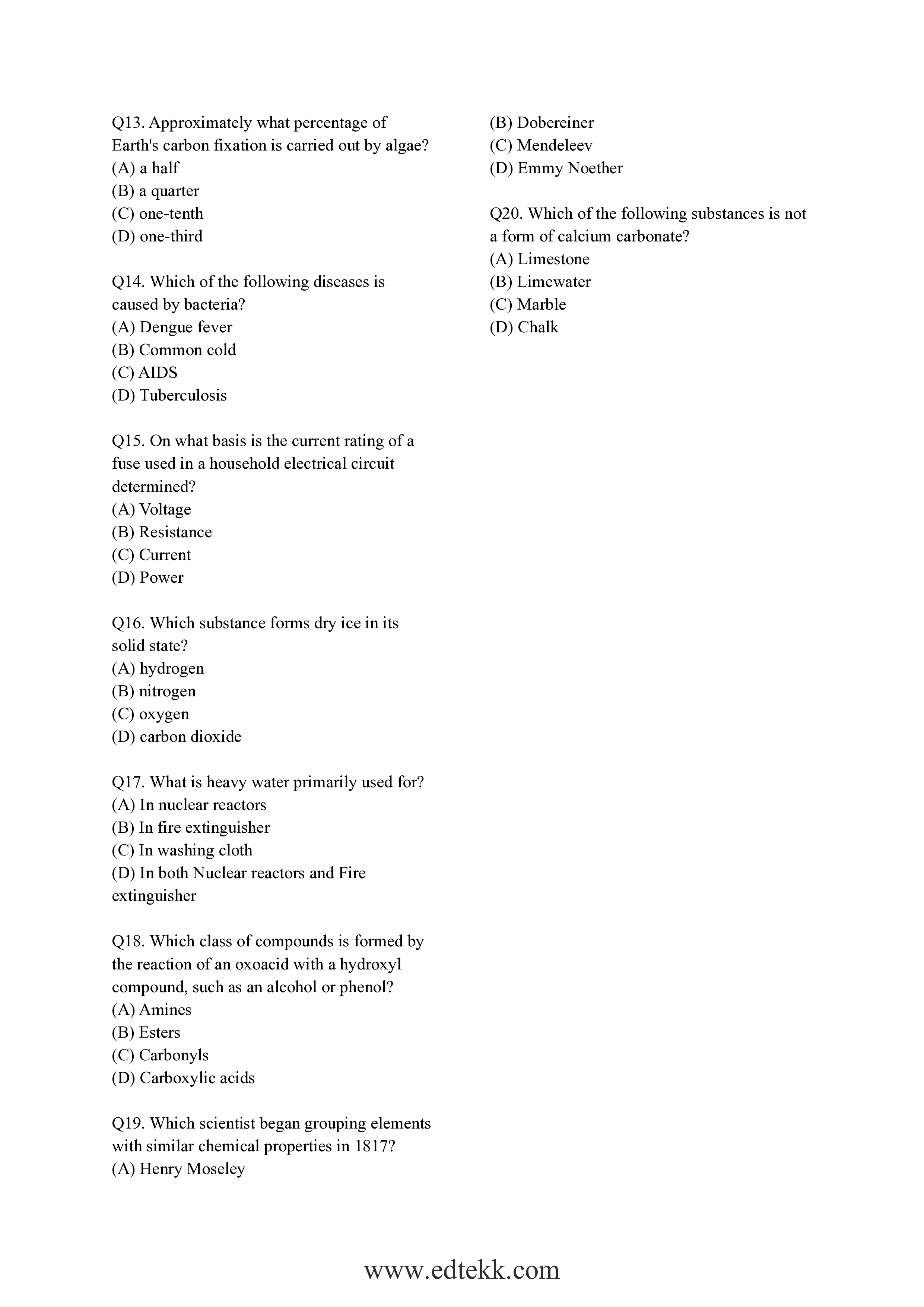
Q13. Approximately what percentage of Earth’s carbon fixation is carried out by algae?
(A) a half
(B) a quarter
(C) one-tenth
(D) one-third
Explanation: Algae, particularly microscopic marine phytoplankton, play a major role in global photosynthesis and carbon fixation. They account for approximately half of the Earth’s photosynthetic carbon fixation. By utilising dissolved carbon dioxide during photosynthesis, they contribute significantly to the global carbon cycle.
Q14. Which of the following diseases is caused by bacteria?
(A) Dengue fever
(B) Common cold
(C) AIDS
(D) Tuberculosis
Explanation: Tuberculosis (TB) is caused by bacteria belonging to the Mycobacterium tuberculosis complex. It most commonly affects the lungs and spreads through the air when a person with infectious TB releases airborne particles. The common cold and dengue are generally caused by viruses, while AIDS results from infection with HIV.
Q15. On what basis is the current rating of a fuse used in a household electrical circuit determined?
(A) Voltage
(B) Resistance
(C) Current
(D) Power
Explanation: A household electric fuse is rated according to the maximum current it can safely carry. If the current exceeds its rated value for sufficient time, the fuse wire heats up and melts, breaking the circuit. Fuse ratings are expressed in amperes and are selected according to the electrical load and circuit requirements.
Q16. Which substance forms dry ice in its solid state?
(A) hydrogen
(B) nitrogen
(C) oxygen
(D) carbon dioxide
Explanation: Dry ice is the solid form of carbon dioxide (CO₂). Under ordinary atmospheric pressure, it changes directly from solid to gas through a process called sublimation, without passing through the liquid state.
Q17. What is heavy water primarily used for?
(A) In nuclear reactors
(B) In fire extinguisher
(C) In washing cloth
(D) In both Nuclear reactors and Fire extinguisher
Explanation: Heavy water (D₂O) is primarily used as a neutron moderator in nuclear reactors. It slows down fast neutrons without absorbing many of them, thereby helping sustain the nuclear fission chain reaction. It is also used as a coolant in certain types of nuclear reactors.
Q18. Which class of compounds is formed by the reaction of an oxoacid with a hydroxyl compound, such as an alcohol or phenol?
(A) Amines
(B) Esters
(C) Carbonyls
(D) Carboxylic acids
Explanation: Esters are formed through esterification, a reaction between an oxoacid, commonly a carboxylic acid, and a hydroxyl-containing compound such as an alcohol or phenol. The reaction generally involves the elimination of water. Esters commonly have fruity odours and are widely used in perfumes, flavourings and solvents.
Q19. Which scientist began grouping elements with similar chemical properties in 1817?
(A) Henry Moseley
(B) Dobereiner
(C) Mendeleev
(D) Emmy Noether
Explanation: Johann Wolfgang Döbereiner began classifying elements with similar chemical properties in 1817. He subsequently developed the concept of triads, grouping three elements with similar properties. The atomic mass of the middle element was approximately the arithmetic mean of the other two.
Q20. Which of the following substances is not a form of calcium carbonate?
(A) Limestone
(B) Limewater
(C) Marble
(D) Chalk
Explanation: Limewater is a dilute aqueous solution of calcium hydroxide, Ca(OH)₂, and is not a form of calcium carbonate. Limestone, chalk and marble are naturally occurring rocks composed predominantly of calcium carbonate (CaCO₃).
Question Paper Images