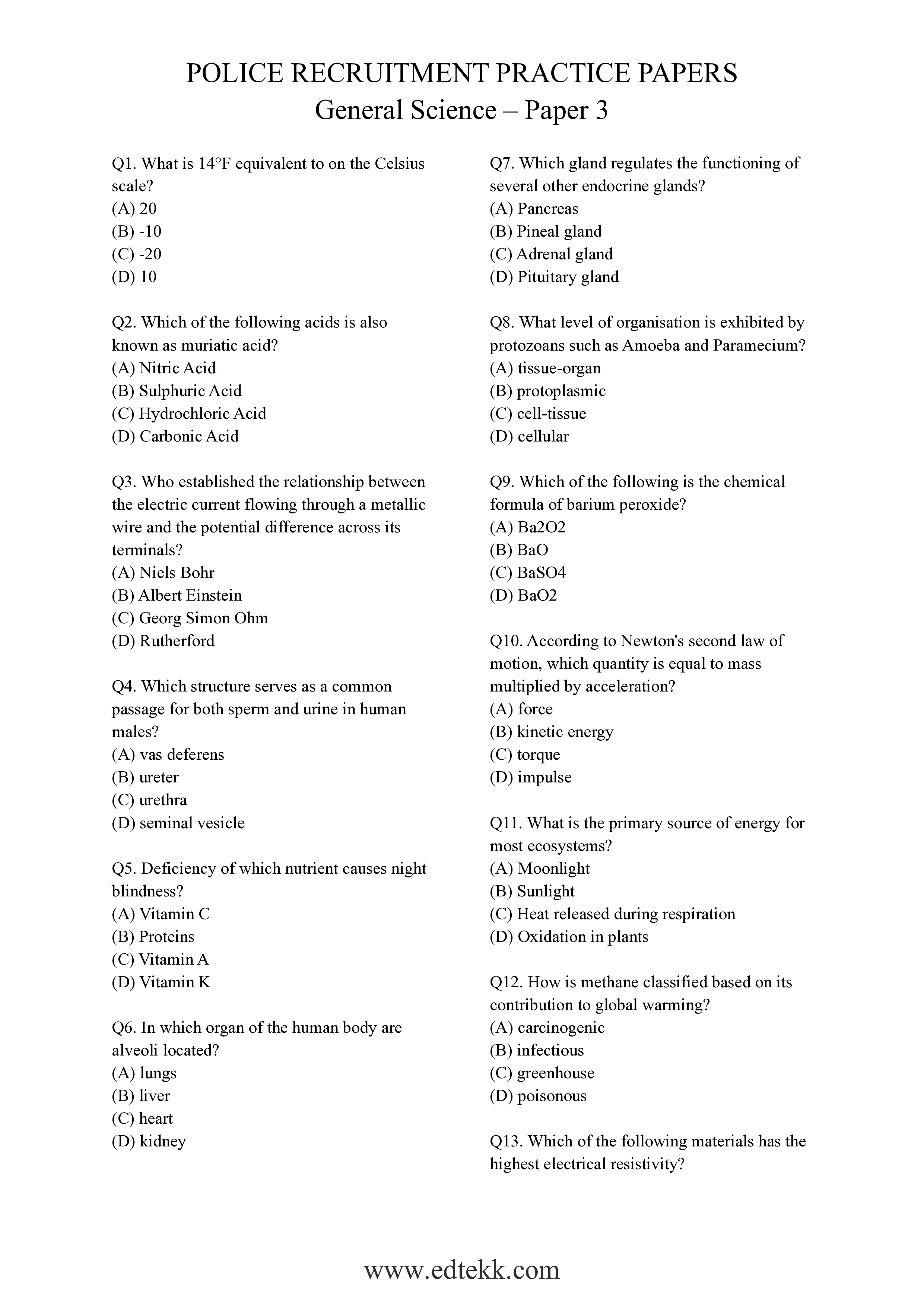
Strengthen your General Science preparation for Police Constable and Police SI recruitment examinations with Practice Paper 3. The set features objective-type questions covering General Science, along with answers and explanations to support revision, improve accuracy and build confidence for competitive examinations.
Test Details
Topic: General Science
Total Questions: 20
Question Format: MCQs – Single Correct Answer
Suitable for: Police Constable, Police SI
Download All Papers in This Series (PDF)
Questions and Answers
Q1. What is 14°F equivalent to on the Celsius scale?
(A) 20
(B) -10
(C) -20
(D) 10
Explanation: Fahrenheit temperature is converted into Celsius using the formula (C=(F-32)times5/9). For 14°F, the calculation is ((14-32)times5/9=-10°C). Therefore, 14 degrees Fahrenheit is equivalent to minus 10 degrees Celsius.
Q2. Which of the following acids is also known as muriatic acid?
(A) Nitric Acid
(B) Sulphuric Acid
(C) Hydrochloric Acid
(D) Carbonic Acid
Explanation: Hydrochloric acid (HCl) is commonly known as muriatic acid, particularly in commercial applications. It is a strong mineral acid widely used in metal cleaning, chemical manufacturing and pH adjustment.
Q3. Who established the relationship between the electric current flowing through a metallic wire and the potential difference across its terminals?
(A) Niels Bohr
(B) Albert Einstein
(C) Georg Simon Ohm
(D) Rutherford
Explanation: Georg Simon Ohm established the relationship between electric current and potential difference in a conductor. His work led to Ohm’s law, which states that current through a conductor is directly proportional to the potential difference across it, provided temperature and other physical conditions remain constant.
Q4. Which structure serves as a common passage for both sperm and urine in human males?
(A) vas deferens
(B) ureter
(C) urethra
(D) seminal vesicle
Explanation: The urethra is the common passage through which both urine and semen are discharged from the male body, although they do not normally pass simultaneously. Urine enters the urethra from the urinary bladder, while semen enters it through the ejaculatory ducts during ejaculation.
Q5. Deficiency of which nutrient causes night blindness?
(A) Vitamin C
(B) Proteins
(C) Vitamin A
(D) Vitamin K
Explanation: Vitamin A deficiency can cause night blindness, a condition characterised by difficulty seeing in dim light or darkness. Vitamin A is required for the formation of retinal, a component of rhodopsin, the light-sensitive pigment present in the rod cells of the retina. Prolonged deficiency can cause corneal damage and permanent blindness.
Q6. In which organ of the human body are alveoli located?
(A) lungs
(B) liver
(C) heart
(D) kidney
Explanation: Alveoli are tiny, balloon-like air sacs located within the lungs and serve as the primary sites of gaseous exchange. Oxygen diffuses across their thin walls into surrounding blood capillaries, while carbon dioxide diffuses from the blood into the alveoli and is subsequently expelled during exhalation.
Q7. Which gland regulates the functioning of several other endocrine glands?
(A) Pancreas
(B) Pineal gland
(C) Adrenal gland
(D) Pituitary gland
Explanation: The pituitary gland is commonly called the master gland because it secretes hormones that regulate several other endocrine glands, including the thyroid, adrenal glands and gonads. However, the hypothalamus plays a major role in controlling pituitary function by regulating its hormone secretion.
Q8. What level of organisation is exhibited by protozoans such as Amoeba and Paramecium?
(A) tissue-organ
(B) protoplasmic
(C) cell-tissue
(D) cellular
Explanation: Protozoans such as Paramecium, Amoeba and Euglena exhibit protoplasmic-level organisation. Their bodies consist of a single cell in which the protoplasm performs all essential life functions. They lack specialised tissues and organs, although different cellular structures perform specific functions.
Q9. Which of the following is the chemical formula of barium peroxide?
(A) Ba2O2
(B) BaO
(C) BaSO4
(D) BaO2
Explanation: Barium peroxide has the chemical formula BaO₂. It consists of barium ions (Ba²⁺) and peroxide ions (O₂²⁻). Barium oxide has the formula BaO, while barium sulphate is represented by BaSO₄.
Q10. According to Newton’s second law of motion, which quantity is equal to mass multiplied by acceleration?
(A) force
(B) kinetic energy
(C) torque
(D) impulse
Explanation: According to Newton’s second law of motion, the net force acting on a body equals the product of its mass and acceleration. Mathematically, (F = ma), where (F) represents force, (m) represents mass and (a) represents acceleration. The SI unit of force is the newton (N).
Q11. What is the primary source of energy for most ecosystems?
(A) Moonlight
(B) Sunlight
(C) Heat released during respiration
(D) Oxidation in plants
Explanation: Sunlight is the primary energy source for most ecosystems. Green plants and other photosynthetic organisms capture solar energy and convert it into chemical energy stored in organic compounds. This energy is transferred through different trophic levels via food chains and food webs. However, some ecosystems, such as deep-sea hydrothermal vent ecosystems, depend on chemical energy rather than sunlight.
Q12. How is methane classified based on its contribution to global warming?
(A) carcinogenic
(B) infectious
(C) greenhouse
(D) poisonous
Explanation: Methane is classified as a greenhouse gas because it absorbs and re-emits infrared radiation, contributing to heat retention in the atmosphere. This process enhances the greenhouse effect and contributes to global warming. Other important greenhouse gases include carbon dioxide, nitrous oxide and water vapour.
Q13. Which of the following materials has the highest electrical resistivity?
(A) Silver
(B) Iron
(C) Nichrome
(D) Chromium
Explanation: Among silver, chromium, iron and nichrome, nichrome has the highest electrical resistivity. Nichrome is an alloy primarily composed of nickel and chromium. Its high resistivity, oxidation resistance and ability to withstand elevated temperatures make it suitable for heating elements in electric heaters, toasters and other electrical appliances.
Q14. Which gas can cause explosions in coal mines?
(A) Carbon dioxide
(B) Butane
(C) Methane
(D) Nitrogen
Explanation: Methane is the principal combustible component of firedamp, a gas mixture found in coal mines. When methane mixes with air in concentrations of approximately 5–15% by volume, it forms an explosive mixture. A spark or flame can ignite this mixture, causing dangerous explosions.
Q15. What are the elements belonging to Group 18 of the periodic table commonly called?
(A) Radioactive Gases
(B) Noble Gases
(C) Reactive Gases
(D) Volatile Gases
Explanation: Group 18 elements of the periodic table are commonly known as noble gases. They include helium, neon, argon, krypton, xenon, radon and oganesson. They generally possess completely filled outermost electron shells, making them relatively unreactive. However, some heavier noble gases can form compounds under specific conditions.
Q16. Which of the following is a thermosetting plastic?
(A) Bakelite
(B) Mycotecture
(C) Bagasse
(D) Bioplastic
Explanation: Bakelite is a thermosetting plastic produced by the condensation polymerisation of phenol and formaldehyde. Once heated and moulded, it forms a rigid, cross-linked structure that cannot be softened and reshaped by reheating. Due to its excellent electrical insulating properties, it is commonly used in electrical switches and insulating components.
Q17. Which of the following gases reduces the oxygen-carrying capacity of blood?
(A) Nitric oxide
(B) Carbon dioxide
(C) Nitrous oxide
(D) Carbon monoxide
Explanation: Carbon monoxide reduces the oxygen-carrying capacity of blood by binding to haemoglobin with an affinity approximately 200–250 times greater than that of oxygen. This forms carboxyhaemoglobin, reducing oxygen transport and impairing oxygen release to tissues. Severe carbon monoxide poisoning can cause tissue hypoxia, unconsciousness and death.
Q18. Which of the following animals is NOT a non-chordate?
(A) Reptiles
(B) Arachnids
(C) Porifera
(D) Arthropods
Explanation: Reptiles are chordates and vertebrates, whereas arthropods, poriferans and arachnids are non-chordates. Chordates possess a notochord at least during some stage of development. Reptiles have a vertebral column and a well-developed internal skeleton.
Q19. Which organism is known as the farmer’s friend because it loosens the soil and breaks down organic matter?
(A) earthworm
(B) locust
(C) rat
(D) weed
Explanation: Earthworms are known as farmers’ friends because they improve soil fertility and structure. Their burrowing activities loosen and aerate the soil, improving water infiltration and root penetration. They consume decomposing organic matter and produce nutrient-rich castings that contribute to soil fertility.
Q20. Magnetic confinement of plasma is the scientific principle used in which of the following techniques?
(A) Electric generator
(B) Particle accelerators
(C) Giant Metrewave Radio Telescope
(D) Fusion reactor
Explanation: Magnetic confinement uses powerful magnetic fields to confine extremely hot plasma and prevent direct contact with reactor walls. This technique is employed in fusion devices such as tokamaks and stellarators to maintain conditions suitable for controlled nuclear fusion reactions.
Question Paper Images